


From Subjective Cognitive Complaints to Dementia: Who is at Risk?: A Systematic Review
- PMID: 26142292
- PMCID: PMC10852868
- DOI: 10.1177/1533317515592331
From Subjective Cognitive Complaints to Dementia: Who is at Risk?: A Systematic Review
Abstract
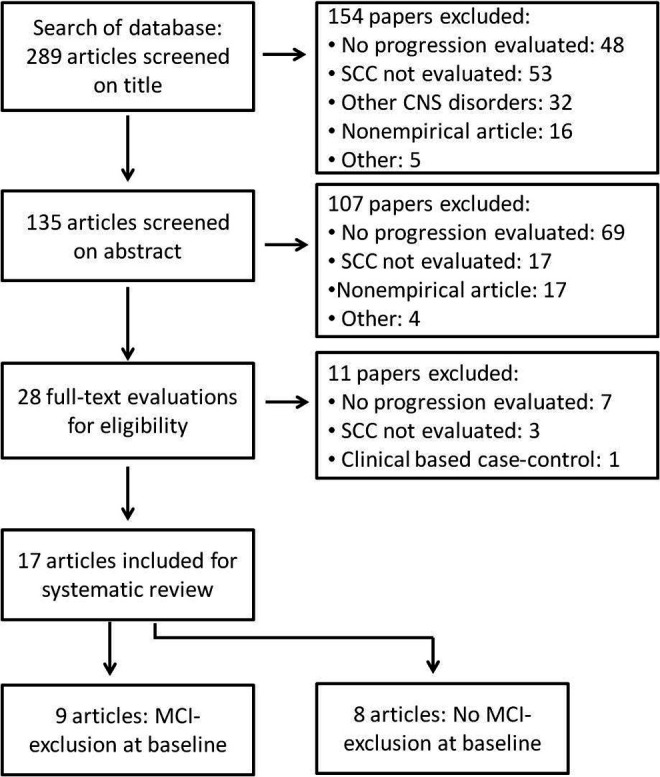
Subjective cognitive complaints (SCCs) are frequent in the elderly population. The majority of individuals with subjective complaints never progress to significant cognitive decline, but some of them have a higher risk of progression to objective cognitive impairment than persons with no cognitive concerns. We performed a systematic review of community-based studies that focused on the progression risk associated with SCC and on the complainers’ characteristics associated with progression. Seventeen studies were included. As a group, SCCs are associated with a significantly higher risk of progression to dementia. Worried complainers, persons who refer an impact of their complaints on activities of daily living, and those whose complaints are also noticed by an informant have the highest risk of progression. Taking into account the fluctuating course of SCC and their frequent reversion, care should be taken to not overvaluate them. Further studies are necessary to better define risk features.
Conflict of interest statement
The authors declared no potential conflicts of interest with respect to the research, authorship, and/or publication of this article.
Figures
References
-
- Mitchell AJ, Beaumont H, Ferguson D, Yadegarfar M, Stubbs B. Risk of dementia and mild cognitive impairment in older people with subjective memory complaints: meta-analysis. Acta Psychiatr Scand. 2014;130(6):439–451. - PubMed
-
- Holmen J, Langballe EM, Midthjell K, et al. Gender differences in subjective memory impairment in a general population: the HUNT study, Norway. BMC Psychol. 2013;1(1):19.
-
- Singh-Manoux A, Dugravot A, Ankri J, et al. Subjective cognitive complaints and mortality: does the type of complaint matter? J Psychiatr Res. 2014;48(1):73–78. - PubMed
-
- Mitchell AJ. Is it time to separate subjective cognitive complaints from the diagnosis of mild cognitive impairment? Age Ageing. 2008;37(5):497–499. - PubMed
-
- Commissaris CJ, Verhey FR, Jr, Ponds RW, Jolles J, Kok GJ. Public education about normal forgetfulness and dementia: importance and effects. Patient Educ Couns. 1994;24(2):109–115. - PubMed
Publication types
MeSH terms
LinkOut - more resources
Full Text Sources
Medical
Research Materials
