


Subretinal Hyperreflective Material in the Comparison of Age-Related Macular Degeneration Treatments Trials
- PMID: 26143666
- PMCID: PMC4549177
- DOI: 10.1016/j.ophtha.2015.05.042
Subretinal Hyperreflective Material in the Comparison of Age-Related Macular Degeneration Treatments Trials
Abstract
Purpose: To evaluate the association of subretinal hyperreflective material (SHRM) with visual acuity (VA), geographic atrophy (GA), and scar in the Comparison of Age-Related Macular Degeneration Treatments Trials (CATT).
Design: Prospective cohort study within a randomized clinical trial.
Participants: The 1185 CATT participants.
Methods: Masked readers graded scar and GA on fundus photography and fluorescein angiography and graded SHRM on time-domain and spectral-domain (SD) optical coherence tomography (OCT) throughout 104 weeks. Measurements of SHRM height and width in the fovea, within the center 1 mm(2), or outside the center 1mm(2) were obtained on SD OCT images at 56 (n = 76) and 104 (n = 66) weeks.
Main outcome measures: Presence of SHRM, as well as location and size, and associations with VA, scar, and GA.
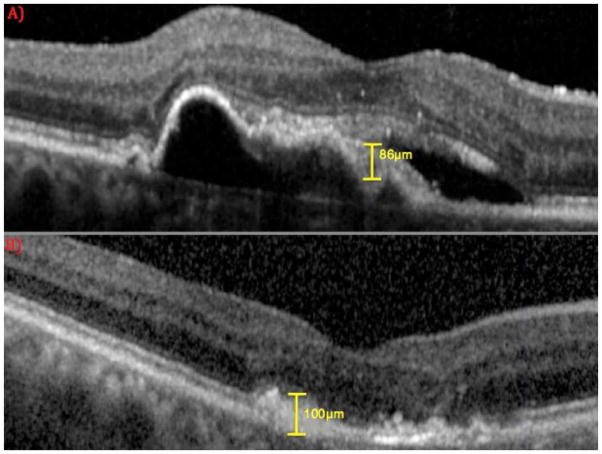
Results: Among CATT participants, the percentage with SHRM at enrollment was 77%, decreasing to 68% at 4 weeks after treatment and to 54% at 104 weeks. At 104 weeks, scar was present more often in eyes with persistent SHRM than in eyes with SHRM that resolved (64% vs. 31%; P < 0.0001). Among eyes with detailed evaluation of SHRM at weeks 56 (n = 76) and 104 (n = 66), mean VA letter score was 73.5 (standard error [SE], 2.8), 73.1 (SE, 3.4), 65.3 (SE, 3.5), and 63.9 (SE, 3.7) when SHRM was absent, present outside the central 1 mm(2), present within the central 1 mm(2) but not the foveal center, or present at the foveal center (P = 0.02), respectively. When SHRM was present, the median maximum height under the fovea, within the central 1 mm(2) including the fovea and anywhere within the scan, was 86 μm, 120 μm, and 122 μm, respectively. Visual acuity was decreased with greater SHRM height and width (P < 0.05).
Conclusions: In eyes with neovascular age-related macular degeneration (AMD), SHRM is common and often persists after anti-vascular endothelial growth factor treatment. At 2 years, eyes with scar were more likely to have SHRM than other eyes. Greater SHRM dimensions were associated with worse VA. In eyes with neovascular AMD, SHRM is an important morphologic biomarker.
Copyright © 2015 American Academy of Ophthalmology. Published by Elsevier Inc. All rights reserved.
Conflict of interest statement
Alex Willoughby: None
Gui-Shuang Ying: Janssen (Consultant)
Maureen Maguire: Genentech: (Consultant)
Cynthia Toth: Alcon Laboratories (Patent); Bioptigen (Financial Support); Genentech (Financial Support); Physical Sciences Inc. (Financial Support)
Russell Burns: None
Ebenezer Daniel: None
Juan E. Grunwald: None
Glenn Jaffe: Heidelberg Engineering (Consultant); Alcon (Consultant); Neurotech (Consultant); Roche (Consultant)
Figures

References
-
- Brown DM, Kaiser PK, Michels M, et al. Ranibizumab versus verteporfin for neovascular age-related macular degeneration. N Engl J Med. 2006;355:1432–44. - PubMed
-
- Rosenfeld PJ, Brown DM, Heier JS, et al. Ranibizumab for neovascular age-related macular degeneration. N Engl J Med. 2006;355:1419–31. - PubMed
-
- Ristau T, Keane PA, Walsh AC, et al. Relationship between visual acuity and spectral domain optical coherence tomography retinal parameters in neovascular age-related macular degeneration. Ophthalmologica. 2014;231:37–44. - PubMed
Publication types
MeSH terms
Substances
Grants and funding
LinkOut - more resources
Full Text Sources
Other Literature Sources
Medical
