


Changes in Serum Levels of Myokines and Wnt-Antagonists after an Ultramarathon Race
- PMID: 26147574
- PMCID: PMC4493015
- DOI: 10.1371/journal.pone.0132478
Changes in Serum Levels of Myokines and Wnt-Antagonists after an Ultramarathon Race
Abstract
Background: Regular physical activities have a positive effect on the muscular skeletal system but overstrenuous exercise may be different. Transiently suppressed bone formation and increased bone resorption after participation in a 246-km ultradistance race has been demonstrated.
Purpose: The aim of this study was to analyze effects of the Spartathlon race on novel musculoskeletal markers.
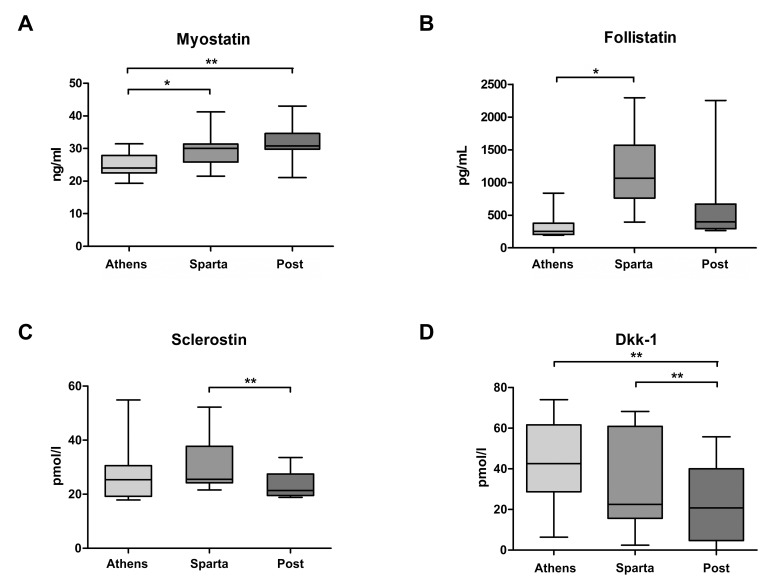
Methods: Venous blood samples were obtained before and immediately after the race from 19 participants of the Spartathlon. From 9 runners who were available 3 days after the start blood was drawn for a third time. Serum levels of myostatin, an inhibitor of myogenic differentiation, and its opponent follistatin as well as sclerostin and dickkopf-1, both of them inhibitors of the wnt signaling pathway, and markers of bone turnover were determined.
Results: Serum levels of myostatin were significantly higher after the race. Serum follistatin only showed a transient increase. Sclerostin levels did not significantly differ before and after the race, whereas dickkopf-1 levels were significantly decreased. At follow-up a decrement of sclerostin and dickkopf-1 levels was seen. Serum cathepsin K levels did not change.
Conclusion: The increase of serum levels of myostatin appears to reflect muscle catabolic processes induced by overstrenuous exercise. After the short-term uncoupling of bone turnover participation in an ultradistance race seems to initiate a long-term positive effect on bone indicated by the low-level inhibition of the Wnt/β-catenin signaling pathway.
Conflict of interest statement
Figures
References
-
- McPherron AC, Lawler AM, Lee SJ. Regulation of skeletal muscle mass in mice by a new TNF-ß superfamily member. Nature 1997; 387: 83–90. - PubMed
-
- Ma K, Mallidis C, Bhasin S, Mahabadi V, Artaza J, Gonzalez-Cadavid N, et al. Glucocorticoid-induced skeletal muscle atrophy is associated with upregulation of myostatin gene expression. Am J Physiol Endorcinol Metab 2003; 285: E363–E371. - PubMed
-
- Zimmers TA, Davies MV, Koniaris LG, Haynes P, Esquela AF, Tomkinson KN, et al. Induction of cachexia in mice by systemically administered myostatin. Science 2002; 296: 1486–1488. - PubMed
-
- Zhu X, Topouzis S, Liang LF, Stotish RL. Myostatin signaling through Smad3, Smad3, and Smad4 is regulated by the inhibitor y Smad7 by negative feedback mechanism. Cytokine 2004; 26: 262–272. - PubMed
Publication types
MeSH terms
Substances
LinkOut - more resources
Full Text Sources
Other Literature Sources
Miscellaneous
