


A large-scale genomic approach affords unprecedented resolution for the molecular epidemiology and evolutionary history of contagious caprine pleuropneumonia
- PMID: 26149260
- PMCID: PMC4492101
- DOI: 10.1186/s13567-015-0208-x
A large-scale genomic approach affords unprecedented resolution for the molecular epidemiology and evolutionary history of contagious caprine pleuropneumonia
Abstract
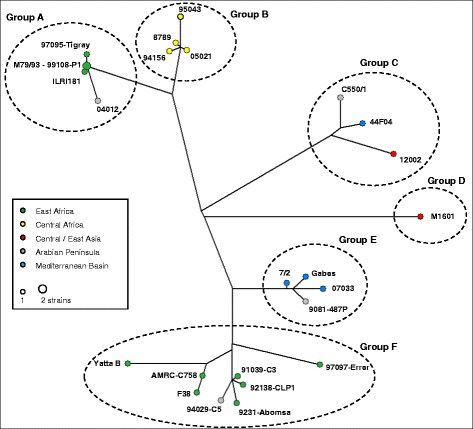
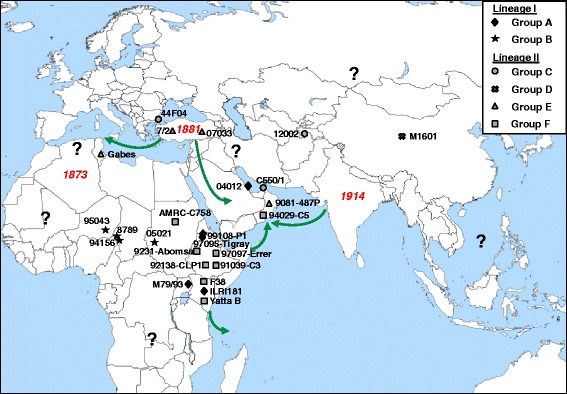
Contagious caprine pleuropneumonia (CCPP), caused by Mycoplasma capricolum subsp. capripneumoniae (Mccp), is a devastating disease of domestic goats and of some wild ungulate species. The disease is currently spreading in Africa and Asia and poses a serious threat to disease-free areas. A comprehensive view of the evolutionary history and dynamics of Mccp is essential to understand the epidemiology of CCPP. Yet, analysing the diversity of genetically monomorphic pathogens, such as Mccp, is complicated due to their low variability. In this study, the molecular epidemiology and evolution of CCPP was investigated using a large-scale genomic approach based on next-generation sequencing technologies, applied to a sample of strains representing the global distribution of this disease. A highly discriminatory multigene typing system was developed, allowing the differentiation of 24 haplotypes among 25 Mccp strains distributed in six genotyping groups, which showed some correlation with geographic origin. A Bayesian approach was used to infer the first robust phylogeny of the species and to date the principal events of its evolutionary history. The emergence of Mccp was estimated only at about 270 years ago, which explains the low genetic diversity of this species despite its high mutation rate, evaluated at 1.3 × 10(-6) substitutions per site per year. Finally, plausible scenarios were proposed to elucidate the evolution and dynamics of CCPP in Asia and Africa, though limited by the paucity of Mccp strains, particularly in Asia. This study shows how combining large-scale genomic data with spatial and temporal data makes it possible to obtain a comprehensive view of the epidemiology of CCPP, a precondition for the development of improved disease surveillance and control measures.
Figures

References
-
- OIE, Contagious caprine pleuropneumonia, Chapter 2.7.6. in: OIE Terrestrial Manual [on line] (2014). http://www.oie.int/fileadmin/Home/eng/Health_standards/tahm/2.07.06_CCPP...
-
- Manso-Silvan L, Vilei EM, Sachse K, Djordjevic SP, Thiaucourt F, Frey J. Mycoplasma leachii sp. nov. as a new species designation for Mycoplasma sp. bovine group 7 of Leach, and reclassification of Mycoplasma mycoides subsp. mycoides LC as a serovar of Mycoplasma mycoides subsp. capri. Int J Syst Evol Microbiol. 2009;59:1353–1358. doi: 10.1099/ijs.0.005546-0. - DOI - PubMed
Publication types
MeSH terms
LinkOut - more resources
Full Text Sources
Other Literature Sources
