


Types of Infant Formulas Consumed in the United States
- PMID: 26149849
- PMCID: PMC4703581
- DOI: 10.1177/0009922815591881
Types of Infant Formulas Consumed in the United States
Abstract
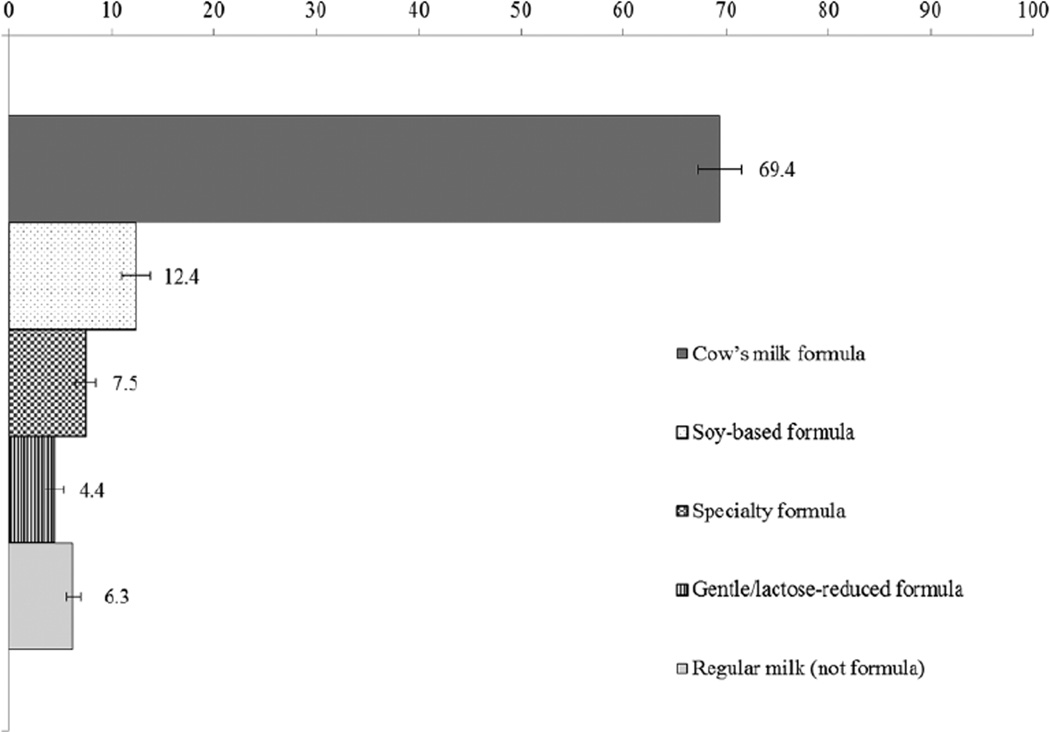
We examined consumption of different types of infant formula (eg, cow's milk, soy, gentle/lactose-reduced, and specialty) and regular milk among a nationally representative sample of 1864 infants, 0 to 12 months old, from the National Health and Nutrition Examination Survey, 2003-2010. Among the 81% of infants who were fed formula or regular milk, 69% consumed cow's milk formula, 12% consumed soy formula, 5% consumed gentle/ lactose-reduced formulas, 6% consumed specialty formulas, and 13% consumed regular milk products. There were differences by household education and income in the percentage of infants consuming cow's milk formula and regular milk products. The majority of infants in the United States who were fed formula or regular milk consumed cow's milk formula (69%), with lower percentages receiving soy, specialty, gentle/sensitive, or lactose-free/reduced formulas. Contrary to national recommendations, 13% of infants younger than 1 year consumed regular milk, and the percentage varied by household education and income levels.
Keywords: children; diet; nutrition; survey.
© The Author(s) 2015.
Conflict of interest statement
The author(s) declared no potential conflicts of interest with respect to the research, authorship, and/or publication of this article.
Figures
References
-
- American Academy of Pediatrics, Section on Breastfeeding. Breastfeeding and the use of human milk. Pediatrics. 2012;129:e827–e841. - PubMed
-
- Centers for Disease Control and Prevention. [Accessed June 4, 2015];Breastfeeding among U.S. children born 2000–2010, CDC National Immunization Survey. http://www.cdc.gov/BREASTFEEDING/data/NIS_data/index.htm.
-
- Centers for Disease Control and Prevention, National Center for Chronic Disease Prevention and Health Promotion, Division of Nutrition, Physical Activity, and Obesity. [Accessed June 4, 2015];Breastfeeding report card, United States. 2014 http://www.cdc.gov/breastfeeding/pdf/2014breastfeedingreportcard.pdf.
-
- O’Connor NR. Infant formula. Am Fam Physician. 2009;79:565–570. - PubMed
-
- Bhatia J, Greer F American Academy of Pediatrics Committee on Nutrition. Use of soy protein-based formulas in infant feeding. Pediatrics. 2008;121:1062–1068. - PubMed
MeSH terms
Grants and funding
LinkOut - more resources
Full Text Sources
Other Literature Sources
Medical
