. 2015 Sep;81(18):6302-13.
doi: 10.1128/AEM.01478-15. Epub 2015 Jul 6.

Improving the Thermostability and Activity of a Thermophilic Subtilase by Incorporating Structural Elements of Its Psychrophilic Counterpart

Affiliations

Improving the Thermostability and Activity of a Thermophilic Subtilase by Incorporating Structural Elements of Its Psychrophilic Counterpart

Bi-Lin Xu et al. Appl Environ Microbiol. 2015 Sep.

Abstract

The incorporation of the structural elements of thermostable enzymes into their less stable counterparts is generally used to improve enzyme thermostability. However, the process of engineering enzymes with both high thermostability and high activity remains an important challenge. Here, we report that the thermostability and activity of a thermophilic subtilase were simultaneously improved by incorporating structural elements of a psychrophilic subtilase. There were 64 variable regions/residues (VRs) in the alignment of the thermophilic WF146 protease, mesophilic sphericase, and psychrophilic S41. The WF146 protease was subjected to systematic mutagenesis, in which each of its VRs was replaced with those from S41 and sphericase. After successive rounds of combination and screening, we constructed the variant PBL5X with eight amino acid residues from S41. The half-life of PBL5X at 85°C (57.1 min) was approximately 9-fold longer than that of the wild-type (WT) WF146 protease (6.3 min). The substitutions also led to an increase in the apparent thermal denaturation midpoint temperature (Tm) of the enzyme by 5.5°C, as determined by differential scanning calorimetry. Compared to the WT, PBL5X exhibited high caseinolytic activity (25 to 95°C) and high values of Km and kcat (25 to 80°C). Our study may provide a rational basis for developing highly stable and active enzymes, which are highly desired in industrial applications.


Figures

FIG 1
FIG 1
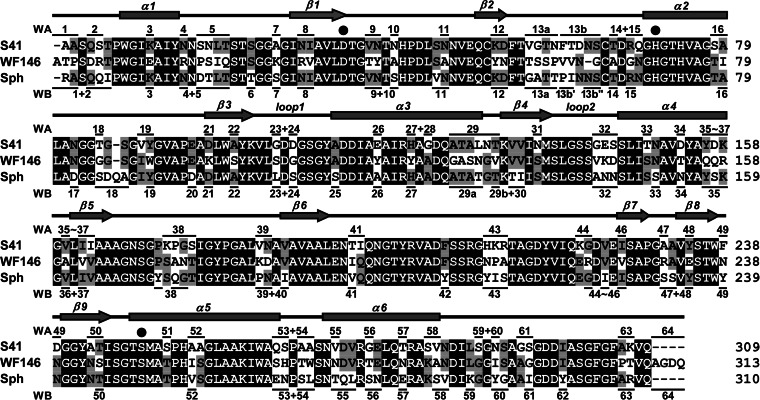
Amino acid sequence alignment (Clustal X) (61) of the mature forms of the WF146 protease (GenBank accession number AAQ82911), subtilisin S41 (PDB accession number 2GKO), and sphericase (Sph; PDB accession number 1EA7). Filled circles mark the catalytic triad residues. Conserved regions/residues are shaded in black. The VRs that are marked by horizontal lines above or below the sequence of S41 or Sph represent those that were used to replace corresponding VRs of the WF146 protease. The numbers above and below the sequence alignments represent the resulting variants of the WF146 protease containing VRs of S41 (WA series) and Sph (WB series), respectively. The α-helices (α1 to α6) and β-strands (β1 to β9) in the WF146 protease, as well as the two loops (1 and 2) that form the S4 substrate-binding subsite of the enzyme, are shown above the sequence alignment.
FIG 2
FIG 2
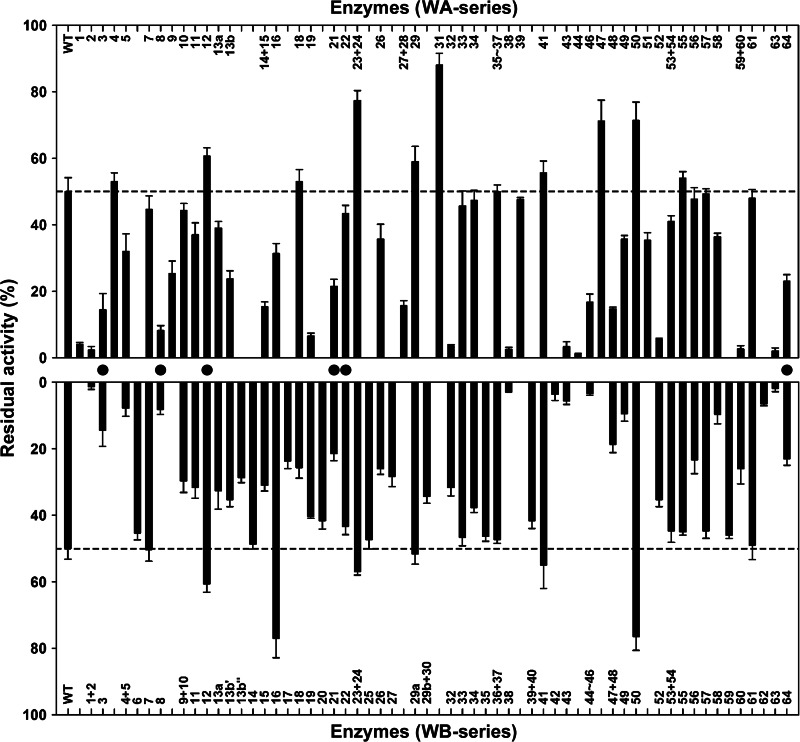
Heat inactivation profiles of the WT and its variants. The enzymes (1.5 μg/ml) in buffer A were incubated at 80°C for 1 h and then subjected to an azocaseinolytic activity assay at 60°C. The residual activity is expressed as a percentage of the original activity, and the values are means ± standard deviations (bars) of the results of three independent experiments. Filled circles indicate the variants with VRs that are identical in S41 and Sph. The dashed lines mark the levels of residual activity of the WT.
FIG 3
FIG 3
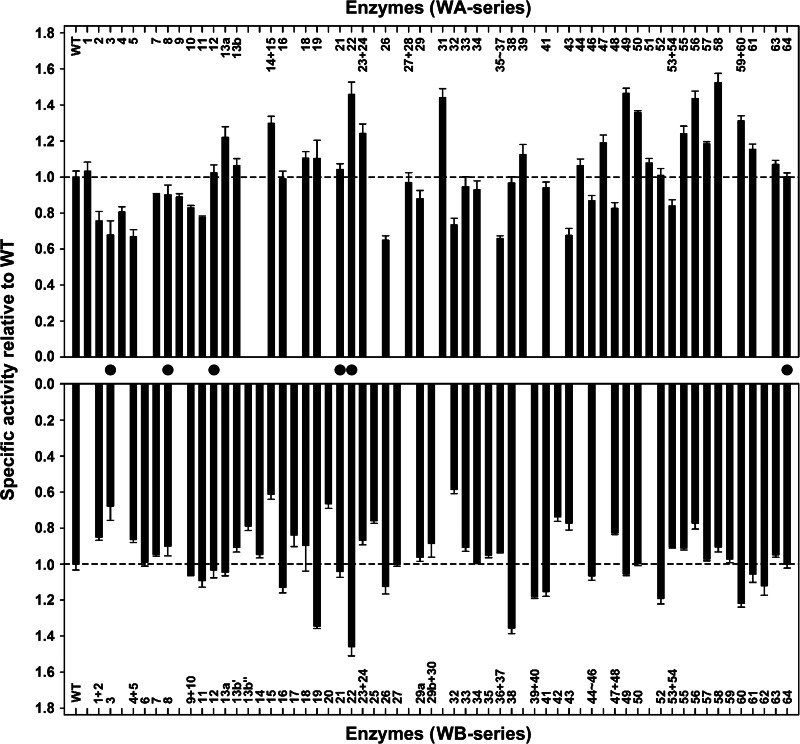
Low-temperature activities of the WT and its variants. The azocaseinolytic activities of the enzymes (0.75 μg/ml) were determined at 25°C. The values are means ± standard deviations (bars) of three independent experiments. The specific activities of the variants relative to the WT were calculated. Filled circles indicate the variants with VRs that are identical in S41 and Sph. The dashed lines mark the activity levels of the WT.
FIG 4
FIG 4
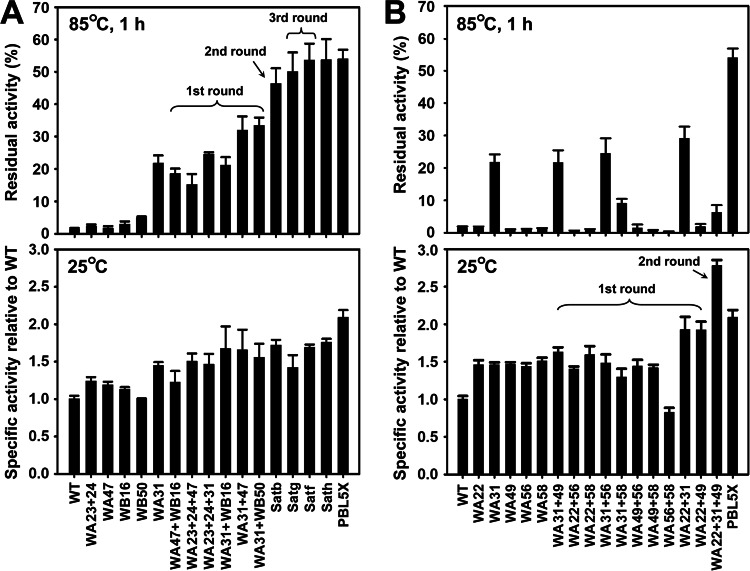
Thermal resistance (upper panels) and low-temperature activity (lower panels) of stability-enhancing (A) and activity-enhancing (B) variants generated by combinations of VRs. The enzymes (1.5 μg/ml) in buffer A were incubated at 85°C for 1 h and then subjected to an azocaseinolytic activity assay at 60°C (upper panels). The residual activity is expressed as a percentage of the original activity, and the values are means ± standard deviations (bars) of the results of three independent experiments. The azocaseinolytic activities of the enzymes (0.75 μg/ml) were determined at 25°C in buffer A (lower panels). The values are means ± standard deviations (bars) of three independent experiments, and the mean value of the WT was defined as 1. The specific activities of the variants relative to the WT were calculated.
FIG 5
FIG 5
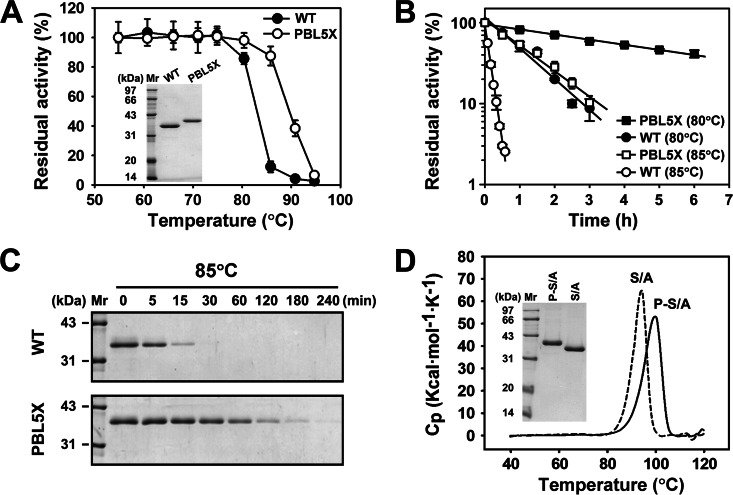
Comparison of the thermostabilities of PBL5X and the WT. (A) Effects of temperature on enzyme stability. After the enzymes (1.5 μg/ml) were incubated in buffer A at different temperatures for 15 min, the remaining activities were measured at 60°C using azocasein as the substrate. The residual activity is expressed as a percentage of the original activity, and the values are means ± standard deviations (bars) of the results of three independent experiments. The inset depicts the SDS-PAGE analysis of purified PBL5X and the WT. (B and C) Heat inactivation profiles. The enzymes (1.5 μg/ml) were incubated in buffer A at 80 or 85°C for the indicated time periods and then subjected to an azocaseinolytic activity assay at 60°C (B) and SDS-PAGE analysis (C). In panel B the residual activity (log scale) is plotted versus incubation time and expressed as a percentage of the original activity. The values are means ± standard deviations (bars) of the results of three independent experiments. (D) Typical DSC curves for the mature forms of the active-site variants of the WT (S/A) and PBL5X (P-S/A). Protein samples (1 mg/ml) in buffer A were heated at a rate of 1°C/min, and excess heat capacity was recorded by DSC. The inset depicts the SDS-PAGE analysis of protein samples. Cp, heat capacity at constant pressure.
FIG 6
FIG 6
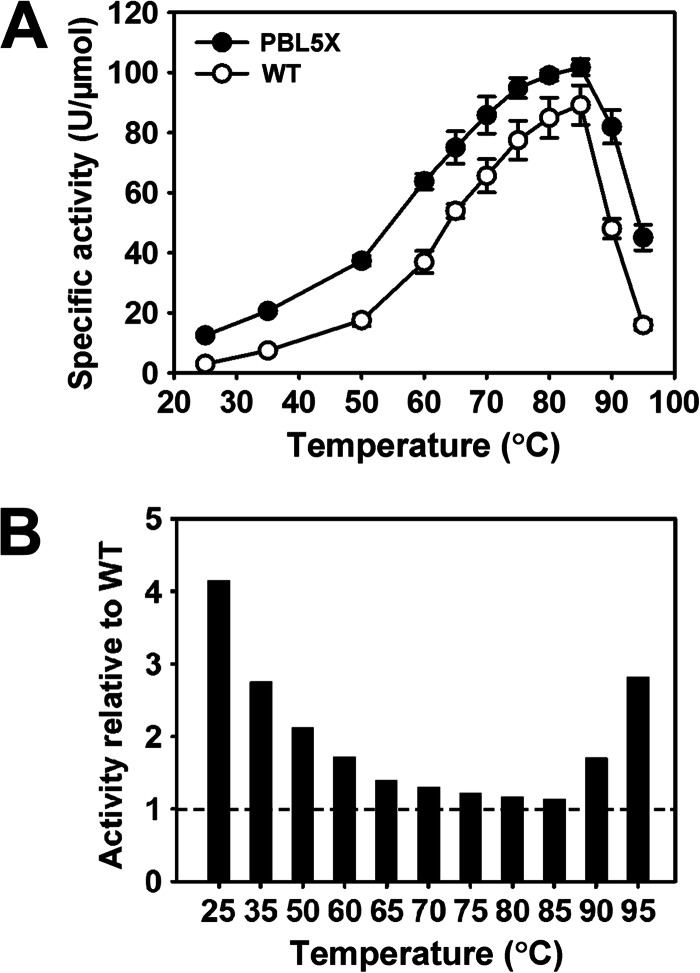
Comparison of the activities of PBL5X and the WT. (A) Temperature dependence of the specific activities of the WT and PBL5X. The caseinolytic activities of the enzymes were determined at the indicated temperatures in buffer A. The values are means ± standard deviations (bars) of the results of three independent experiments. (B) Ratio of the specific activities of PBL5X and the WT. The activity of PBL5X relative to that of the WT was calculated, with that of WT at the respective temperatures defined as 1.
FIG 7
FIG 7
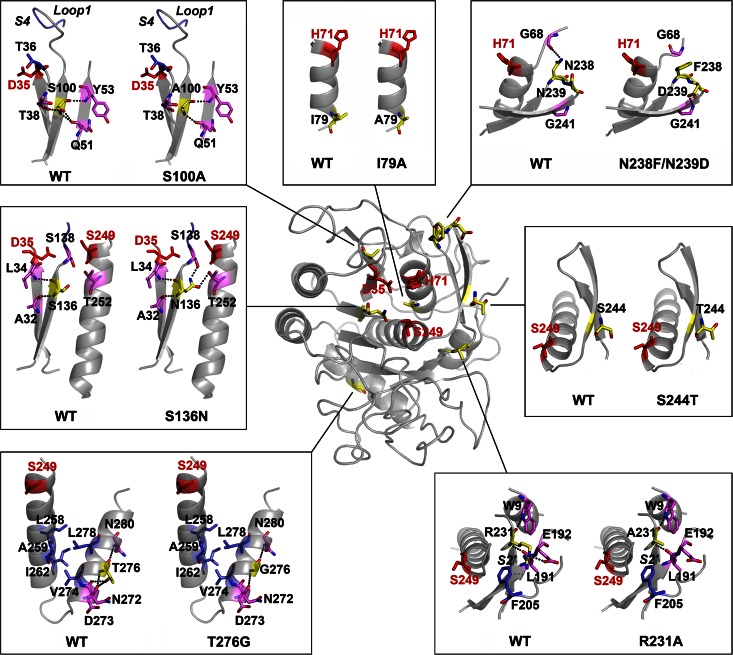
The effects of substitutions on enzyme structure. An overview of the positions of substituted residues (in yellow) and catalytic triad residues (D35, H71, and Ser249; in red) in the homology model of PBL5X is shown in the center of the picture. Local structures around the original residues in the wild-type (WT) WF146 protease and the substituted residues in PBL5X are shown in boxes. Dotted lines represent hydrogen bonds that are formed by the original and substituted residues in the WT and PBL5X, respectively. The substrate-binding subsites, S4 and S2′, as well as loop 1 of the substrate-binding subsite S4 are indicated in the corresponding boxes.

References

    1. Deming JW. 2002. Psychrophiles and polar regions. Curr Opin Microbiol 5:301–309. doi:10.1016/S1369-5274(02)00329-6. - DOI - PubMed
    1. Takai K, Nakamura K, Toki T, Tsunogai U, Miyazaki M, Miyazaki J, Hirayama H, Nakagawa S, Nunoura T, Horikoshi K. 2008. Cell proliferation at 122°C and isotopically heavy CH4 production by a hyperthermophilic methanogen under high-pressure cultivation. Proc Natl Acad Sci U S A 105:10949–10954. doi:10.1073/pnas.0712334105. - DOI - PMC - PubMed
    1. Feller G, Gerday C. 2003. Psychrophilic enzymes: hot topics in cold adaptation. Nat Rev Microbiol 1:200–208. doi:10.1038/nrmicro773. - DOI - PubMed
    1. Fields PA, Somero GN. 1998. Hot spots in cold adaptation: localized increases in conformational flexibility in lactate dehydrogenase A4 orthologs of Antarctic notothenioid fishes. Proc Natl Acad Sci U S A 95:11476–11481. doi:10.1073/pnas.95.19.11476. - DOI - PMC - PubMed
    1. Jaenicke R, Sterner R. 2013. Life at high temperatures, p 337–374. In Rosenberg E, DeLong E, Lory S, Stackebrandt E, Thompson F (ed), The prokaryotes. Springer, Berlin, Germany.

Publication types

Substances

LinkOut - more resources