


Traditional Risk Factors Versus Biomarkers for Prediction of Secondary Events in Patients With Stable Coronary Heart Disease: From the Heart and Soul Study
- PMID: 26150476
- PMCID: PMC4608062
- DOI: 10.1161/JAHA.114.001646
Traditional Risk Factors Versus Biomarkers for Prediction of Secondary Events in Patients With Stable Coronary Heart Disease: From the Heart and Soul Study
Abstract
Background: Patients with stable coronary heart disease (CHD) have widely varying prognoses and treatment options. Validated models for risk stratification of patients with CHD are needed. We sought to evaluate traditional and novel risk factors as predictors of secondary cardiovascular (CV) events, and to develop a prediction model that could be used to risk stratify patients with stable CHD.
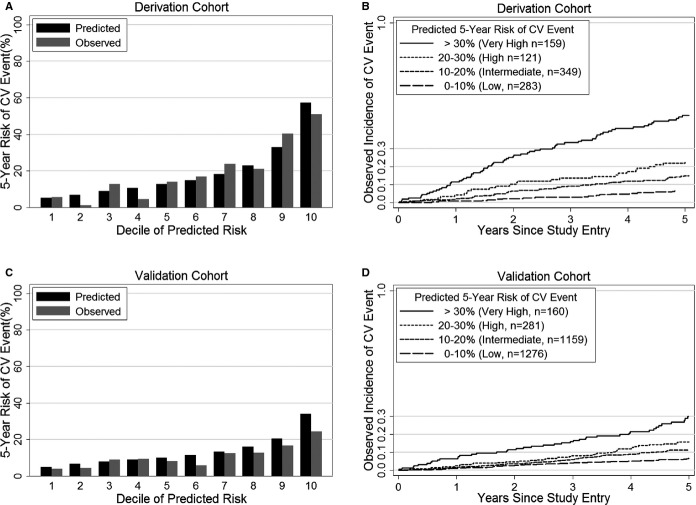
Methods and results: We used independent derivation (912 participants in the Heart and Soul Study) and validation (2876 participants in the PEACE trial) cohorts of patients with stable CHD to develop a risk prediction model using Cox proportional hazards models. The outcome was CV events, defined as myocardial infarction, stroke, or CV death. The annual rate of CV events was 3.4% in the derivation cohort and 2.2% in the validation cohort. With the exception of smoking, traditional risk factors (including age, sex, body mass index, hypertension, dyslipidemia, and diabetes) did not emerge as the top predictors of secondary CV events. The top 4 predictors of secondary events were the following: N-terminal pro-type brain natriuretic peptide, high-sensitivity cardiac troponin T, urinary albumin:creatinine ratio, and current smoking. The 5-year C-index for this 4-predictor model was 0.73 in the derivation cohort and 0.65 in the validation cohort. As compared with variables in the Framingham secondary events model, the Heart and Soul risk model resulted in net reclassification improvement of 0.47 (95% CI 0.25 to 0.73) in the derivation cohort and 0.18 (95% CI 0.01 to 0.40) in the validation cohort.
Conclusions: Novel risk factors are superior to traditional risk factors for predicting 5-year risk of secondary events in patients with stable CHD.
Keywords: coronary disease; epidemiology; prevention; risk prediction.
© 2015 The Authors. Published on behalf of the American Heart Association, Inc., by Wiley Blackwell.
Figures
References
-
- Mozaffarian D, Benjamin EJ, Go AS, Arnett DK, Blaha MJ, Cushman M, de Ferranti S, Despres JP, Fullerton HJ, Howard VJ, Huffman MD, Judd SE, Kissela BM, Lackland DT, Lichtman JH, Lisabeth LD, Liu S, Mackey RH, Matchar DB, McGuire DK, Mohler ER, III, Moy CS, Muntner P, Mussolino ME, Nasir K, Neumar RW, Nichol G, Palaniappan L, Pandey DK, Reeves MJ, Rodriguez CJ, Sorlie PD, Stein J, Towfighi A, Turan TN, Virani SS, Willey JZ, Woo D, Yeh RW, Turner MB American Heart Association Statistics Committee, Stroke Statistics Subcommittee. Heart disease and stroke statistics—2015 update: a report from the American Heart Association. Circulation. 2015;131:e29–e322. - PubMed
-
- Morrow DA. Cardiovascular risk prediction in patients with stable and unstable coronary heart disease. Circulation. 2010;121:2681–2691. - PubMed
-
- Bhatt DL, Eagle KA, Ohman EM, Hirsch AT, Goto S, Mahoney EM, Wilson PW, Alberts MJ, D’Agostino R, Liau CS, Mas JL, Röther J, Smith SC, Salette G, Contant CF, Massaro JM, Steg PG REACH Registry Investigators. Comparative determinants of 4-year cardiovascular event rates in stable outpatients at risk of or with atherothrombosis. JAMA. 2010;304:1350–1357. - PubMed
-
- Lloyd-Jones D. Cardiovascular risk prediction: basic concepts, current status, and future directions. Circulation. 2010;121:1768–1777. - PubMed
-
- Wilson PW, D’Agostino RB, Levy D, Belanger AM, Silbershatz H, Kannel WB. Prediction of coronary heart disease using risk factor categories. Circulation. 1998;97:1837–1847. - PubMed
Publication types
MeSH terms
Substances
Grants and funding
LinkOut - more resources
Full Text Sources
Medical
Research Materials
