


Effect of outdoor activity on myopia onset and progression in school-aged children in northeast China: the Sujiatun Eye Care Study
- PMID: 26152123
- PMCID: PMC4495846
- DOI: 10.1186/s12886-015-0052-9
Effect of outdoor activity on myopia onset and progression in school-aged children in northeast China: the Sujiatun Eye Care Study
Abstract
Background: Due to its high prevalence and associated sight-threatening pathologies, myopia has emerged as a major health issue in East Asia. The purpose was to test the impact on myopia development of a school-based intervention program aimed at increasing the time student spent outdoors.
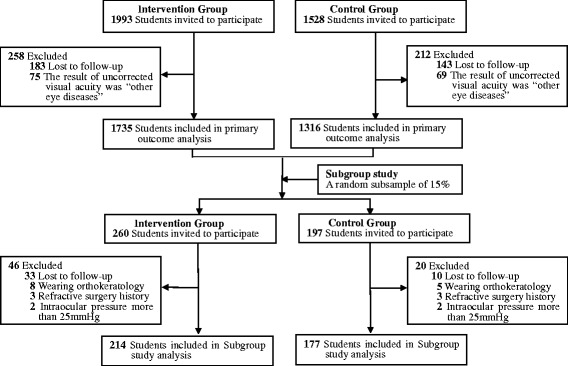
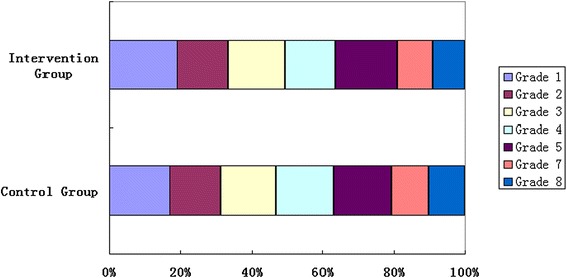
Methods: A total of 3051 students of two primary (grades 1-5, aged 6-11) and two junior high schools (grades 7-8, aged 12-14) in both urban and rural Northeast China were enrolled. The intervention group (n = 1735) unlike the control group (n = 1316) was allowed two additional 20-min recess programs outside the classroom. A detailed questionnaire was administered to parents and children. Uncorrected visual acuity (UCVA) was measured using an E Standard Logarithm Vision Acuity Chart (GB11533-2011) at baseline, 6-month and 1-year intervals. A random subsample (n = 391) participated in the clinic visits and underwent cycloplegia at the beginning and after 1 year.
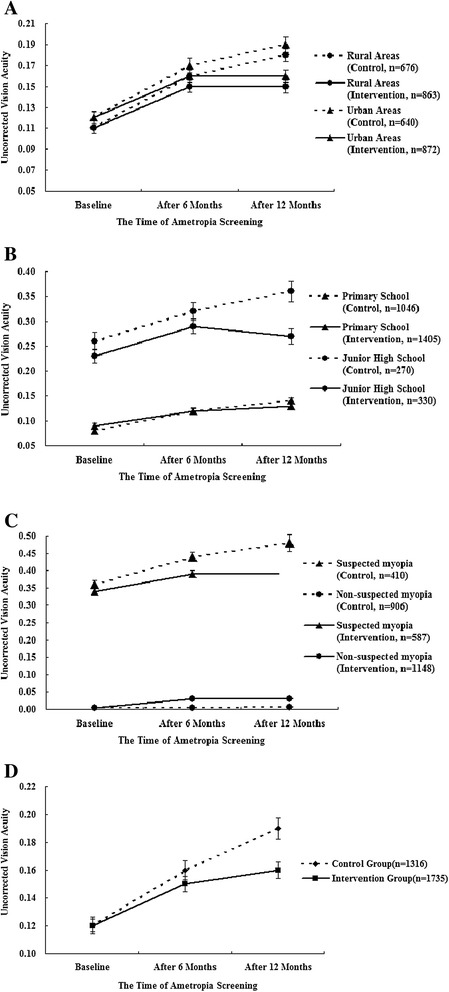
Results: The mean UCVA for the entire intervention group was significantly better than the entire control group after 1 year (P < 0.001). In the subgroup study, new onset of myopia and changes in refractive error towards myopia were direction during the study period was significantly lower in the intervention group than in the control group (3.70 % vs. 8.50 %, P = 0.048; -0.10 ± 0.65 D/year vs. -0.27 ± 0.52 D/year, P = 0.005). Changes in axial length and IOP were also significantly lower following the intervention group (0.16 ± 0.30 mm/year vs. 0.21 ± 0.21 mm/year, P = 0.034; -0.05 ± 2.78 mmHg/year vs. 0.67 ± 2.21 mmHg/year, P = 0.006).
Conclusions: Increasing outdoor activities prevented myopia onset and development, as well as axial growth and elevated IOP in children.
Trial registration: Current controlled trials NCT02271373.
Figures
References
-
- Lin LL, Shih YF, Hsiao CK, Chen CJ. Prevalence of myopia in Taiwanese schoolchildren: 1983 to 2000. Ann Acad Med Singapore. 2004;33(1):27–33. - PubMed
Publication types
MeSH terms
Associated data
LinkOut - more resources
Full Text Sources
Other Literature Sources
Medical
