. 2016 Jan 1;138(1):195-205.
doi: 10.1002/ijc.29676. Epub 2015 Jul 22.

A NOTCH1 gene copy number gain is a prognostic indicator of worse survival and a predictive biomarker to a Notch1 targeting antibody in colorectal cancer

Affiliations

A NOTCH1 gene copy number gain is a prognostic indicator of worse survival and a predictive biomarker to a Notch1 targeting antibody in colorectal cancer

John J Arcaroli et al. Int J Cancer. .

Abstract

Dysregulation of the Notch1 receptor has been shown to facilitate the development and progression of colorectal cancer (CRC) and has been identified as an independent predictor of disease progression and worse survival. Although mutations in the NOTCH1 receptor have not been described in CRC, we have previously discovered a NOTCH1 gene copy number gain in a portion of CRC tumor samples. Here, we demonstrated that a NOTCH1 gene copy number gain is significantly associated with worse survival and a high percentage of gene duplication in a cohort of patients with advanced CRC. In our CRC patient-derived tumor xenograft (PDTX) model, tumors harboring a NOTCH1 gain exhibited significant elevation of the Notch1 receptor, JAG1 ligand and cleaved Notch1 activity. In addition, a significant association was identified between a gain in NOTCH1 gene copy number and sensitivity to a Notch1-targeting antibody. These findings suggest that patients with metastatic CRC that harbor a gain in NOTCH1 gene copy number have worse survival and that targeting this patient population with a Notch1 antibody may yield improved outcomes.

Keywords: Notch1; biomarker; colorectal cancer.


Conflict of interest statement

Conflict of interest: Peter Olson is an employee of Pfizer and owns stock in Pfizer; Xianxian Zheng is an employee of Pfizer and owns stock in Pfizer; Qin Zhang is an employee of Pfizer and owns stock in Pfizer.

Figures

Figure 1
Figure 1
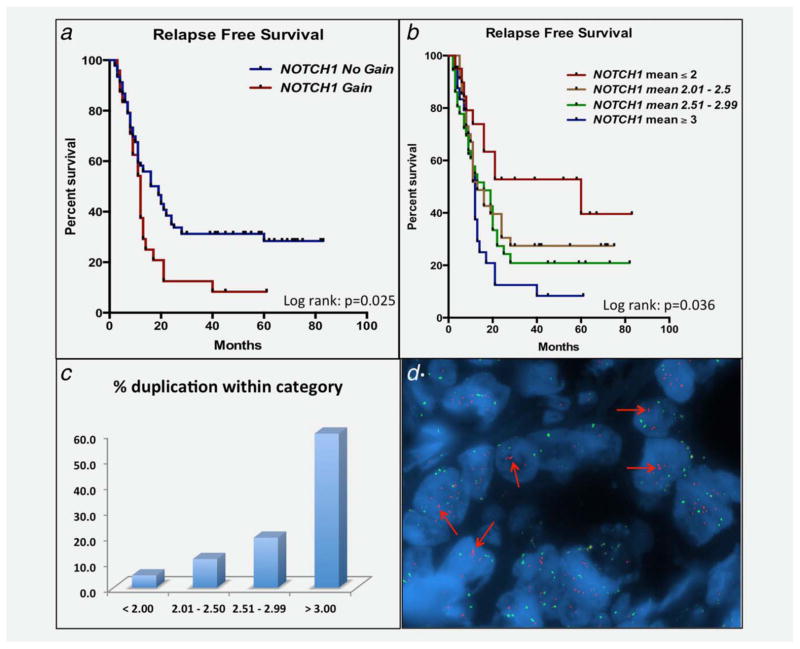
Association between a gain in NOTCH1 gene copy number and worse RFS. (a) An association between a NOTCH1 gain and worse RFS was determined by Kaplan–Meier survival curve analysis (log-rank p =0.025). (b) A stepwise increase in NOTCH1 gene copy number gain was associated with worse RFS. (c) Percent gene duplication with respect to NOTCH1 gene copy number within each category (<2, 2.01–2.50, 2.51–2.99, >3). Percent duplication was determined by dividing the total number of patient samples with Notch1 doublets by the total number of patients within their respective category × 100. (d) Representative photograph of a patient with a NOTCH1 gene copy number gain (more than three copies) and gene duplication.
Figure 2
Figure 2
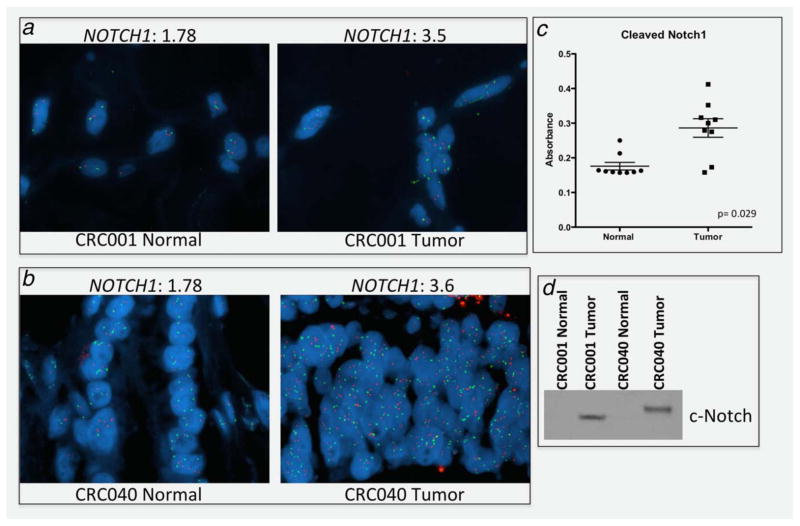
A NOTCH1 gene copy number gain is a genetic evident in tumor cells. (a and b) A representative photograph of two CRC patients normal tissue and matched tumor tissue showing a gain in NOTCH1 gene copy number in tumor cells. The average number of NOTCH1 signals is shown above each representative figure for normal and tumor. (c) Tumors exhibit significantly elevated levels of cleaved Notch1 when compared to matched normal colon tissue (n =9). (d) A representative Western blot of cleaved Notch1 in CRC001 and CRC040 normal colon and tumor tissue.
Figure 3
Figure 3
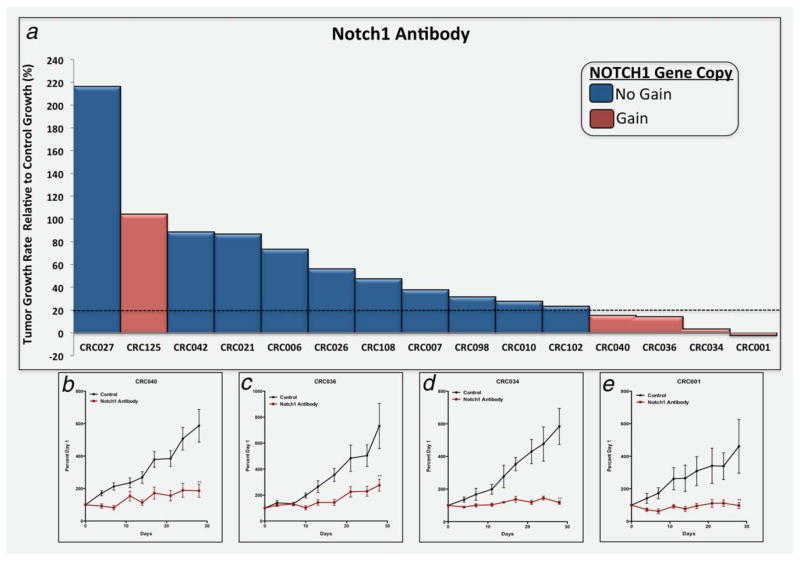
PF-06293622 (Notch1 monoclonal antibody) effects on tumor growth in CRC explants. (a) Fifteen CRC explants were treated with PF-06293622 10 mg/kg weekly for 28 days. Tumor size was evaluated twice per week by caliper measurements using the formula: tumor volume =(length × width)2 × 0.52. (a) A TGII, a standardized measure of tumor growth, which is calculated for each CRC explant using the following formula: TGII =(tumor volume of TX on Day 28 – tumor volume of TX on Day 0)/(tumor volume of Con on Day 28 – tumor volume of Con on Day 0) × 100. Cases with a TGII of ≤20% were considered sensitive, TGII of >20% were considered resistant to PF-06293622. Four xenografts (CRC001, CRC034, CRC036 and CRC040) were sensitive to PF-06293622 (TGI ≤20%) and 11 xenografts were resistant to PF-06293622 (TGI >20%). Columns, mean (n =10 tumors per group). (be) A representative figure of the growth curves from the CRC-sensitive explants (b) CRC040, (c) CRC036, (d) CRC034 and (e) CRC001. SEM. **Significant p <0.01.
Figure 4
Figure 4
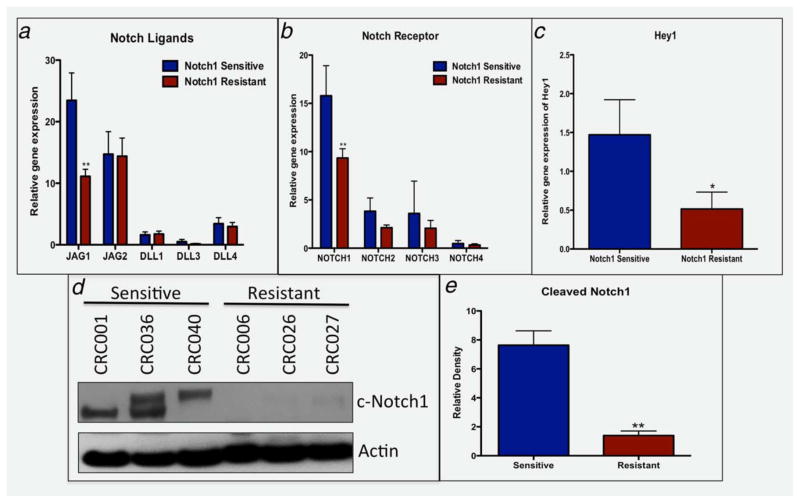
Notch pathway analysis between sensitive (CRC001, 0034, 036 and 040) vs. 11 resistant tumors. (A–C) RNA Seq analysis of baseline levels of Notch ligands, receptors, and the Notch dependent gene Hey1 showed a significant increase in (A) JAG1, (B) Notch1 and (C) Hey1 in sensitive tumors when compared to resistant tumors. (D) Baseline levels of cleaved Notch1 are elevated in sensitive tumors compared to resistant tumors. (E) Densitometry of cleaved Notch1/Actin ratio showed a significant increase in sensitive tumors compared to resistant tumors (p <0.01).
Figure 5
Figure 5
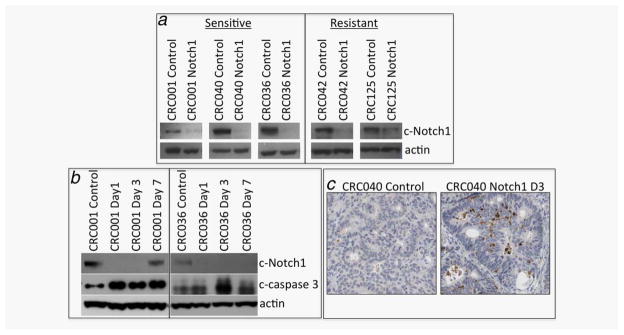
Notch1 inhibition abrogates cleaved Notch1 activity and increases apoptosis. (a) Treatment with the Notch1 antibody reduces cleaved Notch1 in sensitive and resistant tumors at the end of study. (b) Notch1 blockade increases apoptosis as shown by an increase in cleaved caspase 3 in the CRC001- and CRC036-sensitive CRC explants. (c) A representative picture showing elevations in cleaved caspase 3 (brown staining) in control and Notch1-treated after 3 days of treatment in CRC040.

References

    1. Siegel R, Desantis C, Jemal A. Colorectal cancer statistics, 2014. CA: Cancer J Clin. 2014;64:104–17. - PubMed
    1. Cancer Genome Atlas Network. Comprehensive molecular characterization of human colon and rectal cancer. Nature. 2012;487:330–7. - PMC - PubMed
    1. Arcaroli JJ, Quackenbush KS, Purkey A, et al. Tumours with elevated levels of the Notch and Wnt pathways exhibit efficacy to PF-03084014, a gamma-secretase inhibitor, in a preclinical colorectal explant model. Br J Cancer. 2013;109:667–75. - PMC - PubMed
    1. Fischer M, Yen WC, Kapoun AM, et al. Anti-DLL4 inhibits growth and reduces tumor-initiating cell frequency in colorectal tumors with oncogenic KRAS mutations. Cancer Res. 2011;71:1520–5. - PubMed
    1. Hoey T, Yen WC, Axelrod F, et al. DLL4 blockade inhibits tumor growth and reduces tumor-initiating cell frequency. Cell Stem Cell. 2009;5:168–77. - PubMed

MeSH terms