


Lessons From Medicaid's Divergent Paths On Mental Health And Addiction Services
- PMID: 26153307
- PMCID: PMC4831618
- DOI: 10.1377/hlthaff.2015.0151
Lessons From Medicaid's Divergent Paths On Mental Health And Addiction Services
Abstract
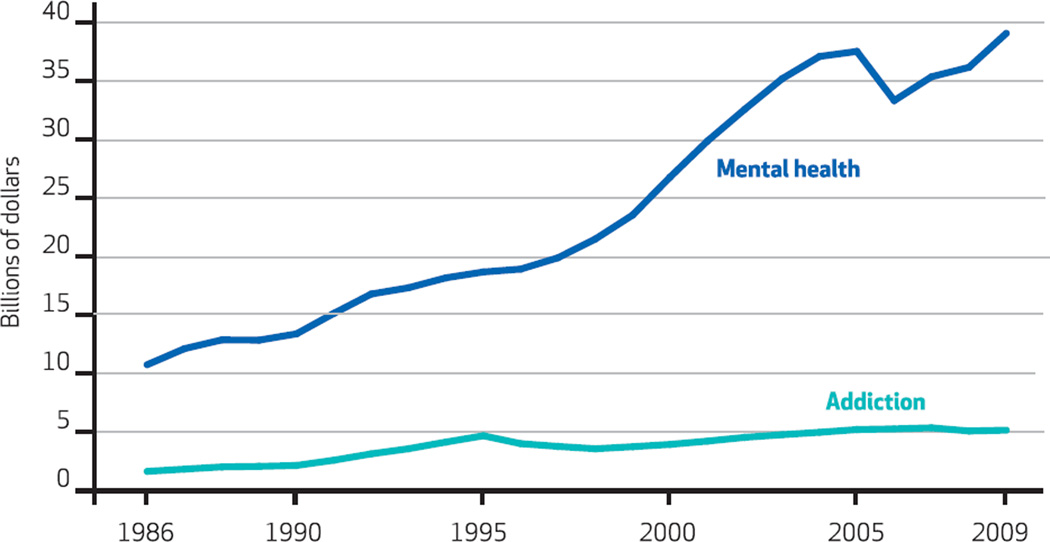
Over the past fifty years Medicaid has taken divergent paths in financing mental health and addiction treatment. In mental health, Medicaid became the dominant source of funding and had a profound impact on the organization and delivery of services. But it played a much more modest role in addiction treatment. This is poised to change, as the Affordable Care Act is expected to dramatically expand Medicaid's role in financing addiction services. In this article we consider the different paths these two treatment systems have taken since 1965 and identify strategic lessons that the addiction treatment system might take from mental health's experience under Medicaid. These lessons include leveraging optional coverage categories to tailor Medicaid to the unique needs of the addiction treatment system, providing incentives to addiction treatment programs to create and deliver high-quality alternatives to inpatient treatment, and using targeted Medicaid licensure standards to increase the quality of addiction services.
Keywords: Medicaid; Mental Health/Substance Abuse; Organization and Delivery of Care.
Project HOPE—The People-to-People Health Foundation, Inc.
Figures
References
-
- Mark TL, Levit KR, Yee T, Chow CM. Spending on mental and substance use disorders projected to grow more slowly than all health spending through 2020. Health Aff (Millwood) 2014;33(8):1407–1415. - PubMed
-
- Frank RG, Goldman HH, Hogan M. Medicaid and mental health: be careful what you ask for. Health Aff (Millwood) 2003;22(1):101–113. - PubMed
-
- Frank RG, Glied SA. Better but not well: mental health policy in the United States since 1950. Baltimore (MD): Johns Hopkins University Press; 2006.
-
- Substance Abuse and Mental Health Services Administration. Rockville (MD): SAMHSA; 2014. [cited 2015 Jun 4]. Controlled expenditures and revenues for mental health services, state fiscal year 2009 [Internet] p. 142. Available from: http://store.samhsa.gov/product/Controlled-Expenditures-and-Revenues-for....
-
- Substance Abuse and Mental Health Services Administration. Rockville (MD): SAMHSA; 2013. [cited 2015 Jun 4]. National expenditures for mental health services and substance abuse treatment, 1986–2009 [Internet] p. 108. Available from: http://store.samhsa.gov/product/National-Expenditures-for-Mental-Health-....
Publication types
MeSH terms
Grants and funding
LinkOut - more resources
Full Text Sources
Other Literature Sources
Medical
Miscellaneous
