. 2015 Jul 21;112(29):E3836-44.
doi: 10.1073/pnas.1511814112. Epub 2015 Jul 7.

Jagged mediates differences in normal and tumor angiogenesis by affecting tip-stalk fate decision

Affiliations

Jagged mediates differences in normal and tumor angiogenesis by affecting tip-stalk fate decision

Marcelo Boareto et al. Proc Natl Acad Sci U S A. .

Abstract

Angiogenesis is critical during development, wound repair, and cancer progression. During angiogenesis, some endothelial cells adopt a tip phenotype to lead the formation of new branching vessels; the trailing stalk cells proliferate to develop the vessel. Notch and VEGF signaling mediate the selection of these tip endothelial cells. However, how Jagged, a Notch ligand that is overexpressed in cancer, affects angiogenesis remains elusive. Here, by developing a theoretical framework for Notch-Delta-Jagged-VEGF signaling, we found that higher production levels of Jagged destabilizes the tip and stalk cell fates and can give rise to a hybrid tip/stalk phenotype that leads to poorly perfused and chaotic angiogenesis, which is a hallmark of cancer. Consistently, the signaling interactions that restrict Notch-Jagged signaling, such as Fringe, cis-inhibition, and increased production of Delta, stabilize tip and stalk fates and limit the existence of hybrid tip/stalk phenotype. Our results underline how overexpression of Jagged can transform physiological angiogenesis into pathological one.

Keywords: Jagged; Notch signaling; VEGF signaling; angiogenesis; tumor angiogenesis.


Conflict of interest statement

The authors declare no conflict of interest.

Figures

Fig. 1.
Fig. 1.
Overview of the intracellular and intercellular interplay between Notch and VEGF signaling pathways. (A) Notch signaling is activated when the transmembrane receptor of one cell (Notch) binds to the transmembrane ligand (Delta or Jagged) of the neighboring cell (trans-activation). This trans-activation cleaves Notch to produce Notch Intracellular Domain (NICD) that is released in the cytoplasm and then enters the nucleus to modulate the transcription of many target genes. NICD can activate Notch and Jagged and inhibit Delta and VEGF receptor 2 (VEGFR2). Glycosylation of Notch by Fringe modifies Notch to have a higher affinity for binding to Delta and a lower affinity for binding to Jagged. Interaction between Notch receptor and ligands (Delta or Jagged) of the same cell (cis-inhibition) leads to the degradation of both the receptor and the ligand; thus, no NICD is generated. VEGF-A binds to VEGFR2, thus activating VEGF signaling in the cell that activates Delta (DLL4). (B) Cells with high levels of Delta, VEGFR2, and active VEGF signaling develop filopodia and migrate toward the VEGF-A gradient, leading the formation of the new branch and are called tip cells. DLL4 from tip cells inhibits the neighboring cells to also adopt a tip phenotype, thereby forcing them to adopt the stalk fate (low Dll4, high Jagged1, and NICD). Stalk cells, by virtue of the lateral induction characteristics of Notch-Jagged signaling, can induce neighboring cells to adopt a stalk cell, therefore elongating the lumen.
Fig. 2.
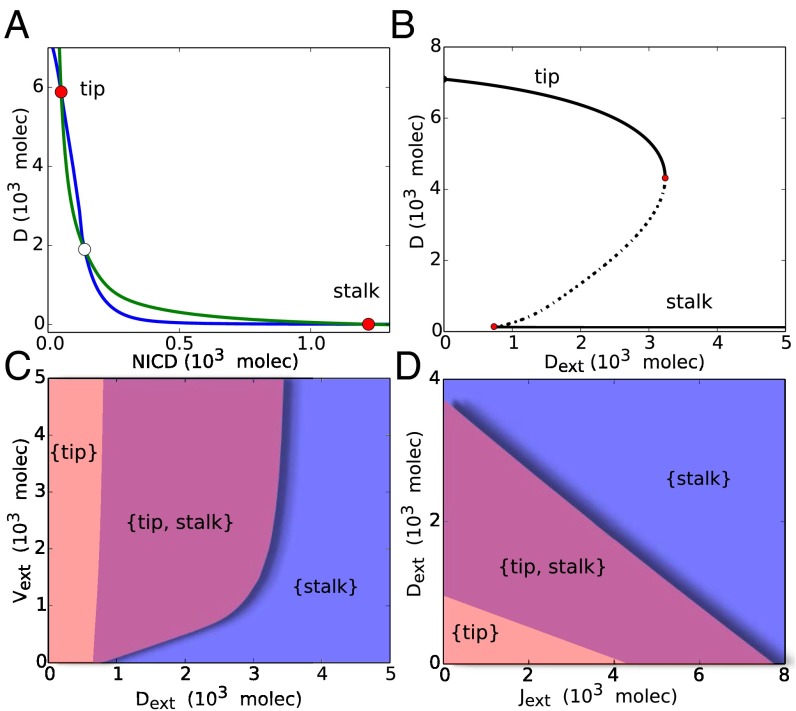
Fig. 2.
Nullcline, bifurcation curve, and phase diagrams for the case of a single cell driven by external proteins Notch, Delta, Jagged, and VEGF. (A) Nullclines for the case of one cell interacting with fixed levels of external proteins (Next=Dext=Jext=Vext=2,000 molecules). Blue nullcline is for the condition of all ODEs being set to zero except for dI/dt and green nullcline is for the condition of all ODEs being set to zero except for dD/dt (Eqs. 16). Unfilled circles represent unstable steady states, whereas red filled circles represent the two stable states: tip (high Delta, low NICD) and stalk (low Delta, high NICD). (B) Bifurcation curve of the levels of Delta (D) on the membrane as a function of the number of external Delta (Dext). At low Dext, the cell adopts the tip fate, whereas at high Dext, the cell adopts the stalk fate. At intermediate Dext, the cell can adopt either fate: tip or stalk. (C) Phase diagram (two-parameter bifurcation diagram) as a function of external Delta (Dext) and VEGF (Vext). The monostable phase {tip} corresponds to the state [high Delta (D), VEGF receptor (VR), active VEGF signaling (V) and low NICD (I) and Jagged (J)], and monostable phase {stalk} corresponds to the state (low D, VR, and V; and high I and J). The bistable phase {tip, stalk} corresponds to a region of coexistence of both states: tip and stalk. (D) Phase diagram as a function of external Delta (Dext) and external Jagged (Jext). Bifurcation curves of the levels of VEGF receptor (VR), active VEGF signaling (V), NICD (I), and Jagged (J) are included in SI Appendix, Fig. S3.
Fig. 3.
Fig. 3.
Dynamical characteristics of the one-cell system for different levels of production rates of the ligands. Bifurcation curves represent the levels of Delta in response to varying Dext for different production rates of the ligands Delta and Jagged. (A) D0=1,000, J0=800; (C) D0=1,000, J0=1,800; (D) D0=800, J0=1,400; and (F) D0=1,600, J0=1,400 (all units in molecules/h). The phenotype diagrams (center) show the different possible phases when the circuit is driven by variable levels of external Delta (Dext), production rate of Delta (D0), and that of Jagged (J0). (B) Phenotype diagram for variable levels of external Delta (Dext) and production rate of Jagged (J0). (E) Phenotype diagram for variable levels of external Delta (Dext) and production rate of Delta (D0). Bifurcation curve of the levels of VEGF receptor (VR), active VEGF signaling (V), NICD (I), and Jagged (J) for cases C and D are included in SI Appendix, Fig. S5.
Fig. 4.
Fig. 4.
3D representation of the effective potential as a function of Delta in cell 1 (D1) and in cell 2 (D2). The effective potential is defined as U=log(P), where P=P(D1,D2) is the probability density calculated by solving the differential equations stochastically using the Euler–Maruyama method. A represents the case of low production rate of Jagged (J0=1,000 molecules/h). B–D represent increasingly high production rates of Jagged: J0=1,400 molecules/h, J0=1,800 molecules/h, and J0=2,200 molecules/h, respectively. (E) Cell fate exchange rate (a measure of plasticity of the system) for increasing values of production rates of Jagged (J0). (F) Cell fate exchange rate for increasing values of production rates of Delta (D0). Red dot represents the standard value as presented in SI Appendix, Table S1.
Fig. 5.
Fig. 5.
Patterning at the tissue level. (A) Cartoon representation of physiological, suboptimal, and pathological angiogenesis. In physiological angiogenesis, two tip cells are separated by a few stalk cells, allowing a proper and robust development of the blood vessel. In the suboptimal case, angiogenesis is increased by a decrease in the number of stalk cells and the emergence of some hybrid tip/stalk cells that lead to some small blood vessels and poor perfusion. For pathological angiogenesis, an excessive number of tip/stalk cells lead to a large number of small blood vessels, leading to excessive but nonproductive angiogenesis. (B) Average of the fraction of cells in (tip), (tip/stalk), or (tip) state as a function of the production of Jagged (J0). (C) Cartoon representation of 1D layer of interacting cells for increased values of J0. (D) Average of the fraction of cells in (tip), (tip/stalk), or (tip) state as a function of the production of Delta (D0). (E) Cartoon representation of 1D layer of interacting cells for increased values of D0. The averages were taken over 100 simulations of a 2D layer of 100 × 100 interacting cells with a periodic boundary condition. The states of the cells are defined according to the amount of VEGF signal (V): stalk, V<100; tip/stalk, 100<V<300; and tip, V>300 molecules. Bidimensional patterning figures representing the levels of V, I, J, and D are presented in SI Appendix, Fig. S8.
Fig. 6.
Fig. 6.
Effect of VEGF gradient on tip and stalk fate decision. (A) Cartoon representation. We simulate two cells interacting via Notch signaling in the presence of a VEGF gradient: cell 2 receives more VEGF-A signal than cell 1. (B) Effective potential representation for the case of Vext=1,000 molecules for cell 1 and Vext=1,500 molecules for cell 2. (C) Fate exchange rate for different values of Vext for cell 2, whereas Vext for cell 1 remains constant (Vext=1,000 molecules).
Fig. 7.
Fig. 7.
Effect of Fringe on tip and stalk fate decision. (A) 3D representation of the effective potential as a function of Delta in cell 1 (D1) and in cell 2 (D2) for the case of no Fringe effect (f=0.0, i.e., λF,D=λF,J=1). B represents the effective potential after including Fringe effect (f=1.0, i.e., λF,D=3, λF,J=0.3). The state with high D2 and low D1, i.e., the one with high levels of Delta in cell 1 but not in cell 2, corresponds to (cell 1 as tip and cell 2 as stalk); the state with high D1 and low D2 corresponds to (cell 1 as stalk and cell 2 as tip). (C) Average of the fraction of cells in (stalk), (tip/stalk), or (tip) state as a function of the Fringe effect. The averages were taken over 100 simulations of a 2D layer of 100 × 100 interacting cells in a square lattice with periodic boundary conditions. (D) Cartoon representation of a 1D layer of interacting cells for increased values of the effect of Fringe. The states of the cells are defined according to the amount of active VEGF signaling (V): stalk (V<100), tip/stalk (100<V<300), and tip (V>300 molecules). The Fringe effect is represented by the variable f. The case f=0.0 represents the no Fringe effect, i.e., λF,D=λF,J=1, i.e., binding affinity of Notch to Delta and to Jagged is the same. As f increases, the values of λF,D and λF,J linearly increase and decrease, respectively, such that at f=1.0, λF,D=3.0 and λF,J=0.3 (SI Appendix, Table S1), i.e., Notch has higher binding affinity to Delta and lower to Jagged. Therefore, (λF,D=1+2f) and (λF,J=10.7f).
Fig. 8.
Fig. 8.
Effect of cis-inhibition on tip and stalk fate decision. (A) 3D representation of the effective potential as a function of Delta in cell 1 (D1) and in cell 2 (D2) for the case of a decrease in 10% of the cis-inhibition strength compared with its standard value (kC=4.5e4). B represents the case of an increase in 10% of the cis-inhibition strength (kC=5.5e4). The state with high D2 and low D1, i.e., the one with high levels of Delta in cell 1 but not in cell 2, corresponds to (cell 1 as tip and cell 2 as stalk); that with high D1 and low D2 corresponds to (cell 1 as stalk and cell 2 as tip).

References

    1. Benedito R, Hellström M. Notch as a hub for signaling in angiogenesis. Exp Cell Res. 2013;319(9):1281–1288. - PubMed
    1. Phng LK, Gerhardt H. Angiogenesis: A team effort coordinated by notch. Dev Cell. 2009;16(2):196–208. - PubMed
    1. Geudens I, Gerhardt H. Coordinating cell behaviour during blood vessel formation. Development. 2011;138(21):4569–4583. - PubMed
    1. Andersson ER, Sandberg R, Lendahl U. Notch signaling: Simplicity in design, versatility in function. Development. 2011;138(17):3593–3612. - PubMed
    1. Shimojo H, Ohtsuka T, Kageyama R. Dynamic expression of notch signaling genes in neural stem/progenitor cells. Front Neurosci. 2011;5:78. - PMC - PubMed

Publication types

MeSH terms

LinkOut - more resources