


Replacing Non-Active Video Gaming by Active Video Gaming to Prevent Excessive Weight Gain in Adolescents
- PMID: 26153884
- PMCID: PMC4496035
- DOI: 10.1371/journal.pone.0126023
Replacing Non-Active Video Gaming by Active Video Gaming to Prevent Excessive Weight Gain in Adolescents
Abstract
Objective: The aim of the current study was to evaluate the effects of and adherence to an active video game promotion intervention on anthropometrics, sedentary screen time and consumption of sugar-sweetened beverages and snacks among non-active video gaming adolescents who primarily were of healthy weight.
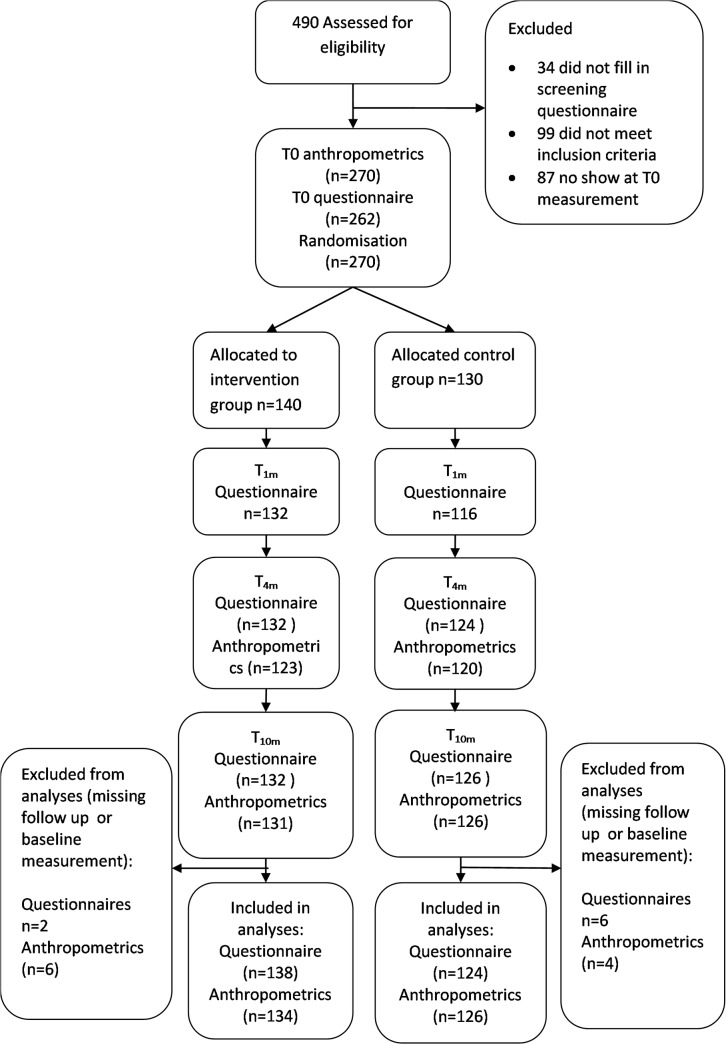
Methods: We assigned 270 gaming (i.e. ≥ 2 hours/week non-active video game time) adolescents randomly to an intervention group (n = 140) (receiving active video games and encouragement to play) or a waiting-list control group (n = 130). BMI-SDS (SDS = adjusted for mean standard deviation score), waist circumference-SDS, hip circumference and sum of skinfolds were measured at baseline, at four and ten months follow-up (primary outcomes). Sedentary screen time, physical activity, consumption of sugar-sweetened beverages and snacks, and process measures (not at baseline) were assessed with self-reports at baseline, one, four and ten months follow-up. Multi-level-intention to treat-regression analyses were conducted.
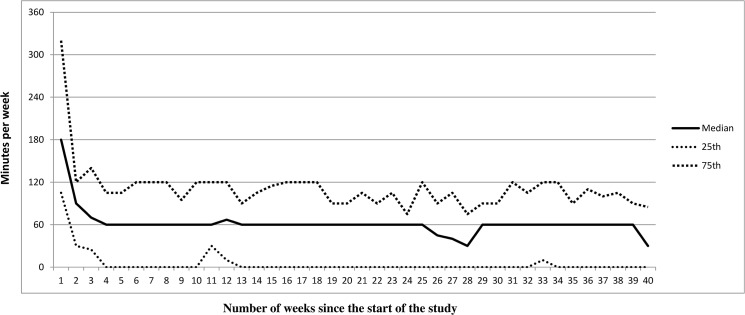
Results: The control group decreased significantly more than the intervention group on BMI-SDS (β = 0.074, 95%CI: 0.008;0.14), and sum of skinfolds (β = 3.22, 95%CI: 0.27;6.17) (overall effects). The intervention group had a significantly higher decrease in self-reported non-active video game time (β = -1.76, 95%CI: -3.20;-0.32) and total sedentary screen time (Exp (β = 0.81, 95%CI: 0.74;0.88) than the control group (overall effects). The process evaluation showed that 14% of the adolescents played the Move video games every week ≥ 1 hour/week during the whole intervention period.
Conclusions: The active video game intervention did not result in lower values on anthropometrics in a group of 'excessive' non-active video gamers (mean ~ 14 hours/week) who primarily were of healthy weight compared to a control group throughout a ten-month-period. Even some effects in the unexpected direction were found, with the control group showing lower BMI-SDS and skin folds than the intervention group. The intervention did result in less self-reported sedentary screen time, although these results are likely biased by social desirability.
Trial registration: Dutch Trial Register NTR3228.
Conflict of interest statement
Figures
References
-
- Ogden CL, Carroll MD, Curtin LR, McDowell MA, Tabak CJ, Flegal KM. Prevalence of overweight and obesity in the United States, 1999–2004. JAMA. 2006;295(13):1549–1555. - PubMed
-
- Livingstone MB. Childhood obesity in Europe: a growing concern. Public Health Nutr. 2001;4(1A):109–116. - PubMed
-
- Bouchard C, Shephard RJ, Stephens T. Physical activity, fitness, and health: International proceedings and consensus statement Champaign, Illinois: Human Kinetics Publishers; 1994.
Publication types
MeSH terms
Associated data
LinkOut - more resources
Full Text Sources
Other Literature Sources
