


How much might a society spend on life-saving interventions at different ages while remaining cost-effective? A case study in a country with detailed data
- PMID: 26155199
- PMCID: PMC4493819
- DOI: 10.1186/s12963-015-0052-2
How much might a society spend on life-saving interventions at different ages while remaining cost-effective? A case study in a country with detailed data
Abstract
Objective: We aimed to estimate the maximum intervention cost (EMIC) a society could invest in a life-saving intervention at different ages while remaining cost-effective according to a user-specified cost-effectiveness threshold.
Methods: New Zealand (NZ) was used as a case study, and a health system perspective was taken. Data from NZ life tables and morbidity data from a burden of disease study were used to estimate health-adjusted life-years (HALYs) gained by a life-saving intervention. Health system costs were estimated from a national database of all publicly funded health events (hospitalizations, outpatient events, pharmaceuticals, etc.). For illustrative purposes we followed the WHO-CHOICE approach and used a cost-effectiveness threshold of the gross domestic product (GDP) per capita (NZ$45,000 or US$30,000 per HALY). We then calculated EMICs for an "ideal" life-saving intervention that fully returned survivors to the same average morbidity, mortality, and cost trajectories as the rest of their cohort.
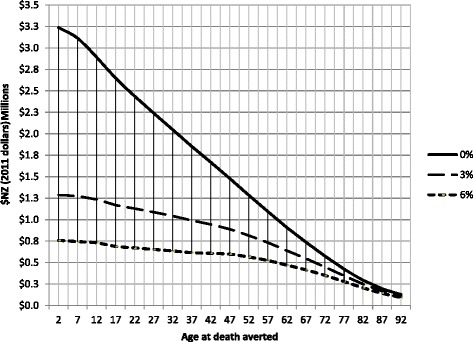
Findings: The EMIC of the "ideal" life-saving intervention varied markedly by age: NZ$1.3 million (US$880,000) for an intervention to save the life of a child, NZ$0.8 million (US$540,000) for a 50-year-old, and NZ$0.235 million (US$158,000) for an 80-year-old. These results were predictably very sensitive to the choice of discount rate and to the selected cost-effectiveness threshold. Using WHO data, we produced an online calculator to allow the performance of similar calculations for all other countries.
Conclusions: We present an approach to estimating maximal cost-effective investment in life-saving health interventions, under various assumptions. Our online calculator allows this approach to be applied in other countries. Policymakers could use these estimates as a rapid screening tool to determine if more detailed cost-effectiveness analyses of potential life-saving interventions might be worthwhile or which proposed life-saving interventions are very unlikely to benefit from such additional research.
Keywords: Age; Cost-effective; Cost-effectiveness threshold; Health system costs; Health-adjusted life expectancy (HALE); Health-adjusted life-years (HALYs); Morbidity; Quality-adjusted life-years (QALYs).
Figures
References
-
- The World Bank. Health expenditure, total (% of GDP). The World Bank. 2014. http://data.worldbank.org/indicator/SH.XPD.TOTL.ZS. Accessed 18 June 2014.
-
- Ministry of Health . Health Expenditure Trends in New Zealand 2000–2010. Wellington: Ministry of Health; 2012.
-
- Bell M, Blick G, Parkyn O, Rodway P, Vowles P. Challenges and Choices: Modelling New Zealand's Long-term Fiscal Position. The Treasury Wellington. 2010. http://www.treasury.govt.nz/publications/research-policy/wp/2010/10-01. Accessed 18 June 2014.
-
- Morton J. Measure the quality of healthcare spending. New Zeal Med J. 2008;121(1284):92–94. - PubMed
-
- Appleby J, Harrison A. Spending on Health Care United Kingdom: King's Fund. 2006.
LinkOut - more resources
Full Text Sources
Other Literature Sources
