


Occupational Complexity and Cognitive Reserve in a Middle-Aged Cohort at Risk for Alzheimer's Disease
- PMID: 26156334
- PMCID: PMC4605365
- DOI: 10.1093/arclin/acv041
Occupational Complexity and Cognitive Reserve in a Middle-Aged Cohort at Risk for Alzheimer's Disease
Abstract
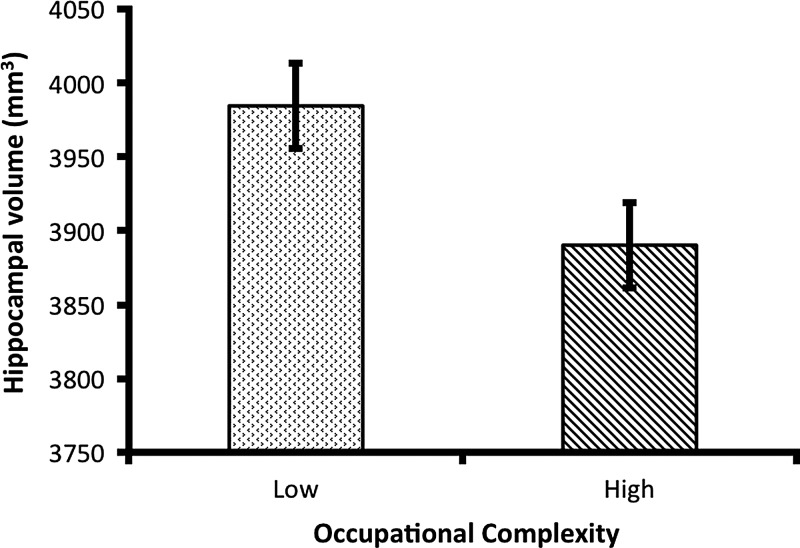
Higher occupational attainment has previously been associated with increased Alzheimer's disease (AD) neuropathology when individuals are matched for cognitive function, indicating occupation could provide cognitive reserve. We examined whether occupational complexity (OCC) associates with decreased hippocampal volume and increased whole-brain atrophy given comparable cognitive function in middle-aged adults at risk for AD. Participants (n = 323) underwent structural MRI, cognitive evaluation, and work history assessment. Three complexity ratings (work with data, people, and things) were obtained, averaged across up to 3 reported jobs, weighted by years per job, and summed to create a composite OCC rating. Greater OCC was associated with decreased hippocampal volume and increased whole-brain atrophy when matched for cognitive function; results remained substantively unchanged after adjusting for several demographic, AD risk, vascular, mental health, and socioeconomic characteristics. These findings suggest that, in people at risk for AD, OCC may confer resilience to the adverse effects of neuropathology on cognition.
Keywords: Alzheimer's disease; Cognition; Cognitive reserve; Hippocampus; Imaging; Occupation.
© The Author 2015. Published by Oxford University Press. All rights reserved. For permissions, please e-mail: journals.permissions@oup.com.
Figures

References
-
- Andel R., Kareholt I., Parker M. G., Thorslund M., Gatz M. (2007). Complexity of primary lifetime occupation and cognition in advanced old age. Journal of Aging and Health, 19, 397–415. - PubMed
-
- Andel R., Silverstein M., Kareholt I. (2015). The role of midlife occupational complexity and leisure activity in late-life cognition. Journals of Gerontology Series B: Psychological Sciences and Social Sciences, 70, 314–321. - PubMed
-
- Bigler E. D., Neeley E. S., Miller M. J., Tate D. F., Rice S. A., Cleavinger H. et al. (2004). Cerebral volume loss, cognitive deficit and neuropsychological performance: Comparative measures of brain atrophy: I. Dementia. Journal of the International Neuropsychological Society, 10, 442–452. - PubMed
-
- Bigler E. D., Tate D. F. (2001). Brain volume, intracranial volume, and dementia. Investigative Radiology, 36, 539–546. - PubMed
Publication types
MeSH terms
Grants and funding
LinkOut - more resources
Full Text Sources
Other Literature Sources
Medical
