Inhibition of hepatic stellate cells by bone marrow-derived mesenchymal stem cells in hepatic fibrosis
- PMID: 26157751
- PMCID: PMC4493357
- DOI: 10.3350/cmh.2015.21.2.141
Inhibition of hepatic stellate cells by bone marrow-derived mesenchymal stem cells in hepatic fibrosis
Abstract
Background/aims: Therapies involving bone-marrow-derived mesenchymal stem cells (BM-MSCs) have considerable potential in the management of hepatic disease. BM-MSCs have been investigated in regenerative medicine due to their ability to secrete various growth factors and cytokines that regress hepatic fibrosis and enhance hepatocyte functionality. The aim of this study was to determine the antifibrosis effect of BM-MSCs on activated hepatic stellate cells (HSCs) and the mechanism underlying how BM-MSCs modulate the function of activated HSCs.
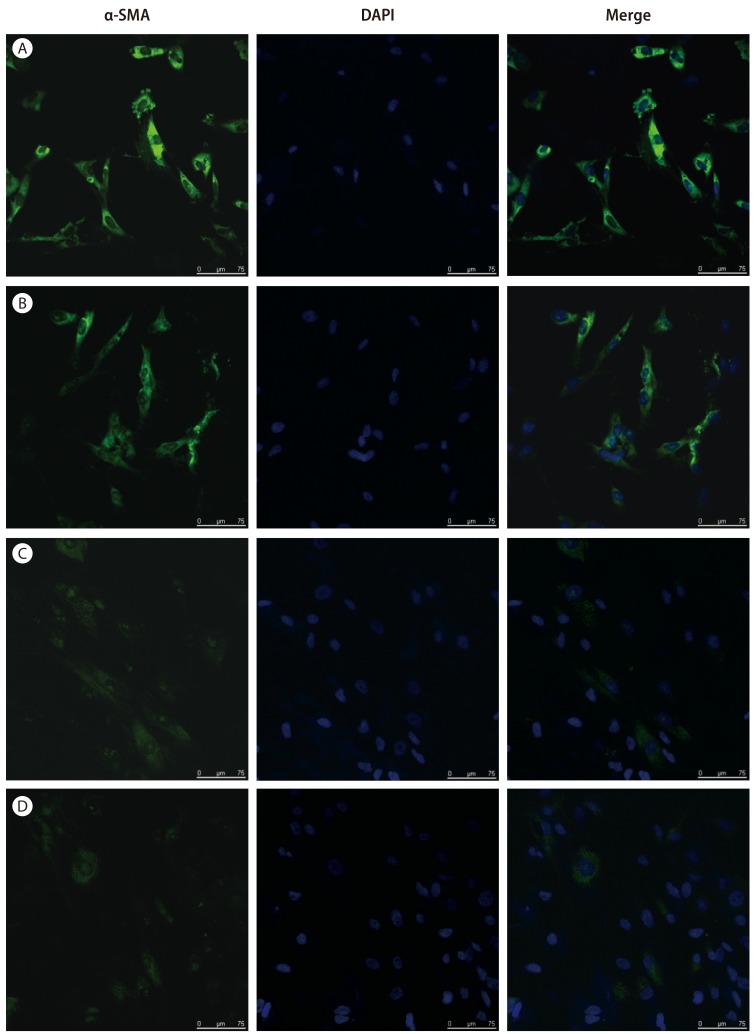
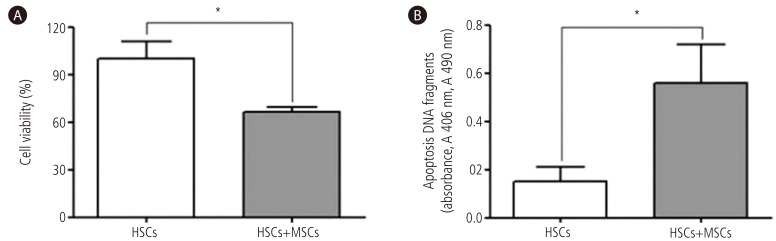
Methods: We used HSCs in both direct and indirect co-culture systems with BM-MSCs to evaluate the antifibrosis effect of BM-MSCs. The cell viability and apoptosis were evaluated by a direct co-culture system of activated HSCs with BM-MSCs. The activations of both HSCs alone and HSCs with BM-MSCs in the direct co-culture system were observed by immunocytochemistry for alpha-smooth muscle actin (α-SMA). The levels of growth factors and cytokines were evaluated by an indirect co-culture system of activated HSCs with BM-MSCs.
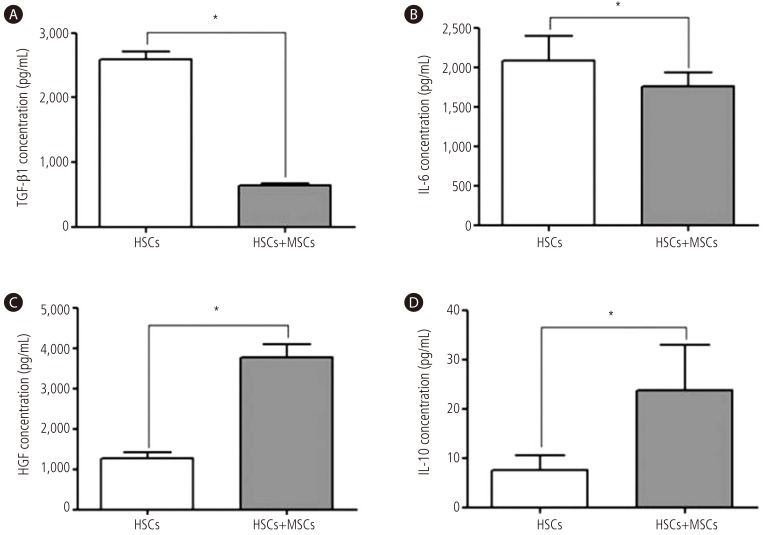
Results: The BM-MSCs in the direct co-culture system significantly decreased the production of α-SMA and the viability of activated HSCs, whereas they induced the apoptosis of activated HSCs. The BM-MSCs in the indirect co-culture system decreased the production of transforming growth factor-β1 and interleukin (IL)-6, whereas they increased the production of hepatocyte growth factor and IL-10. These results confirmed that the juxtacrine and paracrine effects of BM-MSCs can inhibit the proliferative, fibrogenic function of activated HSCs and have the potential to reverse the fibrotic process by inhibiting the production of α-SMA and inducing the apoptosis of HSCs.
Conclusions: These results have demonstrated that BM-MSCs may exert an antifibrosis effect by modulating the function of activated HSCs.
Keywords: Bone-marrow-derived mesenchymal stem cell; Cirrhosis; Hepatic fibrosis.
Conflict of interest statement
Figures
References
-
- Schiff ER, Lee SS, Chao YC, Kew Yoon S, Bessone F, Wu SS, et al. Long-term treatment with entecavir induces reversal of advanced fibrosis or cirrhosis in patients with chronic hepatitis B. Clin Gastroenterol Hepatol. 2011;9:274–276. - PubMed
-
- Chang TT, Liaw YF, Wu SS, Schiff E, Han KH, Lai CL, et al. Long-term entecavir therapy results in the reversal of fibrosis/cirrhosis and continued histological improvement in patients with chronic hepatitis B. Hepatology. 2010;52:886–893. - PubMed
-
- Kim MY, Baik SK, Yea CJ, Lee IY, Kim HJ, Park KW, et al. Hepatic venous pressure gradient can predict the development of hepatocellular carcinoma and hyponatremia in decompensated alcoholic cirrhosis. Eur J Gastroenterol Hepatol. 2009;21:1241–1246. - PubMed
-
- Kim MY, Suk KT, Baik SK, Kim HA, Kim YJ, Cha SH, et al. Hepatic vein arrival time as assessed by contrast-enhanced ultrasonography is useful for the assessment of portal hypertension in compensated cirrhosis. Hepatology. 2012;56:1053–1062. - PubMed
-
- Geerts A. History, heterogeneity, developmental biology, and functions of quiescent hepatic stellate cells. Semin Liver Dis. 2001;21:311–335. - PubMed
Publication types
MeSH terms
Substances
LinkOut - more resources
Full Text Sources
Other Literature Sources