


Functional roles of non-coding Y RNAs
- PMID: 26159929
- PMCID: PMC4726728
- DOI: 10.1016/j.biocel.2015.07.003
Functional roles of non-coding Y RNAs
Abstract
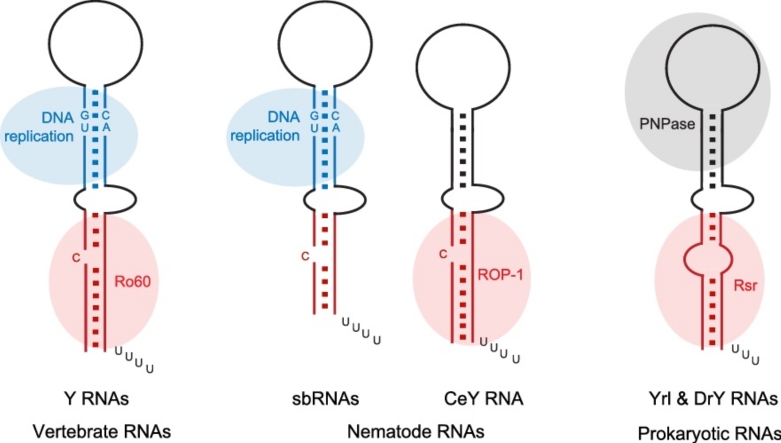
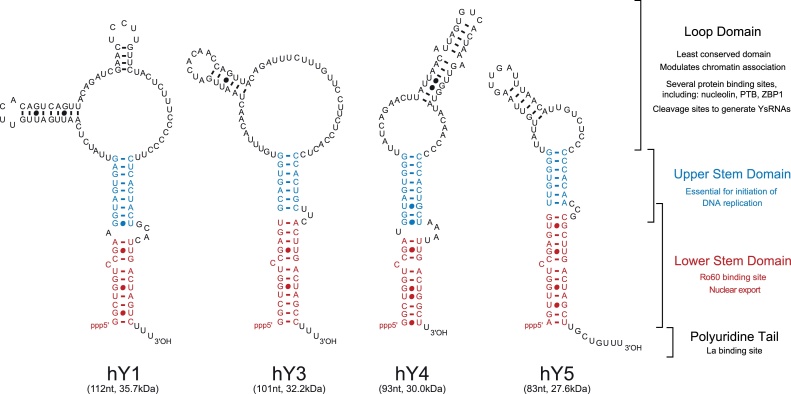
Non-coding RNAs are involved in a multitude of cellular processes but the biochemical function of many small non-coding RNAs remains unclear. The family of small non-coding Y RNAs is conserved in vertebrates and related RNAs are present in some prokaryotic species. Y RNAs are also homologous to the newly identified family of non-coding stem-bulge RNAs (sbRNAs) in nematodes, for which potential physiological functions are only now emerging. Y RNAs are essential for the initiation of chromosomal DNA replication in vertebrates and, when bound to the Ro60 protein, they are involved in RNA stability and cellular responses to stress in several eukaryotic and prokaryotic species. Additionally, short fragments of Y RNAs have recently been identified as abundant components in the blood and tissues of humans and other mammals, with potential diagnostic value. While the number of functional roles of Y RNAs is growing, it is becoming increasingly clear that the conserved structural domains of Y RNAs are essential for distinct cellular functions. Here, we review the biochemical functions associated with these structural RNA domains, as well as the functional conservation of Y RNAs in different species. The existing biochemical and structural evidence supports a domain model for these small non-coding RNAs that has direct implications for the modular evolution of functional non-coding RNAs.
Keywords: DNA replication; Non-coding RNA; RNA domains; RNA stability; Y RNA.
Copyright © 2015 The Authors. Published by Elsevier Ltd.. All rights reserved.
Figures
References
-
- Blow J.J., Dilworth S.M., Dingwall C., Mills A.D., Laskey R.A. Chromosome replication in cell-free systems from Xenopus eggs. Philos. Trans. R. Soc. Lond. B: Biol. Sci. 1987;317:483–494. - PubMed
-
- Boria I., Gruber A.R., Tanzer A., Bernhart S.H., Lorenz R., Mueller M.M., Hofacker I.L., Stadler P.F. Nematode sbRNAs: homologs of vertebrate Y RNAs. J. Mol. Evol. 2010;70:346–358. - PubMed
Publication types
MeSH terms
Substances
Grants and funding
LinkOut - more resources
Full Text Sources
Other Literature Sources
