Pressure drop of filtering facepiece respirators: How low should we go?
- PMID: 26159949
- PMCID: PMC4499853
- DOI: 10.13075/ijomeh.1896.00153
Pressure drop of filtering facepiece respirators: How low should we go?
Abstract
Introduction: This study was undertaken to determine the mean peak filter resistance to airflow (Rfilter) encountered by subjects while wearing prototype filtering facepiece respirators (PRs) with low Rfilter during nasal and oral breathing at sedentary and low-moderate work rates.
Material and methods: In-line pressure transducer measurements of mean Rfilteracross PRs with nominal Rfilter of 29.4 Pa, 58.8 Pa and 88.2 Pa (measured at 85 l/min constant airflow) were obtained during nasal and oral breathing at sedentary and low-moderate work rates for 10 subjects.
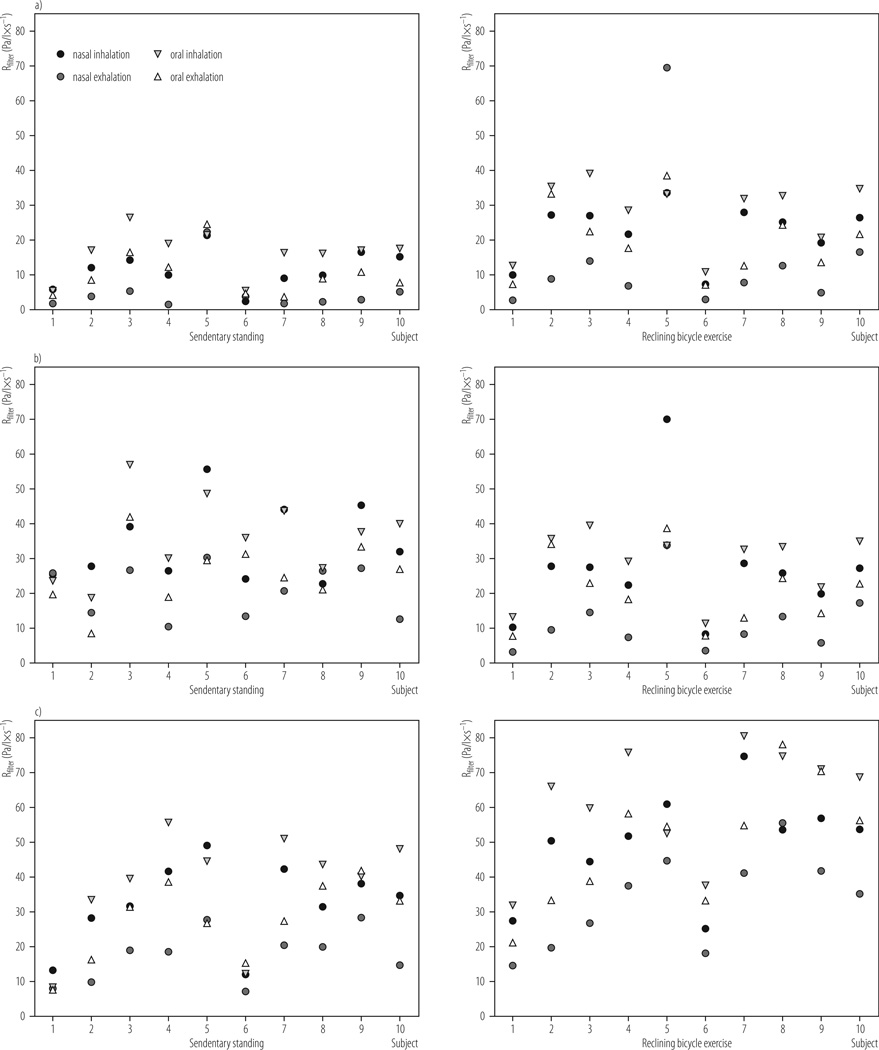
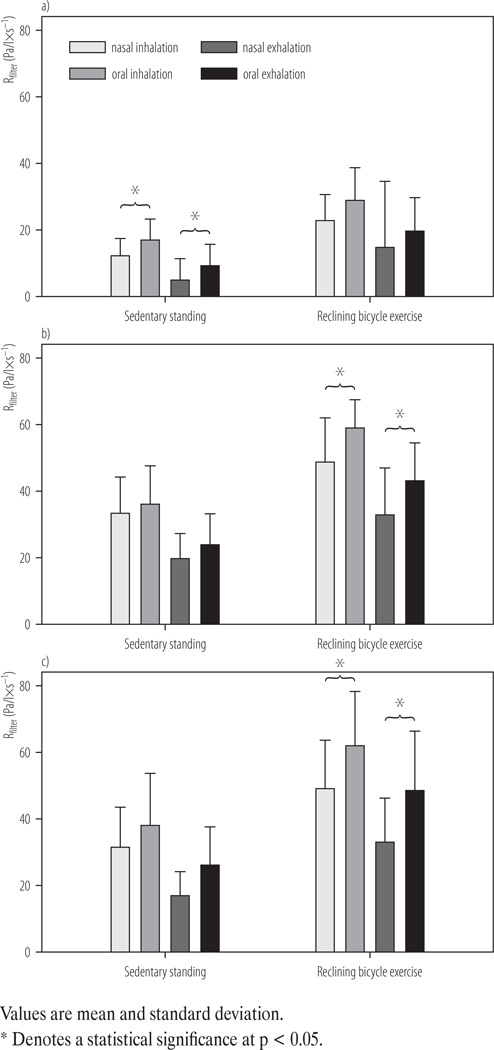
Results: The mean Rfilter for the 29.4 PR was significantly lower than the other 2 PRs (p < 0.000), but there were no significant differences in mean Rfilter between the PRs with 58.8 and 88.2 Pa filter resistance (p > 0.05). The mean Rfilter was greater for oral versus nasal breathing and for exercise compared to sedentary activity (p < 0.001).
Conclusions: Mean oral and nasal Rfilter for all 3 PRs was at, or below, the minimal threshold level for detection of inspiratory resistance (the 58.8-74.5 Pa/l×s-1), which may account for the previously-reported lack of significant subjective or physiological differences when wearing PRs with these low Rfilter. Lowering filtering facepiece respirator Rfilter below 88.2 Pa (measured at 85 l/min constant airflow) may not result in additional subjective or physiological benefit to the wearer.
Keywords: filter; nasal breathing; oral breathing; respirator.
This work is available in Open Access model and licensed under a CC BY-NC 3.0 PL license.
Figures
References
-
- National Institute for Occupational Safety and Health. [cited 2013 Feb 8];Respirator usage in private sector firms. 2001 Available from: http://www.cdc.gov/niosh/docs/respsurv.
-
- Code of Federal Regulations (42 CFR 84.180) [cited 2013 May 16];Airflow resistance tests. Available from: http://www.gpo.gov/fdsys/pkg/CFR-2007-title42-vol1/pdf/CFR-2007-title42-....
-
- Bryce E, Forrester L, Scharf S, Eshqhpour M. What do healthcare workers think? A survey of facial protection equipment user preferences. J Hosp Infect. 2007;68(3):241–247. http://dx.doi.org/10.1016/j.jhin.2007.12.007. - DOI - PubMed
-
- Baig A, Knapp C, Eagan AE, Radonovich LJ., Jr Health care workers’ views about respirator use and features that should be included in the next generation of respirators. Am J Infect Control. 2010;38(1):18–25. http://dx.doi.org/10.1016/j.ajic.2009.09.005. - DOI - PMC - PubMed
-
- Mitchell R, Ogunremi T, Astrakianakis G, Bryce E, Gervais R, Gravel D, et al. Impact of the 2009 influenza A (H1N1) pandemic on Canadian health care workers: A survey on vaccination, illness, absenteeism, and person protective equipment. Am J Infect Control. 2012;40(7):611–616. http://dx.doi.org/10.1016/j.ajic.2012.01.011. - DOI - PubMed
Publication types
MeSH terms
Grants and funding
LinkOut - more resources
Full Text Sources
Other Literature Sources
Research Materials