


Contribution of Major Lifestyle Risk Factors for Incident Heart Failure in Older Adults: The Cardiovascular Health Study
- PMID: 26160366
- PMCID: PMC4508377
- DOI: 10.1016/j.jchf.2015.02.009
Contribution of Major Lifestyle Risk Factors for Incident Heart Failure in Older Adults: The Cardiovascular Health Study
Abstract
Objectives: The goal of this study was to determine the relative contribution of major lifestyle factors on the development of heart failure (HF) in older adults.
Background: HF incurs high morbidity, mortality, and health care costs among adults ≥65 years of age, which is the most rapidly growing segment of the U.S.
Methods: We prospectively investigated separate and combined associations of lifestyle risk factors with incident HF (1,380 cases) over 21.5 years among 4,490 men and women in the Cardiovascular Health Study, which is a community-based cohort of older adults. Lifestyle factors included 4 dietary patterns (Alternative Healthy Eating Index, Dietary Approaches to Stop Hypertension, an American Heart Association 2020 dietary goals score, and a Biologic pattern, which was constructed using previous knowledge of cardiovascular disease dietary risk factors), 4 physical activity metrics (exercise intensity, walking pace, energy expended in leisure activity, and walking distance), alcohol intake, smoking, and obesity.
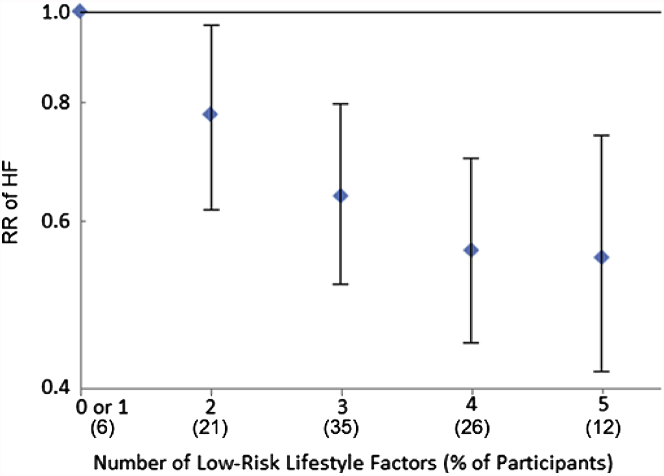
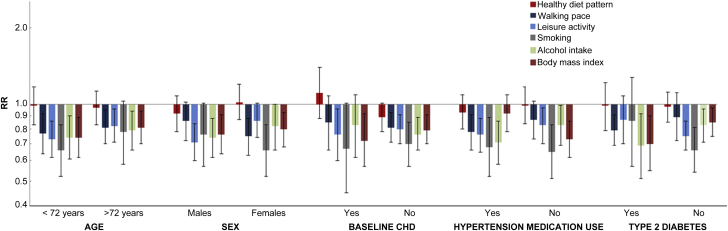
Results: No dietary pattern was associated with developing HF (p > 0.05). Walking pace and leisure activity were associated with a 26% and 22% lower risk of HF, respectively (pace >3 mph vs. <2 mph; hazard ratio [HR]: 0.74; 95% confidence interval [CI]: 0.63 to 0.86; leisure activity ≥845 kcal/week vs. <845 kcal/week; HR: 0.78; 95% CI: 0.69 to 0.87). Modest alcohol intake, maintaining a body mass index <30 kg/m(2), and not smoking were also independently associated with a lower risk of HF. Participants with ≥4 healthy lifestyle factors had a 45% (HR: 0.55; 95% CI: 0.42 to 0.74) lower risk of HF. Heterogeneity by age, sex, cardiovascular disease, hypertension medication use, and diabetes was not observed.
Conclusions: Among older U.S. adults, physical activity, modest alcohol intake, avoiding obesity, and not smoking, but not dietary patterns, were associated with a lower risk of HF.
Keywords: diet; heart failure; lifestyle; nutrition; physical activity; sodium.
Copyright © 2015 American College of Cardiology Foundation. Published by Elsevier Inc. All rights reserved.
Figures
Comment in
-
Primary Prevention of Heart Failure in Older Adults.JACC Heart Fail. 2015 Jul;3(7):529-530. doi: 10.1016/j.jchf.2015.04.004. JACC Heart Fail. 2015. PMID: 26160367 No abstract available.
References
-
- Lloyd-Jones D., Adams R.J., Brown T.M. Heart disease and stroke statistics-2010 update: a report from the American Heart Association. Circulation. 2010;121:e1–e170. - PubMed
-
- Krumholtz H., Chen Y., Wan Y., Vacarriono V., Radford M., Horwitz R. Predictors of readmission among elderly survivors of admission with heart failure. Am Heart J. 2000;139:72–77. - PubMed
-
- Goldberg R.J., Ciampa J., Lessard D., Meyer T.E., Spencer F.A. Long-term survival after heart failure: a contemporary population-based perspective. Arch Intern Med. 2007;167:490–496. - PubMed
-
- Lloyd-Jones D.M., Larson M.G., Leip E.P., et al. for the Framingham Heart Study Lifetime risk for developing congestive heart failure: the Framingham Heart Study. Circulation. 2002;106:3068–3072. - PubMed
Publication types
MeSH terms
Grants and funding
- N01 HC085080/HL/NHLBI NIH HHS/United States
- MC_UP_A100_1003/MRC_/Medical Research Council/United Kingdom
- N01 HC085082/HL/NHLBI NIH HHS/United States
- MC_UU_125015/5/MRC_/Medical Research Council/United Kingdom
- HHSN268201200036C/HL/NHLBI NIH HHS/United States
- N01 HC055222/HL/NHLBI NIH HHS/United States
- N01 HC085079/HL/NHLBI NIH HHS/United States
- R01 HL080295/HL/NHLBI NIH HHS/United States
- HHSN268200800007C/HL/NHLBI NIH HHS/United States
- HL080295/HL/NHLBI NIH HHS/United States
- R01 AG023629/AG/NIA NIH HHS/United States
- N01 HC085081/HL/NHLBI NIH HHS/United States
- R01 HL085710/HL/NHLBI NIH HHS/United States
- U01 HL080295/HL/NHLBI NIH HHS/United States
- HHSN268200800007C/HL/NHLBI NIH HHS/United States
- N01 HC085086/HL/NHLBI NIH HHS/United States
- N01 HC085083/HL/NHLBI NIH HHS/United States
- MC_UU_12015/5/MRC_/Medical Research Council/United Kingdom
- HHSN268201200036C/HL/NHLBI NIH HHS/United States
- AG023629/AG/NIA NIH HHS/United States
- R56 AG023629/AG/NIA NIH HHS/United States
LinkOut - more resources
Full Text Sources
Other Literature Sources
Medical
Research Materials
Miscellaneous
