


Patient and Stakeholder Engagement in the PCORI Pilot Projects: Description and Lessons Learned
- PMID: 26160480
- PMCID: PMC4700002
- DOI: 10.1007/s11606-015-3450-z
Patient and Stakeholder Engagement in the PCORI Pilot Projects: Description and Lessons Learned
Abstract
Background: Patients and healthcare stakeholders are increasingly becoming engaged in the planning and conduct of biomedical research. However, limited research characterizes this process or its impact.
Objective: We aimed to characterize patient and stakeholder engagement in the 50 Pilot Projects funded by the Patient-Centered Outcomes Research Institute (PCORI), and identify early contributions and lessons learned.
Design: A self-report instrument was completed by researchers between 6 and 12 months following project initiation.
Participants: Forty-seven principal investigators or their designees (94 % response rate) participated in the study. MAIN MEASURES Self-report of types of stakeholders engaged, stages and levels of engagement, facilitators and barriers to engagement, lessons learned, and contributions from engagement were measured.
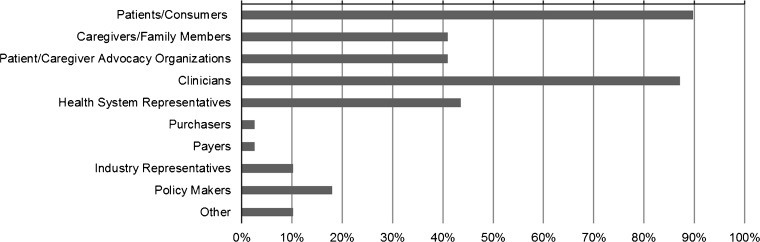
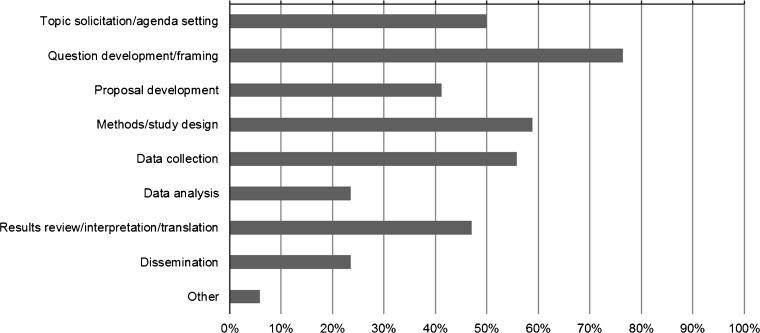
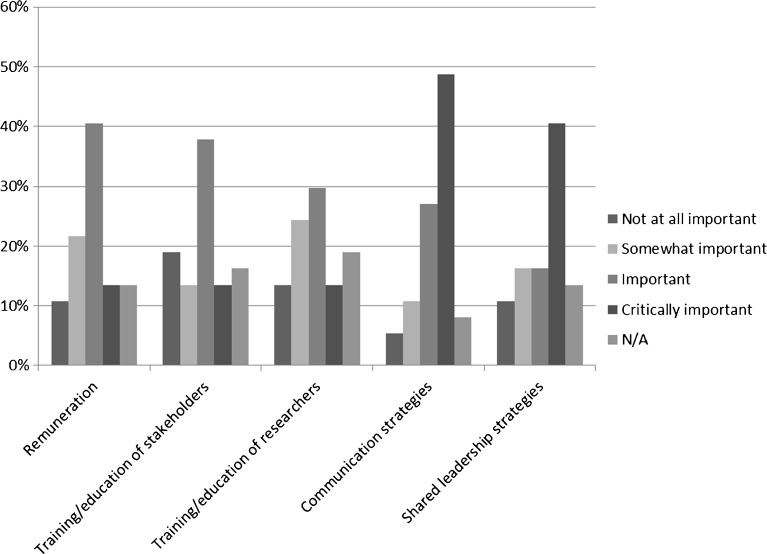
Key results: Most (83 %) reported engaging more than one stakeholder in their project. Among those, the most commonly reported groups were patients (90 %), clinicians (87 %), health system representatives (44 %), caregivers (41 %), and advocacy organizations (41 %). Stakeholders were commonly involved in topic solicitation, question development, study design, and data collection. Many projects engaged stakeholders in data analysis, results interpretation, and dissemination. Commonly reported contributions included changes to project methods, outcomes or goals; improvement of measurement tools; and interpretation of qualitative data. Investigators often identified communication and shared leadership strategies as "critically important" facilitators (53 and 44 % respectively); lack of stakeholder time was the most commonly reported challenge (46 %). Most challenges were only partially resolved. Early lessons learned included the importance of continuous and genuine partnerships, strategic selection of stakeholders, and accommodation of stakeholders' practical needs.
Conclusions: PCORI Pilot Projects investigators report engaging a variety of stakeholders across many stages of research, with specific changes to their research attributed to engagement. This study identifies early lessons and barriers that should be addressed to facilitate engagement. While this research suggests potential impact of stakeholder engagement, systematic characterization and evaluation of engagement at multiple stages of research is needed to build the evidence base.
Keywords: comparative effectiveness research (CER); patient engagement; patient-centered outcomes research.
Figures
References
-
- Patient-Centered Outcomes Research Institute (PCORI). The PCORI Methodology Report. 2013. Available at: http://www.pcori.org/assets/2013/11/PCORI-Methodology-Report.pdf Accessed June 9, 2015.
Publication types
MeSH terms
LinkOut - more resources
Full Text Sources
Other Literature Sources
Medical
