Review
. 2015 Oct:34:26-34.
doi: 10.1016/j.sbi.2015.06.003. Epub 2015 Jul 7.

Recent insights into structures and functions of C-type lectins in the immune system

Affiliations
Review

Recent insights into structures and functions of C-type lectins in the immune system

Kurt Drickamer et al. Curr Opin Struct Biol. 2015 Oct.

Abstract

The majority of the C-type lectin-like domains in the human genome likely to bind sugars have been investigated structurally, although novel mechanisms of sugar binding are still being discovered. In the immune system, adhesion and endocytic receptors that bind endogenous mammalian glycans are often conserved, while pathogen-binding C-type lectins on cells of the innate immune system are more divergent. Lack of orthology between some human and mouse receptors, as well as overlapping specificities of many receptors and formation of receptor hetero-oligomers, can make it difficult to define the roles of individual receptors. There is good evidence that C-type lectins initiate signalling pathways in several different ways, but this function remains the least well understood from a mechanistic perspective.


Figures

Figure 1
Figure 1
Summary of current state of structural analysis of glycan-binding C-type CRDs. Dendrogram at the left shows the relationships of the sequences of human CRDs, with the domains that bind glycans at the conserved Ca2+ site in yellow boxes and the domains that appear to bind glycans through non-canonical sites in blue boxes. Members of other groups that contain C-type lectin-like domains but lack key residues usually associated with Ca2+ and sugar-binding are not shown individually. Names of proteins containing the full set of residues needed to form canonical sugar-binding sites are shown in green when structures with bound glycan ligands have been obtained, in red for those cases in which unliganded structures have been determined and in black where structures have not been elucidated. The organization of proteins containing these CRDs is depicted schematically at the right, with the positions of CRDs, shown as green spheres, shown in relationship to other domains. Groups 2, 4 and 6 are receptors with transmembrane sequences. Proteins that bind sugars but lack the canonical binding site are indicated in blue. The crystal structure of dectin-1 has been determined and a possible mode of sugar binding has been suggested [63].
Figure 2
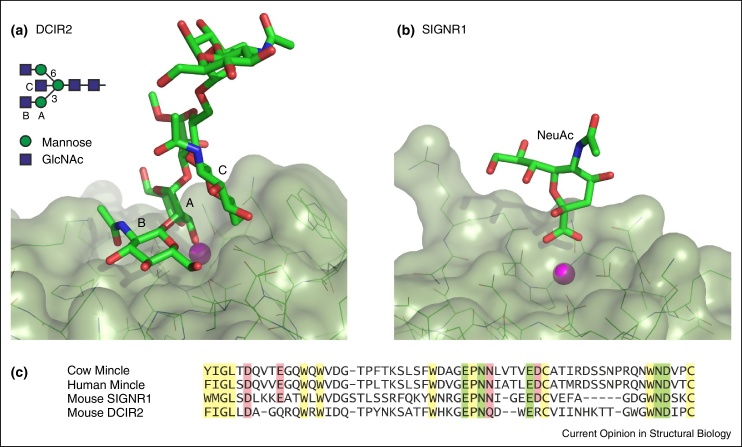
Figure 2
Recently reported structures of C-type CRDs with unusual modes of sugar binding. (a) Mouse dendritic cell immunoreceptor 2 (DCIR2) with a bound bisected biantennary N-linked glycan [PDB 3VYK. The positions of the three sugar residues A, B and C that interact with the protein are indicated in the schematic diagram of the bisected oligosaccharide. (b) Mouse SIGNR1 with bound sialic acid [PDB 4C9F]. In both (a) and (b), the primary Ca2+ bound to the protein is shown as a magenta sphere. (c) Sequence alignment of a portion of the CRDs from the proteins shown in (a) and (b) as well as mincle. Framework residues are highlighted in yellow, ligands for the conserved Ca2+ are highlighted in green and ligands for the adjacent accessory Ca2+ site in mincle are highlighted in pink.
Figure 3
Figure 3
Summary of evolution of vertebrate C-type lectin-like domains. Common domain organizations were established early. However, recent evolution makes it difficult to define specific orthologues for some proteins, even between mammals such as humans and mice.
Figure 4
Figure 4
Organization of proteins containing extracellular C-type CRDs and intracellular domains involved in signalling. Sequence motifs in the cytoplasmic domains include immunotyrosine activation motifs (ITAMs), in which the tyrosine residues become phosphorylated, making them targets for binding to Src homology type 2 domains (SH2).

References

    1. Sharon N., Lis H. History of lectins: from hemagglutinins to biological recognition molecules. Glycobiology. 2004;14:53R–62R. - PubMed
    1. Weis W.I., Taylor M.E., Drickamer K. The C-type lectin superfamily in the immune system. Immunol Rev. 1998;163:19–34. - PubMed
    1. Zarbock A., Ley K., McEver R.P., Hidalgo A. Leukocyte ligands for endothelial selectins: specialized glycoconjugates that mediate rolling and signaling under flow. Blood. 2011;118:6743–6751. - PMC - PubMed
    1. Lühn K., Wild M.K. Human deficiencies of fucosylation and sialylation affecting selectin ligands. Semin Immunopathol. 2012;34:383–399. - PubMed
    1. Keizer M.P., Wouters D., Schlapbach L.J., Kuijpers T.W. Restoration of MBL-deficiency: redefining the safety, efficacy and viability of MBL-substitution therapy. Mol Immunol. 2014;61:174–184. - PubMed

Publication types