. 2015 Oct;26(9):948-56.
doi: 10.1097/CAD.0000000000000271.

RAD1901: a novel, orally bioavailable selective estrogen receptor degrader that demonstrates antitumor activity in breast cancer xenograft models

Affiliations

RAD1901: a novel, orally bioavailable selective estrogen receptor degrader that demonstrates antitumor activity in breast cancer xenograft models

Fiona Garner et al. Anticancer Drugs. 2015 Oct.

Abstract

Agents that inhibit estrogen production, such as aromatase inhibitors or those that directly block estrogen receptor (ER) activity, such as selective estrogen receptor modulators and selective estrogen receptor degraders, are routinely used in the treatment of ER-positive breast cancers. However, although initial treatment with these agents is often successful, many women eventually relapse with drug-resistant breast cancers. To overcome some of the challenges associated with current endocrine therapies and to combat the development of resistance, there is a need for more durable and more effective ER-targeted therapies. Here we describe and characterize a novel, orally bioavailable small-molecule selective estrogen receptor degrader, RAD1901, and evaluate its therapeutic potential for the treatment of breast cancer. RAD1901 selectively binds to and degrades the ER and is a potent antagonist of ER-positive breast cancer cell proliferation. Importantly, RAD1901 produced a robust and profound inhibition of tumor growth in MCF-7 xenograft models. In an intracranial MCF-7 model, RAD1901-treated animals survived longer than those treated with either control or fulvestrant, suggesting the potential benefit of RAD1901 in the treatment of ER-positive breast cancer that has metastasized to the brain. Finally, RAD1901 preserved ovariectomy-induced bone loss and prevented the uterotropic effects of E2, suggesting that it may act selectively as an agonist in bone but as an antagonist in breast and uterine tissues. RAD1901 is currently under clinical study in postmenopausal women with ER-positive advanced breast cancer.


Figures
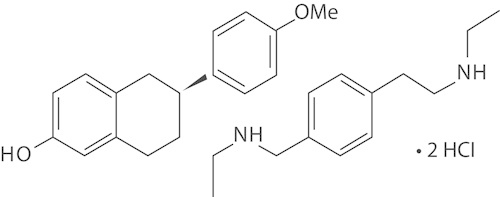
Fig. 1
Fig. 1
Structure of RAD1901.
Fig. 2
Fig. 2
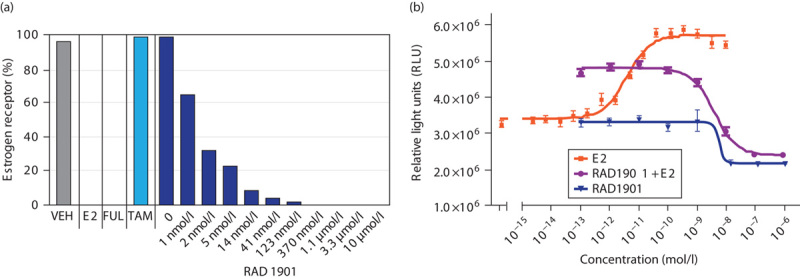
Effects of RAD1901 on proliferation and ERα expression in cultured MCF-7 cells. (a) ERα expression in MCF-7 cells after 48 h in the presence of vehicle (0.1% DMSO), E2 (1 nmol/l), fulvestrant (100 nmol/l), tamoxifen (1 µmol/l), or RAD1901 (10 µmol/l to 0.5 nmol/l). Levels of ERα receptor expression are expressed as percent of vehicle control. (b) For proliferation assays, MCF-7 cells were treated for 48 h in the presence of increasing concentrations of E2, RAD1901, or RAD1901 in the presence of 10 pmol/l E2. DMSO, dimethyl sulfoxide; ERα, estrogen receptor-α; FUL, fulvestrant; TAM, tamoxifen; VEH, vehicle.
Fig. 3
Fig. 3
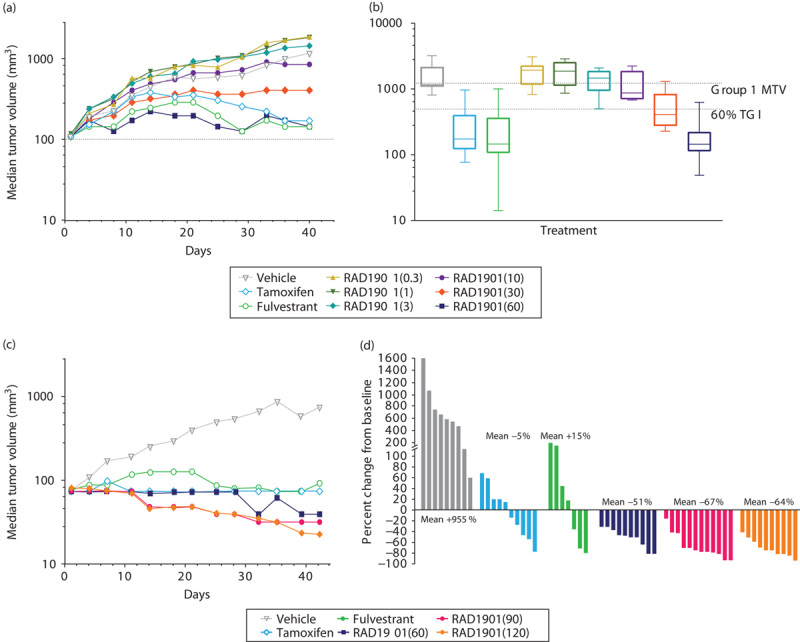
Dose-dependent inhibition of tumor growth by RAD1901 in an MCF-7 mouse xenograft model. Female nude mice were implanted with 1×10⁷ MCF-7 cells subcutaneously in the right flank. Fourteen days after implantation, tumor volumes were recorded and treatment was initiated with vehicle, tamoxifen (1 mg/animal every other day), fulvestrant (0.5 mg/animal daily), or RAD1901 (0.3, 1, 3, 10, 30, 60, 90, and 120 mg/kg daily). Tumor volume was evaluated twice per week until the study endpoint. (a) Mean tumor volumes over time for daily doses of 0.3, 1, 3, 10, 30, 60 mg/kg RAD1901, tamoxifen, and fulvestrant. (b) Box and whisker plots show the day 40 tumor volume by group. The box represents the 25th through 75th percentiles of observations, the line represents the mean of the observations, and the whiskers represent the extreme observations. (c) Mean tumor volumes over time for daily doses of 60, 90, and 120 mg/kg RAD1901, tamoxifen, and fulvestrant. (d) Tumor volumes from individual animals at day 42, with the mean percent change detailed for each group.
Fig. 4
Fig. 4
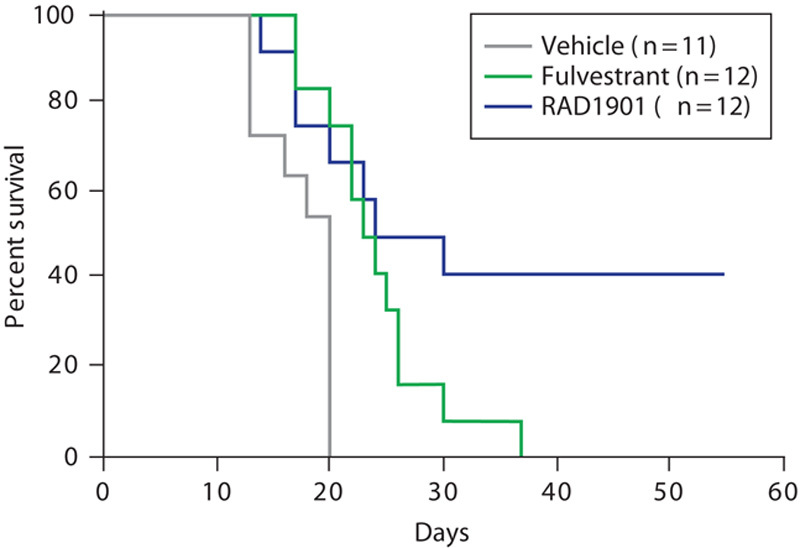
Effect of RAD1901 on mouse survival in an intracranial MCF-7 tumor model. Female nude mice were implanted with 1×10⁶ MCF-7 cells intracranially. Five days after tumor cell implantation (designated as day 1 of the study), mice were randomized into three groups of 12 animals each and treated with vehicle, fulvestrant (0.5 mg/animal daily), or RAD1901 (120 mg/kg daily).
Fig. 5
Fig. 5
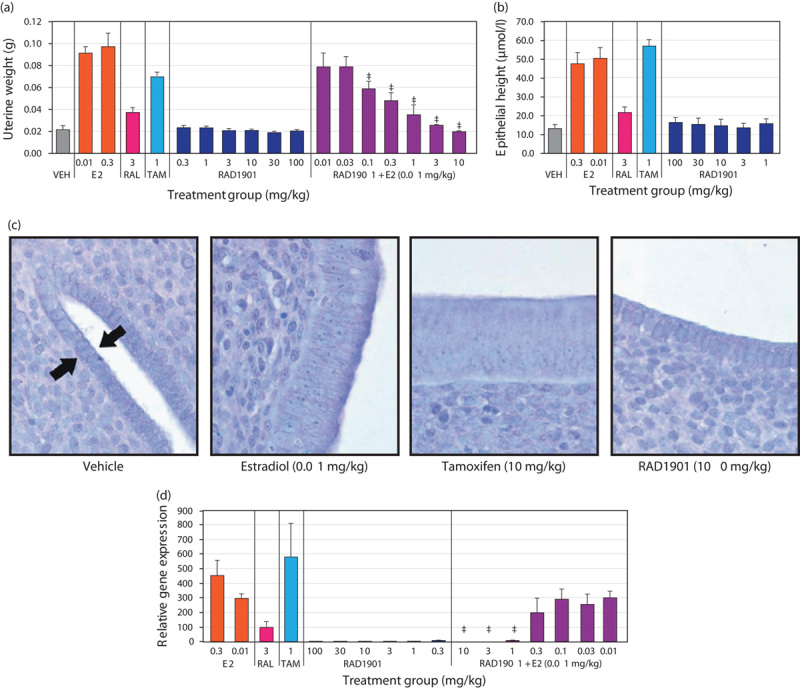
Effect of RAD1901 on uterine tissue. Newly weaned female Sprague–Dawley rats were treated with vehicle, E2 (0.01 mg/kg), raloxifene (3 mg/kg), tamoxifen (1 mg/kg), RAD1901 alone (0.3 to 100 mg/kg), or RAD1901 (0.01 to 10 mg/kg) in combination with E2 (0.01 mg/kg) once daily for three consecutive days. (a) Twenty-four hours after the final dose, rats were killed and uterine wet weights were recorded in grams. (b) Epithelial height was quantified in tissue sections of the uterus. (c) Representative sections of Toluidine Blue O-stained uterine tissue at ×400 magnification. Arrows indicate the uterine epithelium. (d) Total RNA was extracted from uterine tissue and analyzed by quantitative RT-PCR for the level of complement C3 expression relative to the 18S ribosomal RNA housekeeping gene. Data are expressed as mean±SD. *P<0.05 versus vehicle. P<0.05 versus E2. E2, estradiol, RAL, raloxifene; TAM, tamoxifen; VEH, vehicle.

References

    1. Yager JD, Davidson NE. Estrogen carcinogenesis in breast cancer. N Engl J Med 2006; 354:270–282. - PubMed
    1. Ariazi EA, Ariazi JL, Cordera F, Jordan VC. Estrogen receptors as therapeutic targets in breast cancer. Curr Top Med Chem 2006; 6:181–202. - PubMed
    1. Stein RA, McDonnell DP. Estrogen-related receptor alpha as a therapeutic target in cancer. Endocr Relat Cancer 2006; 13 (Suppl 1):S25–S32. - PubMed
    1. Yue W, Yager JD, Wang JP, Jupe ER, Santen RJ. Estrogen receptor-dependent and independent mechanisms of breast cancer carcinogenesis. Steroids 2013; 78:161–170. - PubMed
    1. Stingl J. Estrogen and progesterone in normal mammary gland development and in cancer. Horm Cancer 2011; 2:85–90. - PMC - PubMed

Publication types

MeSH terms

Substances