. 2015 Nov;21(11):877-84.
doi: 10.1016/j.cardfail.2015.06.381. Epub 2015 Jul 9.

Cardiomyopathy Phenotypes and Outcomes for Children With Left Ventricular Myocardial Noncompaction: Results From the Pediatric Cardiomyopathy Registry

Affiliations

Cardiomyopathy Phenotypes and Outcomes for Children With Left Ventricular Myocardial Noncompaction: Results From the Pediatric Cardiomyopathy Registry

John L Jefferies et al. J Card Fail. 2015 Nov.

Abstract

Background: Left ventricular noncompaction (LVNC) is a distinct form of cardiomyopathy characterized by hypertrabeculation of the left ventricle. The LVNC phenotype may occur in isolation or with other cardiomyopathy phenotypes. Prognosis is incompletely characterized in children.

Methods and results: According to diagnoses from the National Heart, Lung, and Blood Institute-funded Pediatric Cardiomyopathy Registry from 1990 to 2008, 155 of 3,219 children (4.8%) had LVNC. Each LVNC patient was also classified as having an associated echocardiographically diagnosed cardiomyopathy phenotype: dilated (DCM), hypertrophic (HCM), restrictive (RCM), isolated, or indeterminate. The time to death or transplantation differed among the phenotypic groups (P = .035). Time to listing for cardiac transplantation significantly differed by phenotype (P < .001), as did time to transplantation (P = .015). The hazard ratio for death/transplantation (with isolated LVNC as the reference group) was 4.26 (95% confidence interval [CI] 0.78-23.3) for HCM, 6.35 (95% CI 1.52-26.6) for DCM, and 5.66 (95% CI 1.04-30.9) for the indeterminate phenotype. Most events occurred in the 1st year after diagnosis.

Conclusions: LVNC is present in at least 5% of children with cardiomyopathy. The specific LVNC-associated cardiomyopathy phenotype predicts the risk of death or transplantation and should inform clinical management.

Keywords: Cardiomyopathy; heart failure; pediatrics.


Figures

Figure 1
Figure 1. Kaplan-Meier estimates of time to death, listing for cardiac transplant or cardiac transplant in children with left ventricular noncompaction by associated cardiomyopathy phenotype
LVNC = left ventricular noncompaction; Unk Pheno = unknown phenotype. Figure 1a. Kaplan-Meier estimates of time to death or cardiac transplant in 155 children with left ventricular noncompaction, by associated cardiomyopathy phenotype (logrank P = 0.035). The curves are truncated at 6 years Figure 1b. Kaplan-Meier estimates of time of listing–free survival in 155 children with left ventricular noncompaction by associated cardiomyopathy phenotype (logrank P = 0.009). The curves are truncated at 6 years. Figure 1c. Kaplan-Meier estimates of time to death in 155 children with left ventricular noncompaction, by associated cardiomyopathy phenotype (logrank P = 0.347). The curves are truncated at 6 years. Figure 1d. Kaplan-Meier estimates of time to cardiac transplant in 155 children with left ventricular noncompaction, by associated cardiomyopathy phenotype (logrank P = 0.015). The curves are truncated at 6 years.
Figure 1
Figure 1. Kaplan-Meier estimates of time to death, listing for cardiac transplant or cardiac transplant in children with left ventricular noncompaction by associated cardiomyopathy phenotype
LVNC = left ventricular noncompaction; Unk Pheno = unknown phenotype. Figure 1a. Kaplan-Meier estimates of time to death or cardiac transplant in 155 children with left ventricular noncompaction, by associated cardiomyopathy phenotype (logrank P = 0.035). The curves are truncated at 6 years Figure 1b. Kaplan-Meier estimates of time of listing–free survival in 155 children with left ventricular noncompaction by associated cardiomyopathy phenotype (logrank P = 0.009). The curves are truncated at 6 years. Figure 1c. Kaplan-Meier estimates of time to death in 155 children with left ventricular noncompaction, by associated cardiomyopathy phenotype (logrank P = 0.347). The curves are truncated at 6 years. Figure 1d. Kaplan-Meier estimates of time to cardiac transplant in 155 children with left ventricular noncompaction, by associated cardiomyopathy phenotype (logrank P = 0.015). The curves are truncated at 6 years.
Figure 1
Figure 1. Kaplan-Meier estimates of time to death, listing for cardiac transplant or cardiac transplant in children with left ventricular noncompaction by associated cardiomyopathy phenotype
LVNC = left ventricular noncompaction; Unk Pheno = unknown phenotype. Figure 1a. Kaplan-Meier estimates of time to death or cardiac transplant in 155 children with left ventricular noncompaction, by associated cardiomyopathy phenotype (logrank P = 0.035). The curves are truncated at 6 years Figure 1b. Kaplan-Meier estimates of time of listing–free survival in 155 children with left ventricular noncompaction by associated cardiomyopathy phenotype (logrank P = 0.009). The curves are truncated at 6 years. Figure 1c. Kaplan-Meier estimates of time to death in 155 children with left ventricular noncompaction, by associated cardiomyopathy phenotype (logrank P = 0.347). The curves are truncated at 6 years. Figure 1d. Kaplan-Meier estimates of time to cardiac transplant in 155 children with left ventricular noncompaction, by associated cardiomyopathy phenotype (logrank P = 0.015). The curves are truncated at 6 years.
Figure 1
Figure 1. Kaplan-Meier estimates of time to death, listing for cardiac transplant or cardiac transplant in children with left ventricular noncompaction by associated cardiomyopathy phenotype
LVNC = left ventricular noncompaction; Unk Pheno = unknown phenotype. Figure 1a. Kaplan-Meier estimates of time to death or cardiac transplant in 155 children with left ventricular noncompaction, by associated cardiomyopathy phenotype (logrank P = 0.035). The curves are truncated at 6 years Figure 1b. Kaplan-Meier estimates of time of listing–free survival in 155 children with left ventricular noncompaction by associated cardiomyopathy phenotype (logrank P = 0.009). The curves are truncated at 6 years. Figure 1c. Kaplan-Meier estimates of time to death in 155 children with left ventricular noncompaction, by associated cardiomyopathy phenotype (logrank P = 0.347). The curves are truncated at 6 years. Figure 1d. Kaplan-Meier estimates of time to cardiac transplant in 155 children with left ventricular noncompaction, by associated cardiomyopathy phenotype (logrank P = 0.015). The curves are truncated at 6 years.
Figure 2
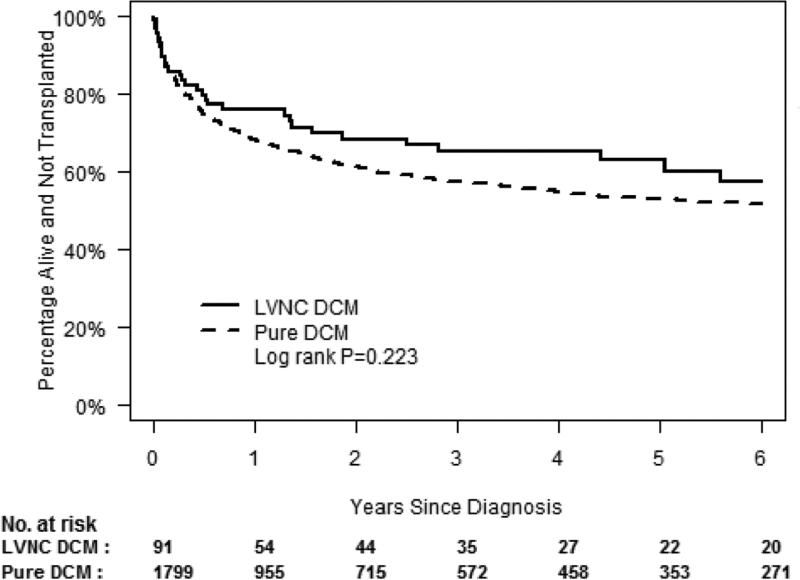
Figure 2. Kaplan- Meier estimates of time to death or cardiac transplant in children with DCM vs. children with LVNC and an associated DCM phenotype
Kaplan-Meier estimates of time to death or cardiac transplant in 1799 children with dilated cardiomyopathy (DCM) vs. 91 children with left ventricular noncompaction (LVNC) and a DCM phenotype (logrank P = 0.223). The curves are truncated at 6 years. The DCM without LVNC comparison group was comprised of all PCMR patients with that phenotype at baseline.
Figure 3
Figure 3. Kaplan-Meier estimates of time to death or cardiac transplant in children with HCM vs. children with LVNC and an associated HCM phenotype
Kaplan-Meier estimates of time to death or cardiac transplant in 778 children with idiopathic or familial isolated hypertrophic cardiomyopathy (HCM) vs. 17 children with left ventricular noncompaction (LVNC) and an HCM phenotype (logrank P = 0.018). The curves are truncated at 6 years. The HCM without LVNC comparison group was comprised of all PCMR patients with that phenotype at baseline.

References

    1. Maron BJ, Towbin JA, Thiene G, Antzelevitch C, Corrado D, Arnett D, et al. Contemporary definitions and classification of the cardiomyopathies: an American Heart Association Scientific Statement from the Council on Clinical Cardiology, Heart Failure and Transplantation Committee; Quality of Care and Outcomes Research and Functional Genomics and Translational Biology Interdisciplinary Working Groups; and Council on Epidemiology and Prevention. Circulation. 2006;113:1807–16. - PubMed
    1. Richardson P, McKenna W, Bristow M, Maisch B, Mautner B, O'Connell J, et al. Report of the 1995 World Health Organization/International Society and Federation of Cardiology Task Force on the Definition and Classification of Cardiomyopathies. Circulation. 1996;93:841–2. - PubMed
    1. Tigen K, Karaahmet T, Gurel E, Cevik C, Basaran Y. Biventricular noncompaction: a case report. Echocardiography. 2008;25:993–6. - PubMed
    1. Sarma RJ, Chana A, Elkayam Left ventricular noncompaction. Prog Cardiovasc Dis. 2010;52:264–73. - PubMed
    1. Dusek J, Ostadal B, Duskova M. Postnatal persistence of spongy myocardium with embryonic blood supply. Arch Pathol. 1975;99:312–7. - PubMed

Publication types

MeSH terms