


Minimal clinically important difference on the Beck Depression Inventory--II according to the patient's perspective
- PMID: 26165748
- PMCID: PMC4611356
- DOI: 10.1017/S0033291715001270
Minimal clinically important difference on the Beck Depression Inventory--II according to the patient's perspective
Abstract
Background: The Beck Depression Inventory, 2nd edition (BDI-II) is widely used in research on depression. However, the minimal clinically important difference (MCID) is unknown. MCID can be estimated in several ways. Here we take a patient-centred approach, anchoring the change on the BDI-II to the patient's global report of improvement.
Method: We used data collected (n = 1039) from three randomized controlled trials for the management of depression. Improvement on a 'global rating of change' question was compared with changes in BDI-II scores using general linear modelling to explore baseline dependency, assessing whether MCID is best measured in absolute terms (i.e. difference) or as percent reduction in scores from baseline (i.e. ratio), and receiver operator characteristics (ROC) to estimate MCID according to the optimal threshold above which individuals report feeling 'better'.
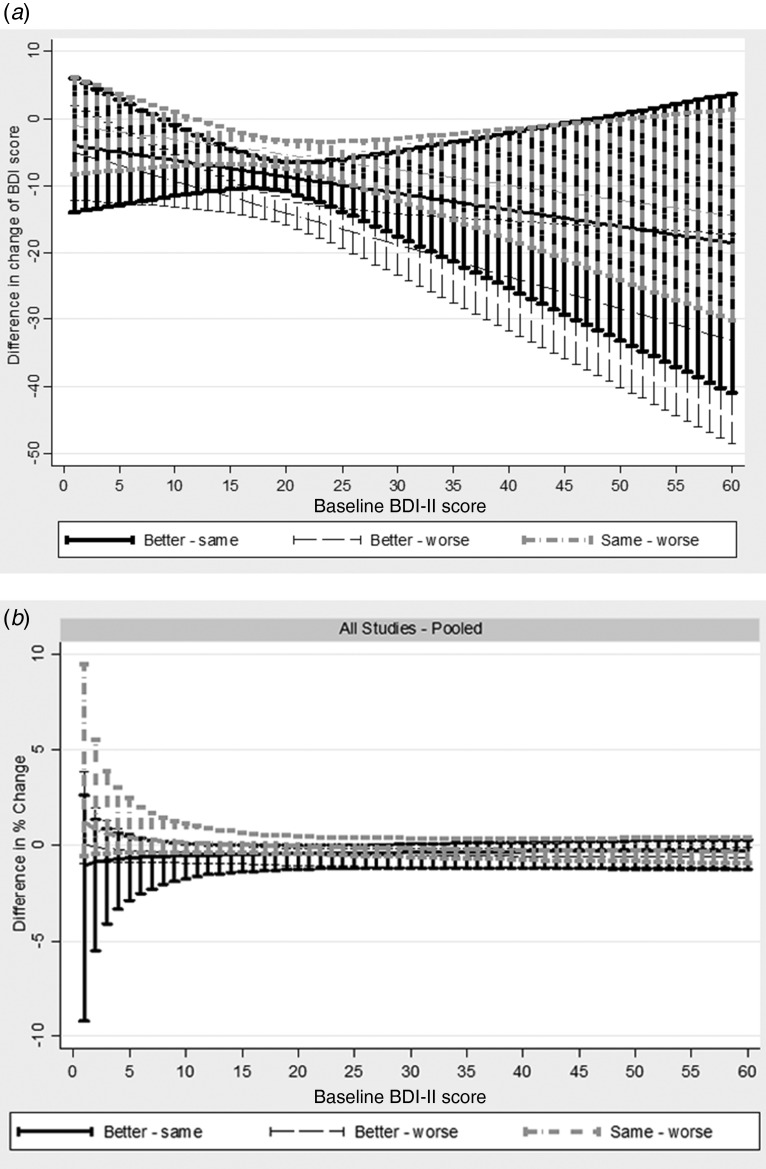
Results: Improvement in BDI-II scores associated with reporting feeling 'better' depended on initial depression severity, and statistical modelling indicated that MCID is best measured on a ratio scale as a percentage reduction of score. We estimated a MCID of a 17.5% reduction in scores from baseline from ROC analyses. The corresponding estimate for individuals with longer duration depression who had not responded to antidepressants was higher at 32%.
Conclusions: MCID on the BDI-II is dependent on baseline severity, is best measured on a ratio scale, and the MCID for treatment-resistant depression is larger than that for more typical depression. This has important implications for clinical trials and practice.
Keywords: 2nd edition (BDI-II); Beck Depression Inventory; depression; minimal clinically important difference; outcome assessment; primary care.
Figures
References
-
- APA (1994). Diagnostic and Statistical Manual of Mental Disorders, 4th edn (DSM-IV). American Psychiatric Association: Washington, DC.
-
- Beck A, Steer RA, Brown GK (1996). Beck Depression Inventory – Second Edition: Manual. The Psychological Corporation: San Antonio, TX.
-
- Chalder M, Wiles NJ, Campbell J, Hollinghurst SP, Haase AM, Taylor AH, Fox KR, Costelloe C, Searle A, Baxter H, Winder R, Wright C, Turner KM, Calnan M, Lawlor DA, Peters TJ, Sharp DJ, Montgomery AA, Lewis G (2012). Facilitated physical activity as a treatment for depressed adults: randomised controlled trial. British Medical Journal 344, . - PMC - PubMed
-
- Claeskens G, Hjort NL (2008). Model Selection and Model Averaging. Cambridge University Press: Cambridge.
-
- D'Agostino RB, Weintraub M (1995). Meta-analysis: a method for synthesizing research. Clinical Pharmacology and Therapeutics 58, 605–616. - PubMed
Publication types
MeSH terms
Grants and funding
LinkOut - more resources
Full Text Sources
Medical
