Review
. 2016 Jan;167(1):7-34.
doi: 10.1016/j.trsl.2015.06.011. Epub 2015 Jun 23.

Targeting heme oxygenase-1 and carbon monoxide for therapeutic modulation of inflammation

Affiliations
Review

Targeting heme oxygenase-1 and carbon monoxide for therapeutic modulation of inflammation

Stefan W Ryter et al. Transl Res. 2016 Jan.

Abstract

The heme oxygenase-1 (HO-1) enzyme system remains an attractive therapeutic target for the treatment of inflammatory conditions. HO-1, a cellular stress protein, serves a vital metabolic function as the rate-limiting step in the degradation of heme to generate carbon monoxide (CO), iron, and biliverdin-IXα (BV), the latter which is converted to bilirubin-IXα (BR). HO-1 may function as a pleiotropic regulator of inflammatory signaling programs through the generation of its biologically active end products, namely CO, BV and BR. CO, when applied exogenously, can affect apoptotic, proliferative, and inflammatory cellular programs. Specifically, CO can modulate the production of proinflammatory or anti-inflammatory cytokines and mediators. HO-1 and CO may also have immunomodulatory effects with respect to regulating the functions of antigen-presenting cells, dendritic cells, and regulatory T cells. Therapeutic strategies to modulate HO-1 in disease include the application of natural-inducing compounds and gene therapy approaches for the targeted genetic overexpression or knockdown of HO-1. Several compounds have been used therapeutically to inhibit HO activity, including competitive inhibitors of the metalloporphyrin series or noncompetitive isoform-selective derivatives of imidazole-dioxolanes. The end products of HO activity, CO, BV and BR may be used therapeutically as pharmacologic treatments. CO may be applied by inhalation or through the use of CO-releasing molecules. This review will discuss HO-1 as a therapeutic target in diseases involving inflammation, including lung and vascular injury, sepsis, ischemia-reperfusion injury, and transplant rejection.


Figures

Figure 1
Figure 1
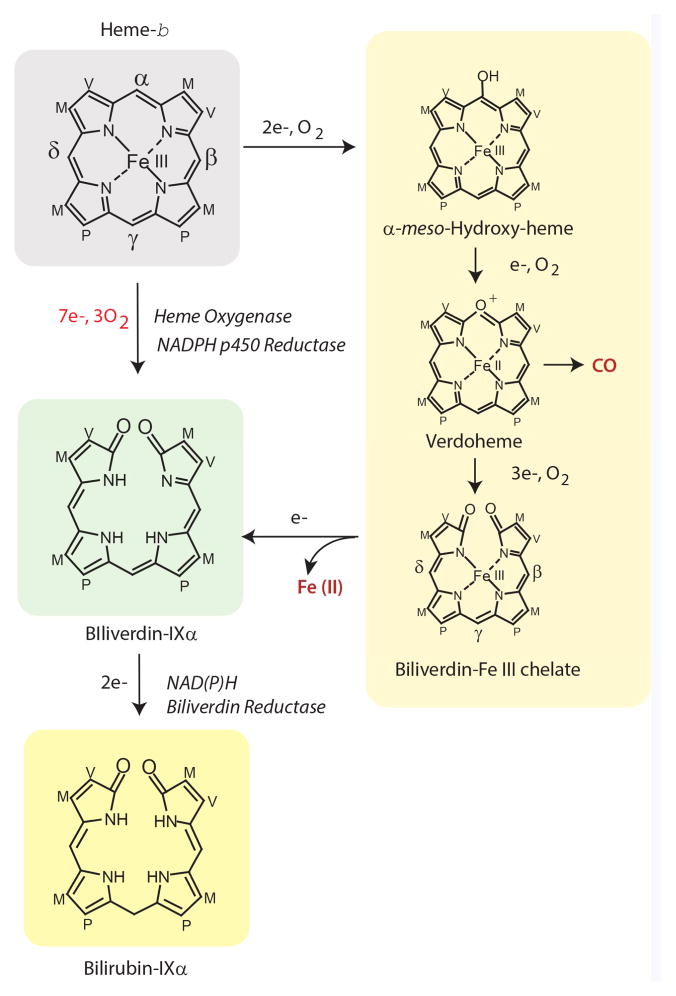
The heme oxygenase (HO) reaction cleaves heme at the α-methene bridge carbon and generates carbon monoxide (CO), biliverdin-IXα. and ferrous iron (Fe II). The reaction proceeds through three sequential oxidation steps each requiring one mole of molecular oxygen (O2), and a total of seven electrons from NADPH: cytochrome p450 reductase. Three reaction intermediates have been proposed: α-meso-hydroxyheme, verdoheme, and the Fe (III)-biliverdin complex. Upon univalent reduction, the Fe (III)-biliverdin complex dissociates to form biliverdin-IXα and free Fe (II). The completion of enzymatic heme degradation involves the divalent reduction of biliverdin-IXα by NAD(P)H: biliverdin reductase (BVR; E.C. 1.3.1.24), which produces the lipid soluble pigment bilirubin-IXα. Heme side chains are designated: M=Methyl, V=Vinyl, P=Propionate.
Figure 2
Figure 2
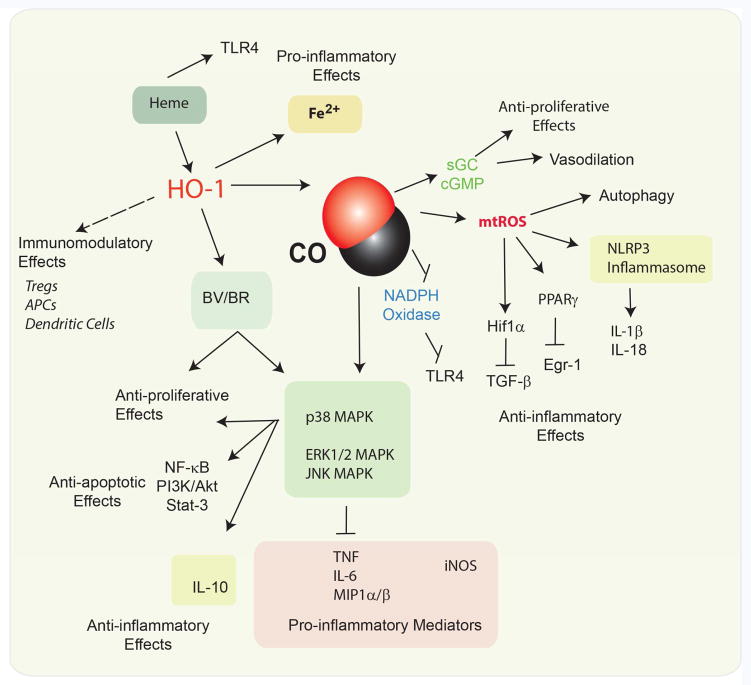
Pivotal Functions of HO-1 in inflammation. HO-1 may have immunomodulatory effects with respect to regulating the functions of antigen presenting cells, dendritic cells, and regulatory T-cells. Heme may exert pro-inflammatory effects. HO-1 end products generated from heme degradation may modulate inflammation. Iron release from HO activity may be pro-inflammatory in the case of excess activation, and has been associated with neurodegenerative diseases. CO whether endogenously produced or applied as a pharmacological treatment, has been shown to modulate apoptotic, proliferative, and inflammatory cellular programs. In particular, CO can downregulate the production of pro-inflammatory cytokines (e.g., IL-1β, IL-6, TNFα, Mip1α/β, and upregulate the anti-inflammatory cytokines (IL-10). These effects were attributed to alterations of MAPK activities including p38 MAPK. CO can stimulate mitochondrial ROS production, which can promote the autophagy program, activate HIF-1α, and downregulate pro-inflammatory transcription factor Egr1. Recent evidence also suggests that CO can modulate the activation of the NLRP3 inflammasome, which regulates the production of IL-1β, and IL-18. BR, a product of heme degaradtion, also may exert anti-inflammatory and anti-proliferative effects.
Figure 3
Figure 3
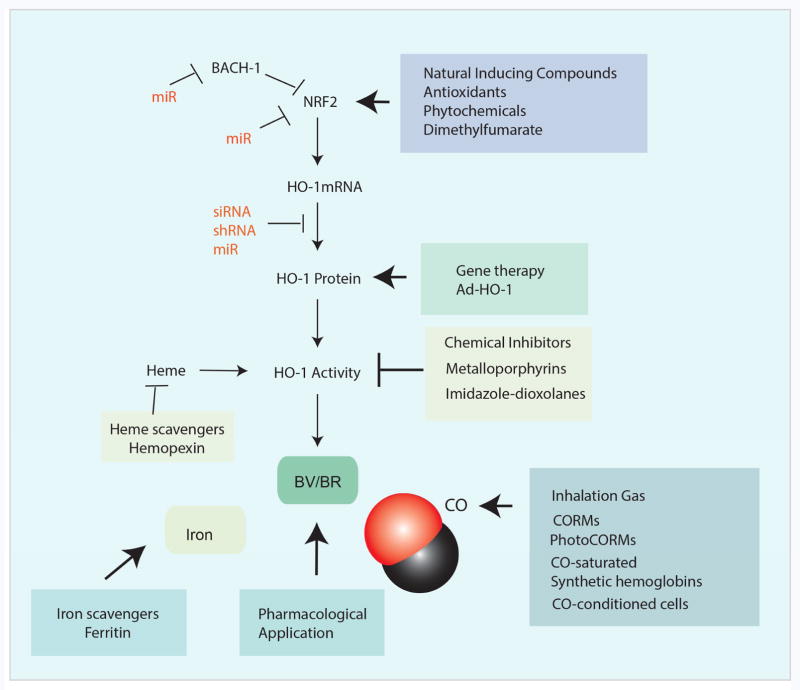
Therapeutic modulation of the HO-1/CO system. HO-1 can be upregulated by natural antioxidants which act upon the NRF2/Keap1 system to upregulate the transcription of the Hmox1 gene. The application of antioxidant compounds may represent a possible strategy for therapeutic manipulation of HO-1. Gene therapy approaches using retroviral vectors may be used to upregulate HO-1. HO-1 is subject to natural up or downregulation through mIRs that target Hmox1 or other genes involved in its regulation (Bach1, Nrf2). The targeted expression of specific mIRs may also be combined with gene therapy approaches. Several compounds have been used therapeutically to inhibit HO activity. These include competitive inhibitors of the metaloporphyrin series, or non-competitive isoform selective derivatives of imidazole-dioxolanes. The end-products of HO activity, namely BV or BR, and CO may be used therapeutically as pharmological reagents. CO may be applied by inhalation, or through the use of CO releasing molecules (CORMs and PhotoCORMs). Additional therapeutic strategies involving CO include CO-saturated hemoglobins, or the use of CO preconditioned cells for cell based therapy. Furthermore, the removal of hemoglobin/heme or iron by scavenger compounds or chelation, respectively, have been proposed as intervention strategies.
Figure 4
Figure 4
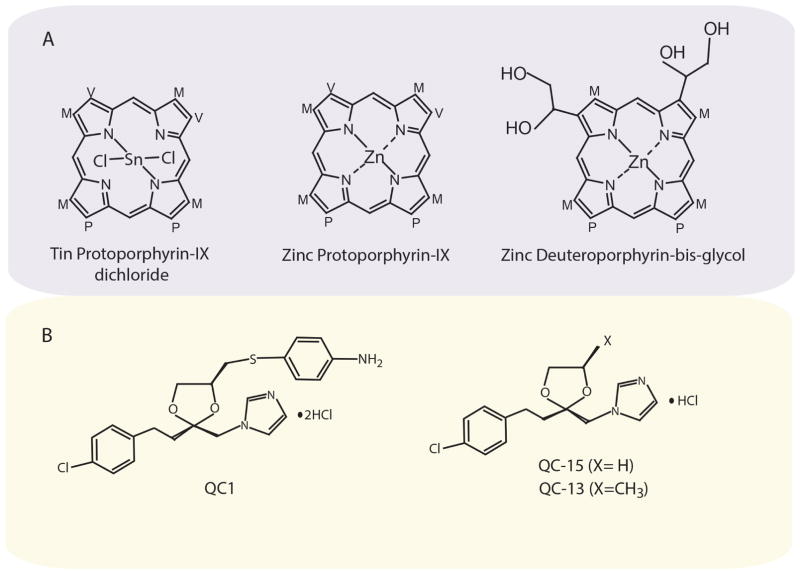
Structures of HO inhibitor compounds. (Top) Representative metalloporphyrin compounds that act as competitive inhibitors of HO activity. Tin protoporphyrin IX (SnPPIX), Zinc Protoporphyrin (ZnPPIX), and Zinc Deuteroporphyrin Bis Glycol (ZnDPBG). (Bottom) Representative imidazole-dioxolanes that act as non-competitive inhibitors of HO activity. QC-1: (azalanstat) (2S,4S)-2-[2-(4-chlorophenyl)ethyl]-2-[(1H-imidazol-1-yl)methyl]-4-[((4-aminophenyl)thio)methyl]-1,3-dioxolane. QC-13: (2R,4R)-2-[2-(4-chlorophenyl)ethyl]-2-[(1H-imidazol-1-yl)methyl]-4-methyl-1,3-dioxolane hydrochloride QC-15: (2R,4R)-2-[2-(4-chlorophenyl)ethyl]-2-[(1H-imidazol-1-yl)methyl]-1,3-dioxolane hydrochloride.

References

    1. Ryter SW, Choi AM. Heme oxygenase-1/carbon monoxide: from metabolism to molecular therapy. Am J Respir Cell Mol Biol. 2009;41:251–260. - PMC - PubMed
    1. Tenhunen R, Marver HS, Schmid R. The enzymatic conversion of heme to bilirubin by microsomal heme oxygenase. Proc Natl Acad Sci USA. 1968;61:748–755. - PMC - PubMed
    1. Tenhunen R, Marver HS, Schmid R. Microsomal heme oxygenase. Characterization of the enzyme. J Biol Chem. 1969;244:6388–6394. - PubMed
    1. Maines MD. Heme oxygenase: function, multiplicity, regulatory mechanisms, and clinical applications. FASEB J. 1988;2:2557–2568. - PubMed
    1. Alam J, Shibahara S, Smith A. Transcriptional activation of the heme oxygenase gene by heme and cadmium in mouse hepatoma cells. J Biol Chem. 1989;264:6371–6375. - PubMed

Publication types