


The effect of drill-generated noise in the contralateral healthy ear following mastoid surgery: The emphasis on hearing threshold recovery time
- PMID: 26168951
- PMCID: PMC4900484
- DOI: 10.4103/1463-1741.160691
The effect of drill-generated noise in the contralateral healthy ear following mastoid surgery: The emphasis on hearing threshold recovery time
Abstract
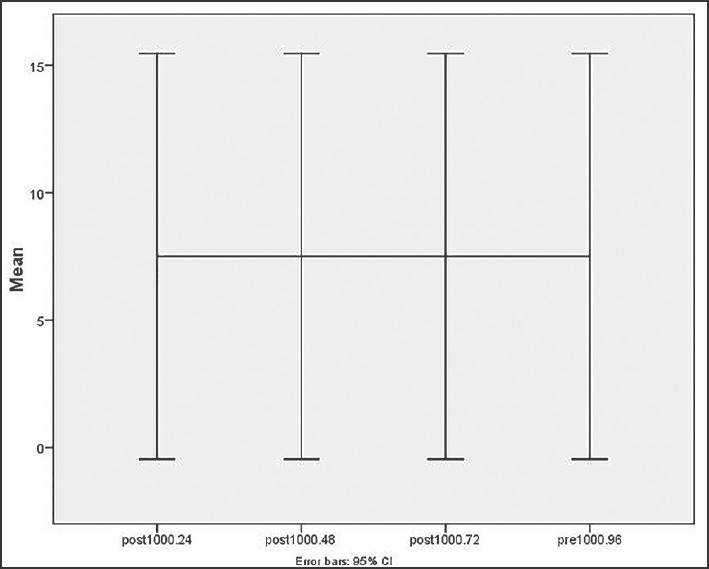
In mastoid surgeries, contralateral ear noise exposure is a known, identified factor leading to high-frequency hearing loss due to the wide variety of surgical devices that may be used during the surgery. However, the hearing threshold recovery time after this trauma was uncertain. The present study aimed to assess this time. In this prospective survival analysis study, 28 consecutive patients with chronic otitis media who were undergoing tympanomastoidectomy were assessed. Standard pure-tone audiometry (PTA) and distortion-product otoacoustic emission (DPOAE) were measured in all contralateral ears before and 6 h, 24 h, 48 h, 72 h, and 96 h after the surgery. Based on the PTA postoperative hearing loss, survival rates at frequencies of 3000 Hz, 4000 Hz, 6000 Hz, and 8000 Hz were 44.4%, 36.4%, 51.7%, and 47.4%, 24 h after surgery; 11.1%, 9.1%, 10.3%, and 13.2%, 48 h after surgery; and 0%, 0%, 3.4%, and 2.6%, 72 h after surgery, respectively. Based on the PTA and DPOAE, survival rates at all frequencies were 0%, 96 h after the surgery. According to the PTA, mean hearing recovery times were 61.98 ± 26.76 h (3000 Hz), 62.73 ± 26.50 h (4000 Hz), 67.08 ± 25.90 h (6000 Hz), 70.70 ± 24.13 h (8000 Hz), and with regard to DPOAE the recovery times were 58.58 ± 28.39 h (2000 Hz), 63.32 ± 28.83 h (4000 Hz), 65.22 ± 29.13 h (6000 Hz), and 75.14 ± 22.70 h (8000 Hz), respectively. To conclude, high-frequency hearing loss usually occurs following mastoid surgeries that is mainly temporary and reversible after 72 h.
Conflict of interest statement
Figures




References
-
- Kylén P, Stjernvall JE, Arlinger S. Variables affecting the drill-generated noise levels in ear surgery. Acta Otolaryngol. 1977;84:252–9. - PubMed
-
- Strömberg AK, Yin X, Olofsson A, Duan M. Evaluation of the usefulness of a silicone tube connected to a microphone in monitoring noise levels induced by drilling during mastoidectomy and cochleostomy. Acta Otolaryngol. 2010;130:1163–8. - PubMed
-
- Man A, Winerman I. Does drill noise during mastoid surgery affect the contralateral ear? Am J Otol. 1985;6:334–5. - PubMed
-
- Farzanegan G, Ghasemi M, Panahi F, Raza M, Alghasi M. Does drill-induced noise have an impact on sensorineural hearing during craniotomy procedure? Br J Neurosurg. 2010;24:40–5. - PubMed
-
- Kylén P, Arlinger S. Drill-generated noise levels in ear surgery. Acta Otolaryngol. 1976;82:402–9. - PubMed
MeSH terms
LinkOut - more resources
Full Text Sources
Other Literature Sources
Medical