


doi: 10.1007/s12471-015-0714-5.
Platypnoea-orthodeoxia syndrome, an underdiagnosed cause of hypoxaemia: four cases and the possible underlying mechanisms
Affiliations
- PMID: 26170192
- PMCID: PMC4608923
- DOI: 10.1007/s12471-015-0714-5
Item in Clipboard
Platypnoea-orthodeoxia syndrome, an underdiagnosed cause of hypoxaemia: four cases and the possible underlying mechanisms
Neth Heart J.
2015 Nov.
Abstract
Cardiac platypnoea-orthodeoxia syndrome (POS) is a position-dependent condition of dyspnoea and hypoxaemia due to right-to-left shunting. It often remains unrecognised in clinical practice, possibly because of its complex underlying pathophysiology. We present four consecutive patients with POS and patent foramen ovale (PFO) who underwent a successful percutaneous PFO closure, describe the mechanism of their POS and provide a review of the literature.
Keywords: Atrial septum; Dyspnoea; Foramen ovale, patent; Mechanism; Platypnoea-orthodeoxia.
Figures
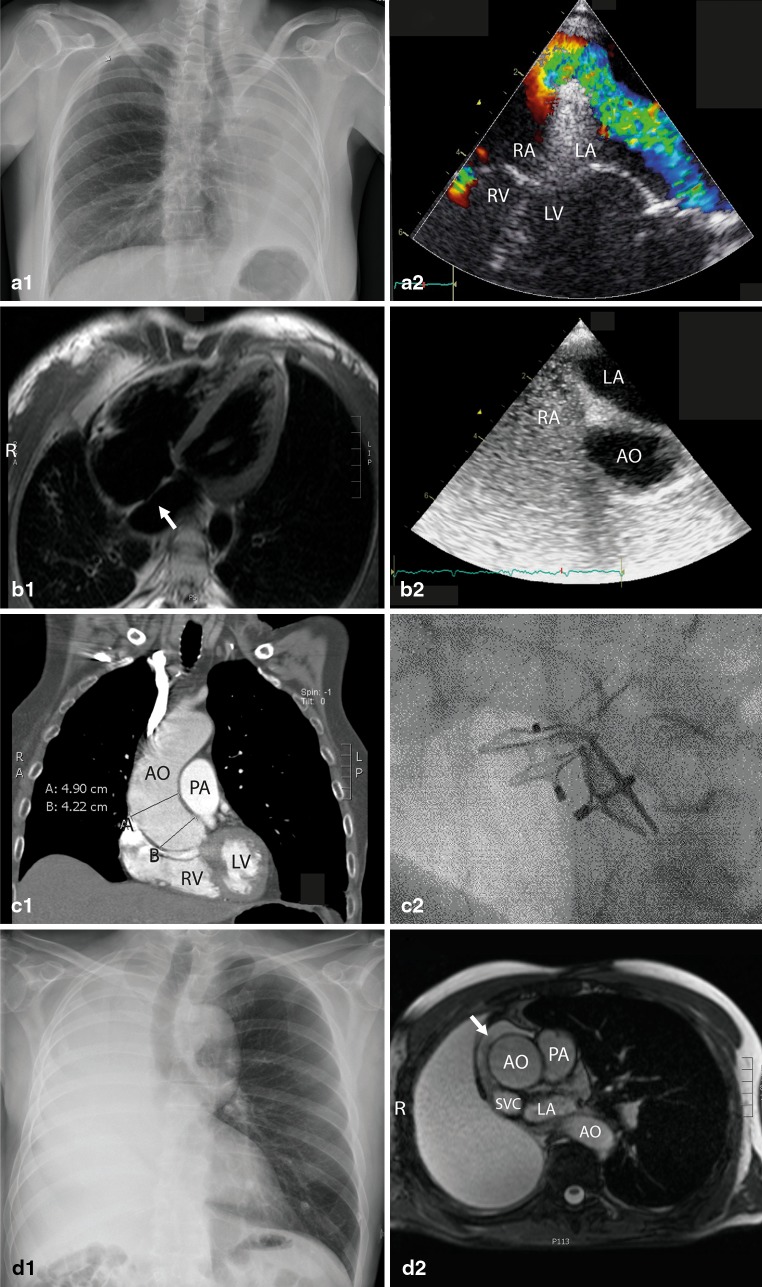
Different imaging modalities of case 1(a), 2 (b), 3(c) and 4 (d), respectively, for the purpose of diagnosing POS by PFO. a1 Chest X-ray showing the heart position against the left thoracic wall. a2 Four chamber view of a Doppler TEE with a right-to-left shunt by PFO. b1 CMR showing malposition of the right thoracic wall resulting in a heart shift to the right and presence of PFO (arrow). b2 Short axis basal view of a Bubble contrast TEE showing no resting right-to-left shunting over the PFO. c1 CT angiography showing the dilated ascending aorta (A) and aorta root (B). c2 Periprocedural angiographic image of both Amplatzer devices. d1 Chest X-ray showing a tracheal shift to the left after pneumonectomy. d2 CMR shows a right hemithorax filled with pleural effusion and a compressed right atrium (arrow). RA right atrium, LA left atrium, RV right ventricle, LV left ventricle, R right, AO aorta, PA pulmonary artery, SVC superior vena cava
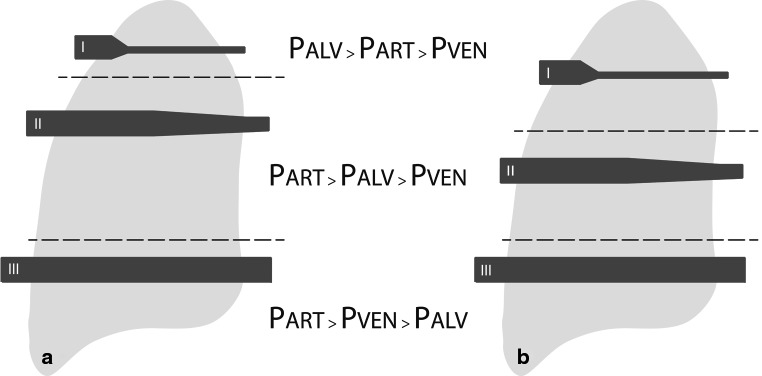
A physiological model of the pulmonary vasculature in the upright position in a normal lung (a) versus a lung post-pneumonectomy (b). Due to gravitation, in the upright position blood flow in the apex of the lung is physiologically prevented since alveolar pressure exceeds the pulmonary arteriolar pressure (pulmonary zone I phenomenon). A high pulmonary vascular resistance in the post-pneumonectomy situation causes an increase in right ventricular afterload. When right ventricular output reduces in the upright position, this afterload cannot be compensated. Consequently, pulmonary arteriolar pressure drops even more, causing a larger pulmonary zone I. I pulmonary zone I with restricted blood flow, II zone II with normal blood flow, III zone III with maximum blood flow; Palv alveolar pressure, Part arteriolar pressure, Pven venous pressure
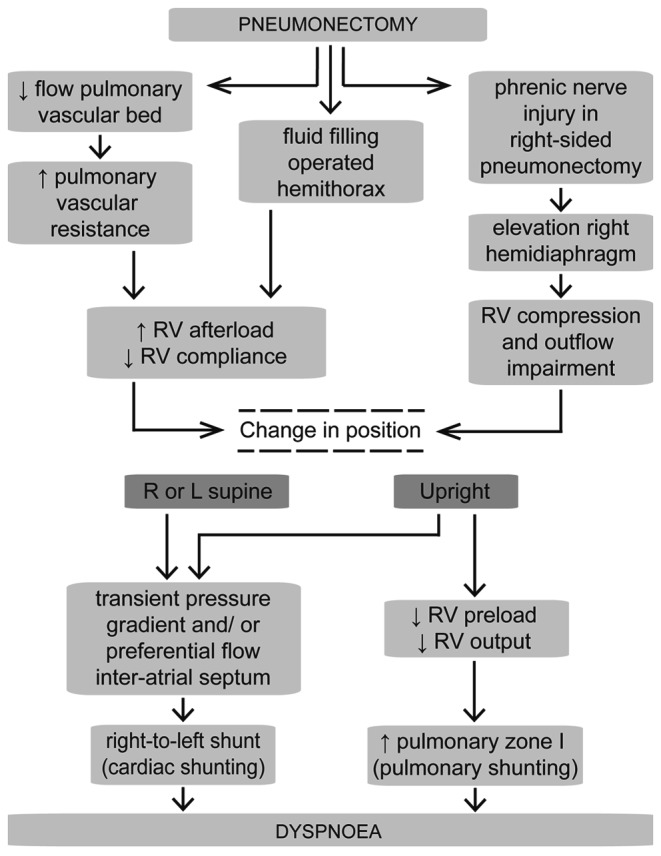
Schematic view of the haemodynamic mechanism explaining the position-dependent dyspnoea after pneumonectomy in case of an inter-atrial communication. Through several pathways pneumonectomy can result in dyspnoea by a position-dependent transient pressure gradient or an anatomical preferential flow across the inter-atrial septum. In the upright position gravity leads to additional pulmonary shunting. RV right ventricle, R right, L left
References
-
- Burchell HB, Helmholz HFJ, Wood EH. Reflex orthostatic dyspnea associated with pulmonary hypertension. Am J Physiol. 1949;159:563–4.
-
- Cheng TO. Mechanisms of platypnea-orthodeoxia: what causes water to flow uphill? Circulation. 2002;105(6):e47. - PubMed
LinkOut - more resources
Full Text Sources
Other Literature Sources
