


Novel applications of trophic factors, Wnt and WISP for neuronal repair and regeneration in metabolic disease
- PMID: 26170801
- PMCID: PMC4424733
- DOI: 10.4103/1673-5374.155427
Novel applications of trophic factors, Wnt and WISP for neuronal repair and regeneration in metabolic disease
Abstract
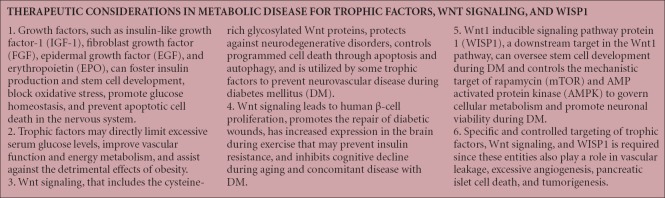
Diabetes mellitus affects almost 350 million individuals throughout the globe resulting in significant morbidity and mortality. Of further concern is the growing population of individuals that remain undiagnosed but are susceptible to the detrimental outcomes of this disorder. Diabetes mellitus leads to multiple complications in the central and peripheral nervous systems that include cognitive impairment, retinal disease, neuropsychiatric disease, cerebral ischemia, and peripheral nerve degeneration. Although multiple strategies are being considered, novel targeting of trophic factors, Wnt signaling, Wnt1 inducible signaling pathway protein 1, and stem cell tissue regeneration are considered to be exciting prospects to overcome the cellular mechanisms that lead to neuronal injury in diabetes mellitus involving oxidative stress, apoptosis, and autophagy. Pathways that involve insulin-like growth factor-1, fibroblast growth factor, epidermal growth factor, and erythropoietin can govern glucose homeostasis and are intimately tied to Wnt signaling that involves Wnt1 and Wnt1 inducible signaling pathway protein 1 (CCN4) to foster control over stem cell proliferation, wound repair, cognitive decline, β-cell proliferation, vascular regeneration, and programmed cell death. Ultimately, cellular metabolism through Wnt signaling is driven by primary metabolic pathways of the mechanistic target of rapamycin and AMP activated protein kinase. These pathways offer precise biological control of cellular metabolism, but are exquisitely sensitive to the different components of Wnt signaling. As a result, unexpected clinical outcomes can ensue and therefore demand careful translation of the mechanisms that govern neural repair and regeneration in diabetes mellitus.
Keywords: AMPK; Alzheimer's disease; CCN4; EGF; EPO; FGF; IGF-1; WISP1; Wnt; apoptosis; autophagy; central nervous system; diabetes mellitus; erythropoietin; mTOR; neuron; neuropathy; oxidative stress; psychiatric; stem cells.
Figures
References
-
- Aksu I, Ates M, Baykara B, Kiray M, Sisman AR, Buyuk E, Baykara B, Cetinkaya C, Gumus H, Uysal N. Anxiety correlates to decreased blood and prefrontal cortex IGF-1 levels in streptozotocin induced diabetes. Neurosci Lett. 2012;531:176–181. - PubMed
Publication types
LinkOut - more resources
Full Text Sources
Other Literature Sources
Research Materials
Miscellaneous