


doi: 10.4103/1673-5374.155414.
Oleanolic acid: a promising neuroprotective agent for cerebral ischemia
Affiliations
- PMID: 26170805
- PMCID: PMC4424737
- DOI: 10.4103/1673-5374.155414
Item in Clipboard
Oleanolic acid: a promising neuroprotective agent for cerebral ischemia
Neural Regen Res.
2015 Apr.
No abstract available
Figures
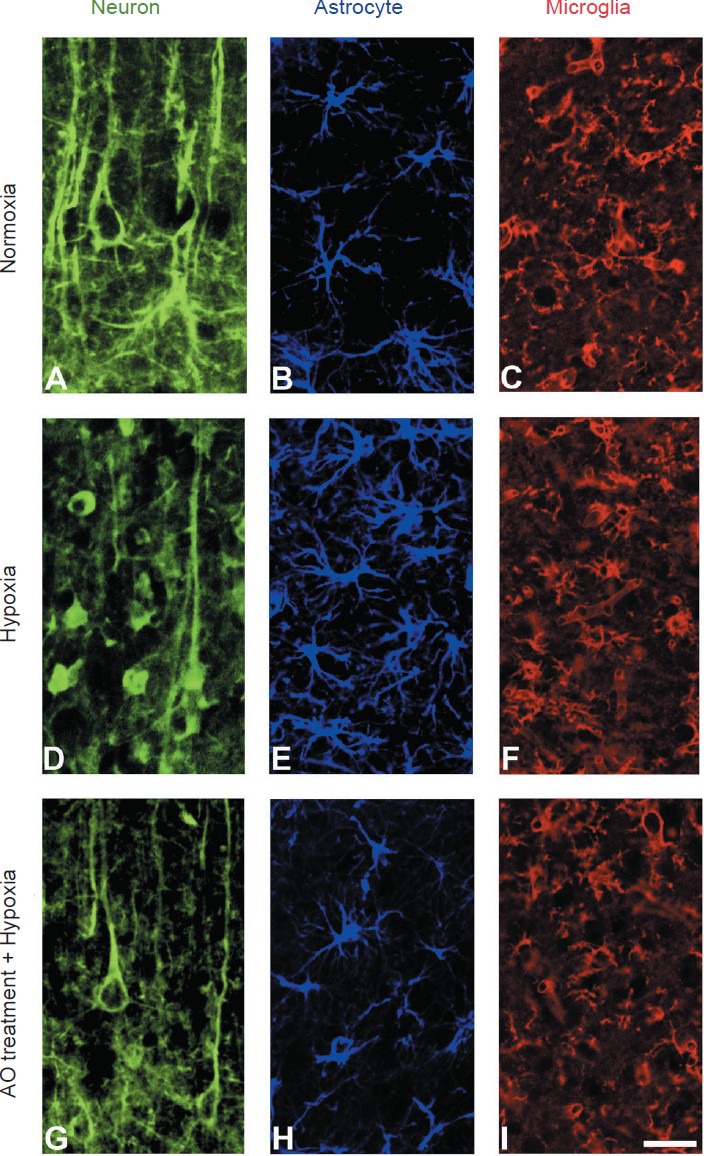
Photomicrographs showing neurons (A, D, G), astrocytes (B, E, H) and microglial cells (C, F, I) in different experimental conditions. Hypoxia induces neuronal degeneration with loss of dendritic trees (D) and glial reaction – astrocytosis (E) and microglial activation (F). The pretreatment with oleanolic acid (OA) decreases neuronal damage (G), astrocytic reaction (H) and microglial activation (I). (A–C) Normoxic conditions. (D–F) Hypoxic coditions. (G–I) Pretreatment with OA and hypoxic conditions. Immunofluorescence for 200 kDa neurofilaments in A, D, and G, and for gliofribrillary acidic protein in B, E and H. Histochemical staining for microglial cells (C, F and I) was made with tomato lectin. Scale bar: 15 μm.
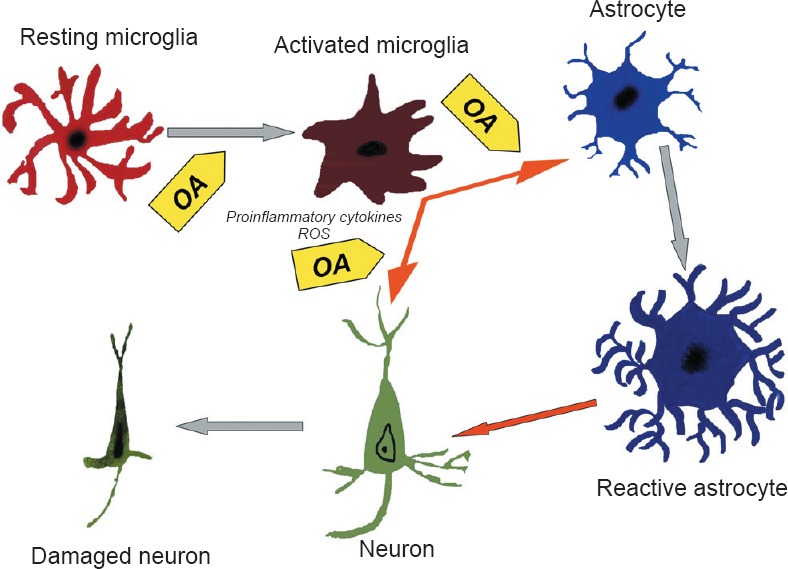
Schematic representation of cellular processes occurring in the hypoxic brain and the effects of oleanolic acid (OA) pretreatment. Hypoxia induces the activation of microglial cells, which suffer morphological transformations and become ameboid-shaped. The activated microglial cells release proinflammatory cytokines and reactive oxygen species (ROS) such as nitric oxide, which induce astroglial reaction and neuronal damage. OA reduces microglial reaction and then decreases astroglial reaction, thus protecting neuron morphology and function. Gray arrows indicate the effects of hypoxia on neurons, astrocytes and microglial cells. Orange arrows indicate inflammatory effects on nervous tissue cells. Yellow arrows indicate OA preventive effects.
References
-
- Caltana L, Rutolo D, Nieto ML, Brusco A. Further evidence for the neuroprotective role of oleanolic acid in a model of focal brain hypoxia in rats. Neurochem Int. 2014;79:79–87. - PubMed
-
- Camer D, Yu Y, Szabo A, Huang XF. The molecular mechanisms underpinning the therapeutic properties of oleanolic acid, its isomer and derivatives for type 2 diabetes and associated complications. Mol Nutr Food Res. 2014;58:1750–1759. - PubMed
-
- Go AS, Mozaffarian D, Roger VL, Benjamin EJ, Berry JD, Blaha MJ, Dai S, Ford ES, Fox CS, Franco S, Fullerton HJ, Gillespie C, Hailpern SM, Heit JA, Howard VJ, Huffman MD, Judd SE, Kissela BM, Kittner SJ, Lackland DT, et al. Heart disease and stroke statistics--2014 update: a report from the American Heart Association. Circulation. 2014;129:e28–292. - PMC - PubMed
-
- López-Miranda J, Pérez-Jiménez F, Ros E, De Caterina R, Badimón L, Covas MI, Escrich E, Ordovαs JM, Soriguer F, Abiα R, de la Lastra CA, Battino M, Corella D, Chamorro-Quirós J, Delgado-Lista J, Giugliano D, Esposito K, Estruch R, Fernandez-Real JM, Gaforio JJ, et al. Olive oil and health: summary of the II international conference on olive oil and health consensus report, Jaén and Córdoba (Spain) 2008. Nutr Metab Cardiovasc Dis. 2010;20:284–294. - PubMed
LinkOut - more resources
Full Text Sources
Other Literature Sources