


Barriers to uptake among high-risk individuals declining participation in lung cancer screening: a mixed methods analysis of the UK Lung Cancer Screening (UKLS) trial
- PMID: 26173719
- PMCID: PMC4513485
- DOI: 10.1136/bmjopen-2015-008254
Barriers to uptake among high-risk individuals declining participation in lung cancer screening: a mixed methods analysis of the UK Lung Cancer Screening (UKLS) trial
Abstract
Objective: The current study aimed to identify the barriers to participation among high-risk individuals in the UK Lung Cancer Screening (UKLS) pilot trial.
Setting: The UKLS pilot trial is a randomised controlled trial of low-dose CT (LDCT) screening that has recruited high-risk people using a population approach in the Cambridge and Liverpool areas.
Participants: High-risk individuals aged 50-75 years were invited to participate in UKLS. Individuals were excluded if a LDCT scan was performed within the last year, if they were unable to provide consent, or if LDCT screening was unable to be carried out due to coexisting comorbidities.
Outcome measures: Statistical associations between individual characteristics and UKLS uptake were examined using multivariable regression modelling. In those who completed a non-participation questionnaire (NPQ), thematic analysis of free-text data was undertaken to identify reasons for not taking part, with subsequent exploratory linkage of key themes to risk factors for non-uptake.
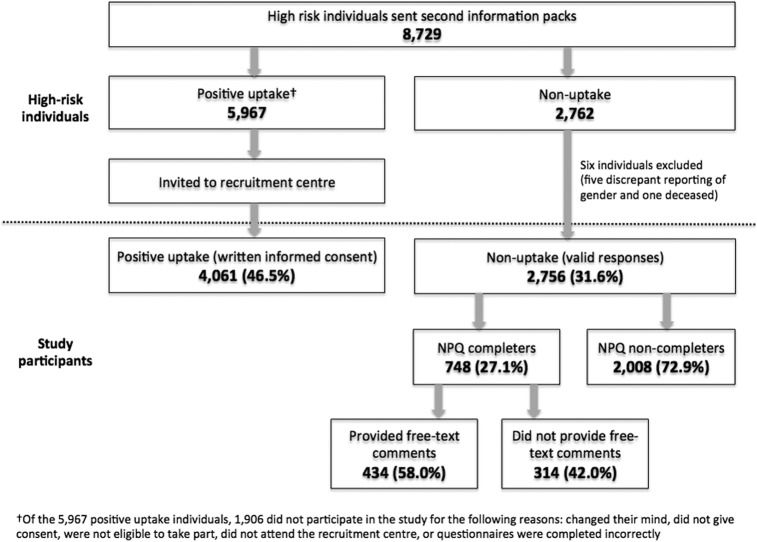
Results: Comparative data were available from 4061 high-risk individuals who consented to participate in the trial and 2756 who declined participation. Of those declining participation, 748 (27.1%) completed a NPQ. Factors associated with non-uptake included: female gender (OR=0.64, p<0.001), older age (OR=0.73, p<0.001), current smoking (OR=0.70, p<0.001), lower socioeconomic group (OR=0.56, p<0.001) and higher affective risk perception (OR=0.52, p<0.001). Among non-participants who provided a reason, two main themes emerged reflecting practical and emotional barriers. Smokers were more likely to report emotional barriers to participation.
Conclusions: A profile of risk factors for non-participation in lung screening has emerged, with underlying reasons largely relating to practical and emotional barriers. Strategies for engaging high-risk, hard-to-reach groups are critical for the equitable uptake of a potential future lung cancer screening programme.
Trial registration number: The UKLS trial was registered with the International Standard Randomised Controlled Trial Register under the reference 78513845.
Keywords: Barriers; High-risk; Lung cancer; Screening; UKLS.
Published by the BMJ Publishing Group Limited. For permission to use (where not already granted under a licence) please go to http://group.bmj.com/group/rights-licensing/permissions.
Figures
References
-
- Cancer Research UK . Lung cancer statistics 2014 [25 March 2014]. http://www.cancerresearchuk.org/cancer-info/cancerstats/types/lung/
-
- Takemura T, Sakai E, Kusumoto M et al. . Utility of helical CT for the secondary mass screening of lung cancer. Nihon Igaku Hoshasen Gakkai Zasshi 1992;52:1322–4. - PubMed
-
- Matsumoto M, Horikoshi H, Moteki T et al. . A pilot study with lung-cancer screening CT (LSCT) at the secondary screening for lung cancer detection. Nihon Igaku Hoshasen Gakkai Zasshi 1995;55:172–9. - PubMed
Publication types
MeSH terms
Associated data
Grants and funding
LinkOut - more resources
Full Text Sources
Other Literature Sources
Medical
