


doi: 10.1113/JP270269.
CrossTalk proposal: Fear of falling does influence vestibular-evoked balance responses
Affiliations
- PMID: 26173819
- PMCID: PMC4532514
- DOI: 10.1113/JP270269
Item in Clipboard
CrossTalk proposal: Fear of falling does influence vestibular-evoked balance responses
J Physiol.
.
No abstract available
Figures
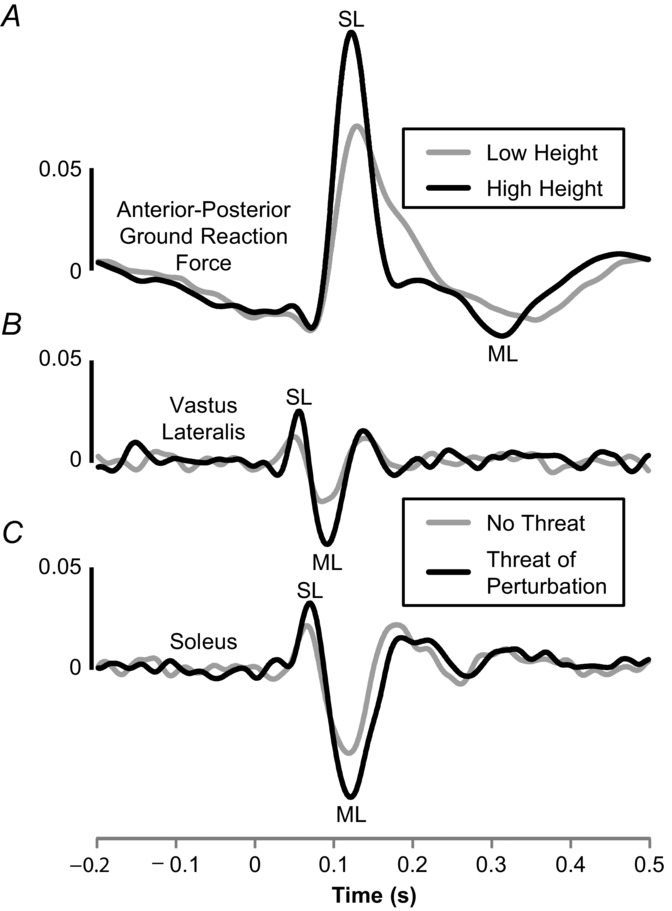
Short- (SL) and medium-latency (ML) vestibular-evoked balance responses with threat Amplitude-normalized cumulant density plots representing cross-correlation between stochastic electrical vestibular stimulation (SVS) and anterior–posterior ground reaction forces acting on the body (A), vastus lateralis (B) and soleus muscle activity (C). In all cases, positive peaks reflect a positive correlation between SVS and the respective measure [e.g. a positive current caused a forward-directed force (A) or increase in muscle activity (B and C)]. The ground reaction force trace (A) is reproduced from Horslen et al. (; their Fig. 2C); SVS (2–25 Hz bandwidth) evoked balance responses while subjects (n = 10) stood at low and high surface heights with feet at the edge and head turned 90 deg to the right. The muscle activity traces (B and C) were reproduced with permission from Lim (; her Fig. 3.12); SVS (0–25 Hz) evoked responses while subjects (n = 13) stood with the head facing forward with and without the threat of laterally directed support surface perturbations.
Comment in
-
Rebuttal from Raymond Reynolds, Callum Osler, Linda Tersteeg and Ian Loram.J Physiol. 2015 Jul 15;593(14):2987. doi: 10.1113/JP270804. J Physiol. 2015. PMID: 26173822 Free PMC article. No abstract available.
References
-
- Balaban CD. Neural substrates linking balance control and anxiety. Physiol Behav. 2002;77:469–475. - PubMed
-
- Britton TC, Day BL, Brown P, Rothwell JC, Thompson PD. Marsden CD. Postural electromyographic responses in the arm and leg following galvanic vestibular stimulation in man. Exp Brain Res. 1993;94:143–151. - PubMed
-
- Brown LA. Frank JS. Postural com-pensations to the potential consequences of instability: kinematics. Gait Posture. 1997;6:89–97.
-
- Carpenter MG, Allum JH. Honegger F. Directional sensitivity of stretch reflexes and balance corrections for normal subjects in the roll and pitch planes. Exp Brain Res. 1999;129:93–113. - PubMed
-
- Carpenter MG, Frank JS, Adkin AL, Paton A. Allum JHJ. Influence of postural anxiety on postural reactions to multi-directional surface rotations. J Neurophysiol. 2004;92:3255–3265. - PubMed
Publication types
MeSH terms
LinkOut - more resources
Full Text Sources
Medical
