. 2015 Jul 15:5:12017.
doi: 10.1038/srep12017.

Circulating levels of sphingosine-1-phosphate are elevated in severe, but not mild psoriasis and are unresponsive to anti-TNF-α treatment

Affiliations

Circulating levels of sphingosine-1-phosphate are elevated in severe, but not mild psoriasis and are unresponsive to anti-TNF-α treatment

Antonio Checa et al. Sci Rep. .

Abstract

Sphingolipids are bioactive molecules with a putative role in inflammation. Alterations in sphingolipids, in particular ceramides, have been consistently observed in psoriatic skin. Herein, we quantified the circulating sphingolipid profile in individuals with mild or severe psoriasis as well as healthy controls. In addition, the effects of anti-TNF-α treatment were determined. Levels of sphingoid bases, including sphingosine-1-phosphate (S1P), increased in severe (P < 0.001; n = 32), but not in mild (n = 32), psoriasis relative to healthy controls (n = 32). These alterations were not reversed in severe patients (n = 16) after anti-TNF-α treatment despite significant improvement in psoriasis lesions. Circulating levels of sphingomyelins and ceramides shifted in a fatty acid chain length-dependent manner. These alterations were also observed in psoriasis skin lesions and were associated with changes in mRNA levels of ceramide synthases. The lack of S1P response to treatment may have pathobiological implications due to its close relation to the vascular and immune systems. In particular, increased levels of sphingolipids and especially S1P in severe psoriasis patients requiring biological treatment may potentially be associated with cardiovascular comorbidities. The fact that shifts in S1P levels were not ameliorated by anti-TNF-α treatment, despite improvements in the skin lesions, further supports targeting S1P receptors as therapy for severe psoriasis.


Figures
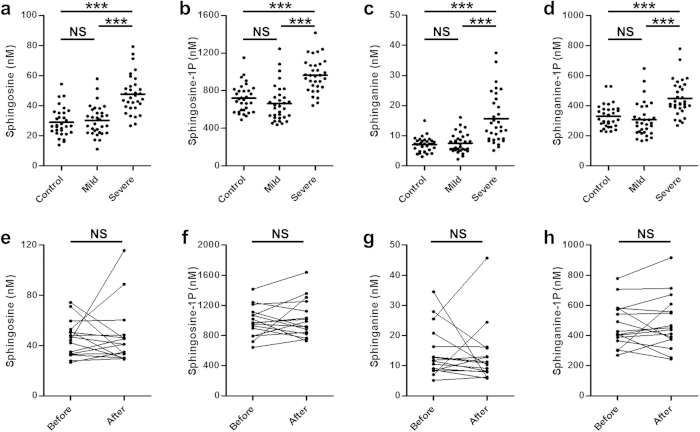
Figure 1
Figure 1. Circulating sphingoid bases are increased in severe psoriasis patients.
(ad) Plasma levels of sphingoid bases are increased in severe psoriasis patients (n = 32) in comparison to healthy controls (n = 32) and mild psoriasis patients (n = 32). Each point represents an individual. A horizontal line shows the mean value for the group. (eh) Levels of sphingoid bases are not affected by anti-TNF-α treatment in severe psoriasis patients (n = 16). Connected dots represent one individual. Normality was assessed by the Kolmogorov-Smirnov test. The statistical significance for multiple group comparisons was determined via a one way ANOVA with Tukey’s post-hoc correction. Pairwise comparisons were performed using the Wilcoxon signed-rank test. ***P < 0.001, NS = Not significant.
Figure 2
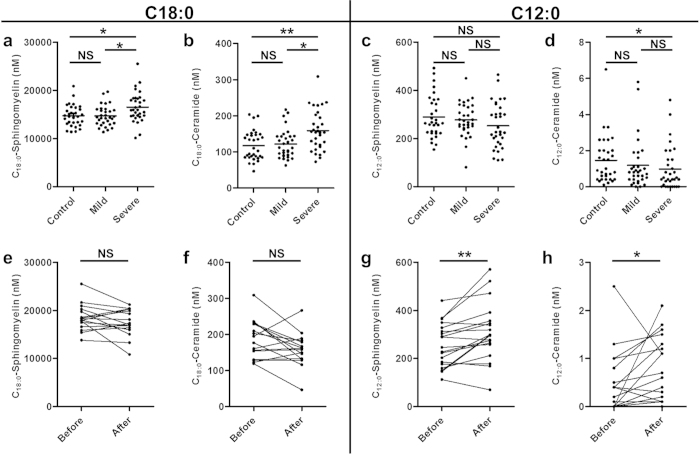
Figure 2. Levels of circulating ceramides evidence fatty acyl chain length-dependent shifts.
(ad) Plasma levels of sphingomyelins and ceramides are increased in severe psoriasis patients (n = 32) in comparison to healthy controls (n = 32) and mild psoriasis patients (n = 32) for C18:0 fatty acid chain-containing analogs, whereas the levels of C12:0 fatty acid chain-containing ceramides are decreased. Each point represents an individual. A horizontal line shows the mean value for the group. (ef) Anti-TNF-α treatment (n = 16) in severe psoriasis patients resulted in increased C12:0 fatty acid chain-containing sphingolipids and did not affect levels of C18:0 fatty acid chain-containing sphingolipids. Connected dots represent one individual. Statistical significance for multiple comparisons was determined via a Kruskal-Wallis test with Dunn´s post-hoc correction. Pairwise comparisons were performed using the Wilcoxon signed-rank test. C12:0 = fatty acid chain with 12 carbons (lauric acid); C18:0 = fatty acid chain with 18 carbons (stearic acid). *P < 0.05, **P < 0.01, NS = Not significant.
Figure 3
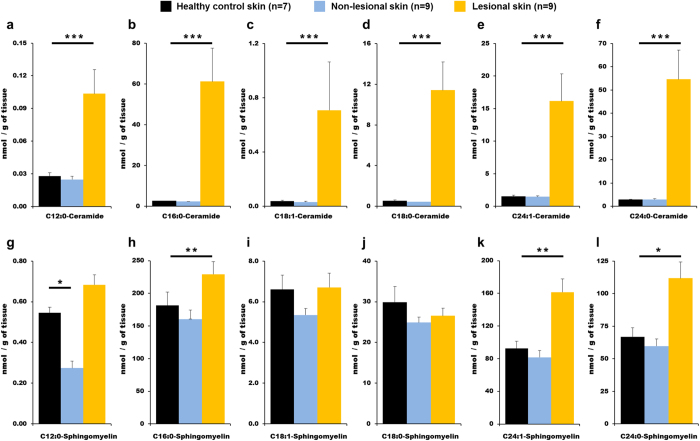
Figure 3. Levels of ceramides and sphingomyelins in lesional and non-lesional skin from severe psoriasis patients compared to healthy controls.
Data are presented as the mean ± SEM. Statistical significance was determined via a Kruskal-Wallis test with Dunn´s post-hoc correction comparing to the healthy control group. *P < 0.05; **P < 0.01; ***P < 0.001.
Figure 4
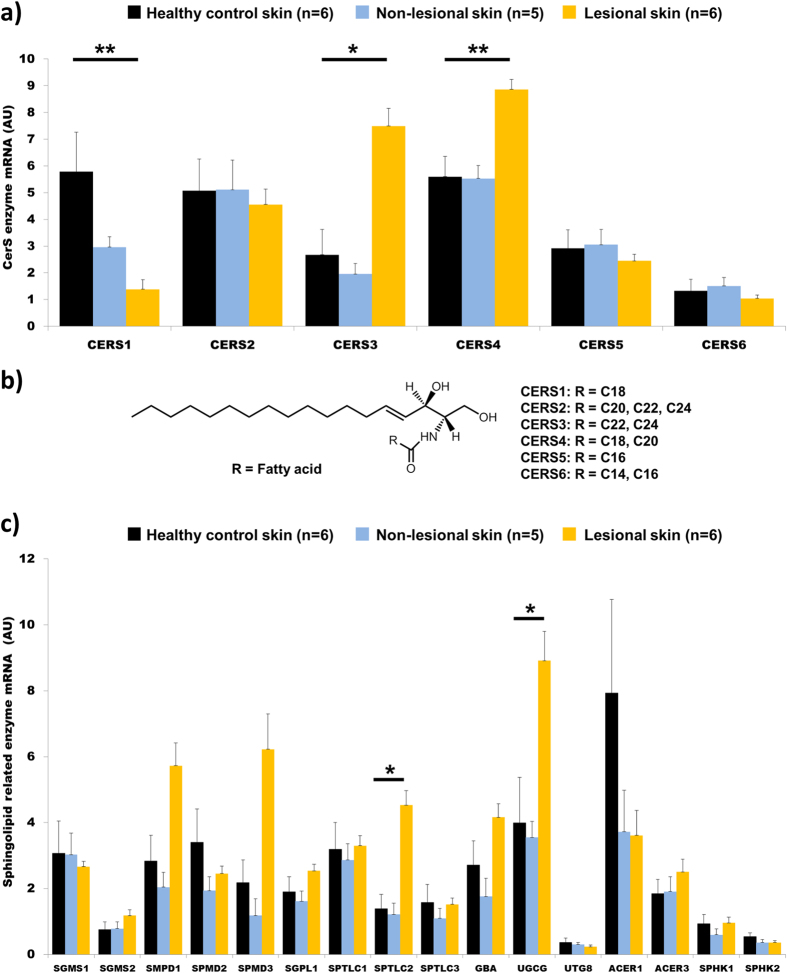
Figure 4. mRNA levels of ceramide synthases (CerS) and other sphingolipid pathway related enzymes are altered in lesional relative to non-lesional skin from severe psoriasis patients and healthy controls.
(a) Levels of CerS in the different groups. (b) Structure of ceramide and affinities of CerS for different fatty acyl chain lengths included in the present study (Adapted from Levy and Futerman, 201033). (c) Levels of other sphingolipid pathway related enzymes. Data are presented as mean ± SEM. AU = Arbitrary units normalized based on the expression of the internal positive control 18S RNA. One extreme outlier was excluded from the non-lesional skin group. Statistical significance was determined via a Kruskal-Wallis test with Dunn´s post-hoc correction comparing to the healthy control group. The enzyme nomenclature is as defined in the Materials and Methods. *P < 0.05; **P < 0.01.

References

    1. Lowes M. A., Bowcock A. M. & Krueger J. G. Pathogenesis and therapy of psoriasis. Nature 445, 866–873 (2007). - PubMed
    1. Tonel G. & Conrad C. Interplay between keratinocytes and immune cells—Recent insights into psoriasis pathogenesis. The International Journal of Biochemistry & Cell Biology 41, 963–968 (2009). - PubMed
    1. Hla T. & Dannenberg Andrew J. Sphingolipid Signaling in Metabolic Disorders. Cell Metabolism 16, 420–434 (2012). - PMC - PubMed
    1. Van Smeden J., Janssens M., Gooris G. S. & Bouwstra J. A. The important role of stratum corneum lipids for the cutaneous barrier function. Biochimica et Biophysica Acta (BBA) - Molecular and Cell Biology of Lipids 1841, 295–313 (2014). - PubMed
    1. Školová B. et al. Ceramides in the Skin Lipid Membranes: Length Matters. Langmuir 29, 15624–15633 (2013). - PubMed

Publication types

MeSH terms