Hierarchy of evidence referring to the central nervous system in a high-impact radiation oncology journal: a 10-year assessment. Descriptive critical appraisal study
- PMID: 26176836
- PMCID: PMC10876347
- DOI: 10.1590/1516-3180.2014.8792210
Hierarchy of evidence referring to the central nervous system in a high-impact radiation oncology journal: a 10-year assessment. Descriptive critical appraisal study
Abstract
Context and objective: To the best of our knowledge, there has been no systematic assessment of the classification of scientific production within the scope of radiation oncology relating to central nervous system tumors. The aim of this study was to systematically assess the status of evidence relating to the central nervous system and to evaluate the geographic origins and major content of these published data.
Design and setting: Descriptive critical appraisal study conducted at a private hospital in São Paulo, Brazil.
Methods: We evaluated all of the central nervous system studies published in the journal Radiotherapy & Oncology between 2003 and 2012. The studies identified were classified according to their methodological design and level of evidence. Information regarding the geographical location of the study, the institutions and authors involved in the publication, main condition or disease investigated and time of publication was also obtained.
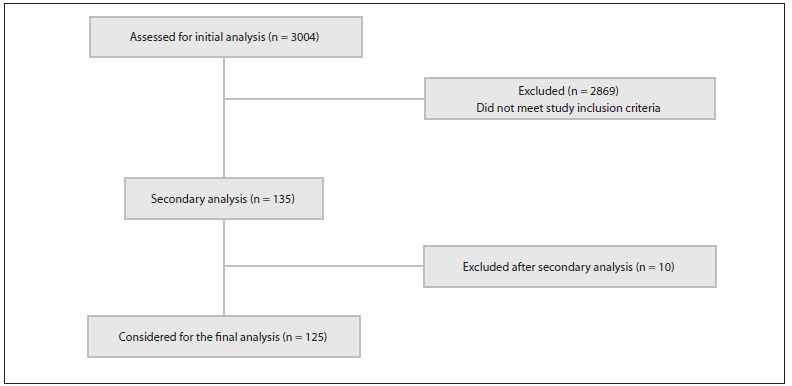
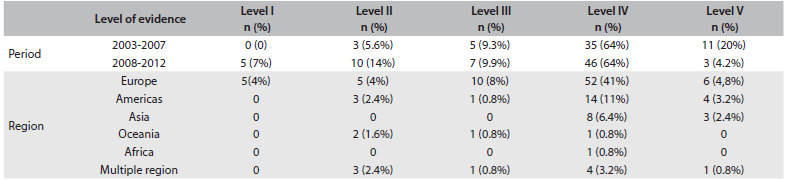
Results: We identified 3,004 studies published over the 10-year period. Of these, 125 (4.2%) were considered eligible, and 66% of them were case series. Systematic reviews and randomized clinical trials accounted for approximately 10% of all the published papers. We observed an increase in high-quality evidence and a decrease in low-quality published papers over this period (P = 0.036). The inter-rater reliability demonstrated significant agreement between observers in terms of the level of evidence.
Conclusions: Increases in high-level evidence and in the total number of central nervous system papers were clearly demonstrated, although the overall number of such studies remained relatively small.
CONTEXTO E OBJETIVO:: Até onde sabemos, não há avaliação sistemática da classificação da produção científica no âmbito da radioterapia de tumores de sistema nervoso central. O objetivo deste estudo foi avaliar sistematicamente o estado das evidências relativas ao sistema nervoso central e avaliar origem geográfica e a temática envolvida nestas publicações.
TIPO DE ESTUDO E LOCAL:: Estudo descritivo de avaliação crítica, realizado em um hospital privado em São Paulo, Brasil.
MÉTODOS:: Foram avaliados todos os estudos publicados em sistema nervoso central na revista Radiotherapy & Oncology, entre 2003 e 2012. Os estudos identificados foram classificados de acordo com o desenho metodológico e nível de evidência. Informações sobre a localização geográfica do estudo, instituições e os autores envolvidos nas publicações, a principal condição ou doença estudada e o período de publicação também foram obtidos.
RESULTADOS:: Foram identificados 3.004 estudos publicados no período de 10 anos. Destes, 125 (4,2%) foram considerados como elegíveis, e 66% destes eram séries de casos. As revisões sistemáticas e ensaios clínicos randomizados foram responsáveis por cerca de 10% de todas as publicações. Observou-se um aumento das evidências de alta qualidade e uma diminuição das publicações de baixa qualidade durante o período (P = 0,036). A confiabilidade entre avaliadores demonstrou concordância significativa para níveis de evidência.
CONCLUSÕES:: Um aumento nas evidências de alto nível, assim como no número absoluto de artigos em sistema nervoso central foi claramente demonstrado, apesar de o número global ser ainda relativamente pequeno.
Conflict of interest statement
Figures

Similar articles
-
Hierarchy of evidence relating to hand surgery in Brazilian orthopedic journals.Sao Paulo Med J. 2011 Mar;129(2):94-8. doi: 10.1590/s1516-31802011000200007. Sao Paulo Med J. 2011. PMID: 21603786 Free PMC article.
-
Assessments of the quality of randomized controlled trials published in International Journal of Urology from 1994 to 2011.Int J Urol. 2013 Dec;20(12):1212-9. doi: 10.1111/iju.12150. Epub 2013 Apr 9. Int J Urol. 2013. PMID: 23573913
-
Authorship in Radiation Oncology: Proliferation Trends Over 30 Years.Int J Radiat Oncol Biol Phys. 2015 Nov 15;93(4):754-6. doi: 10.1016/j.ijrobp.2015.07.2289. Epub 2015 Oct 19. Int J Radiat Oncol Biol Phys. 2015. PMID: 26530742
-
Clinical radiology research in Pakistan: from evidence to practice.J Pak Med Assoc. 2009 Aug;59(8):544-6. J Pak Med Assoc. 2009. PMID: 19757702 Review.
-
The distribution of forensic journals, reflections on authorship practices, peer-review and role of the impact factor.Forensic Sci Int. 2007 Jan 17;165(2-3):115-28. doi: 10.1016/j.forsciint.2006.05.013. Epub 2006 Jun 19. Forensic Sci Int. 2007. PMID: 16784827 Review.
Cited by
-
The relationship of study and authorship characteristics on trial sponsorship and self-reported conflicts of interest among neuro-oncology clinical trials.J Neurooncol. 2018 Aug;139(1):195-203. doi: 10.1007/s11060-018-2860-2. Epub 2018 Jun 4. J Neurooncol. 2018. PMID: 29869023
-
External beam re-irradiation, combination chemoradiotherapy, and particle therapy for the treatment of recurrent glioblastoma.Expert Rev Anticancer Ther. 2016;16(3):347-58. doi: 10.1586/14737140.2016.1143364. Epub 2016 Feb 9. Expert Rev Anticancer Ther. 2016. PMID: 26781426 Free PMC article. Review.
References
-
- Guyatt G, Rennie D, Meade M, Cook D. Users’ guide to the medical literature: a manual for evidence-based clinical practice. 2nd ed. New York: McGraw-Hill; 2008.
-
- Watts G. Let’s pension off the “major breakthrough”. BMJ. 2007;334(Suppl 1):s4–s4. - PubMed
-
- Overgaard J, Bentzen SM. Evidence-based radiation oncology. Radiother Oncol. 1998;46(1):1–3. - PubMed
-
- Overgaard J. Advancing radiation oncology through scientific publication--100 volumes of Radiotherapy and Oncology. Radiother Oncol. 2011;100(1):1–6. - PubMed
MeSH terms
LinkOut - more resources
Full Text Sources