


Thermodynamic explanation of the universal correlation between oxygen evolution activity and corrosion of oxide catalysts
- PMID: 26178185
- PMCID: PMC4503990
- DOI: 10.1038/srep12167
Thermodynamic explanation of the universal correlation between oxygen evolution activity and corrosion of oxide catalysts
Abstract
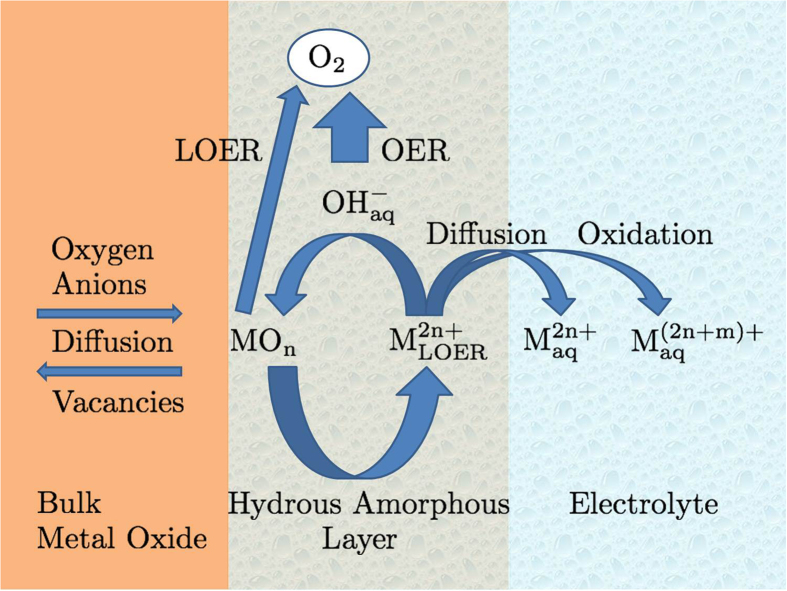
In recent years, the oxygen evolution reaction (OER) has attracted increased research interest due to its crucial role in electrochemical energy conversion devices for renewable energy applications. The vast majority of OER catalyst materials investigated are metal oxides of various compositions. The experimental results obtained on such materials strongly suggest the existence of a fundamental and universal correlation between the oxygen evolution activity and the corrosion of metal oxides. This corrosion manifests itself in structural changes and/or dissolution of the material. We prove from basic thermodynamic considerations that any metal oxide must become unstable under oxygen evolution conditions irrespective of the pH value. The reason is the thermodynamic instability of the oxygen anion in the metal oxide lattice. Our findings explain many of the experimentally observed corrosion phenomena on different metal oxide OER catalysts.
Figures
References
-
- Trasatti S. Electrocatalysis in the anodic evolution of oxygen and chlorine. Electrochim. Acta 29, 1503–1512 (1984).
-
- Katsounaros I., Cherevko S., Zeradjanin A. R. & Mayrhofer K. J. J. Oxygen electrochemistry as a cornerstone for sustainable energy conversion. Angew. Chem. Int. Ed. 53, 102–121 (2014). - PubMed
-
- Fabbri E., Habereder A., Waltar K., Kötz R. & Schmidt T. J. Developments and perspectives of oxide-based catalysts for the oxygen evolution reaction. Catal. Sci. Tech. 4, 3800–3821 (2014).
-
- Cheng F. Y. et al. Rapid room-temperature synthesis of nanocrystalline spinels as oxygen reduction and evolution electrocatalysts. Nat. Chem. 3, 79–84 (2011). - PubMed
-
- Liang Y. Y. et al. Co3O4 nanocrystals on graphene as a synergistic catalyst for oxygen reduction reaction. Nat. Mater. 10, 780–786 (2011). - PubMed
Publication types
LinkOut - more resources
Full Text Sources
Other Literature Sources
