


Schistosoma mansoni among pre-school children in Musozi village, Ukerewe Island, North-Western-Tanzania: prevalence and associated risk factors
- PMID: 26178484
- PMCID: PMC4504164
- DOI: 10.1186/s13071-015-0997-9
Schistosoma mansoni among pre-school children in Musozi village, Ukerewe Island, North-Western-Tanzania: prevalence and associated risk factors
Abstract
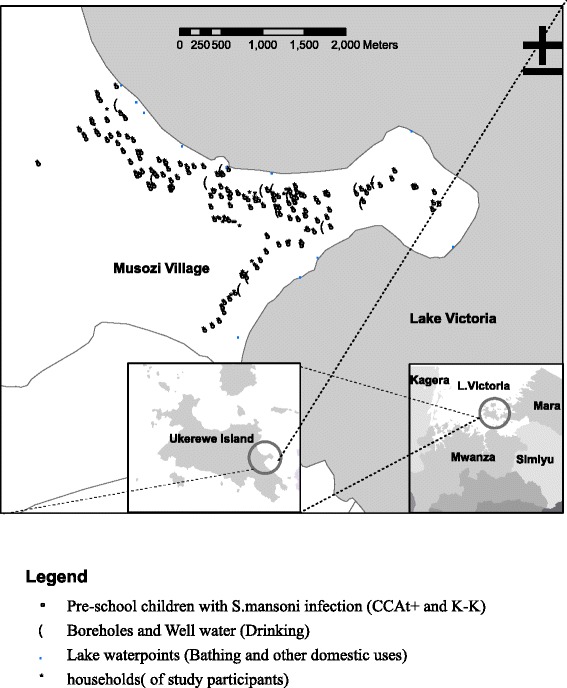
Background: Recent evidence indicates that pre-school children (PSC) living in S. mansoni highly endemic areas are at similar risk of schistosomiasis infection and morbidity as their school aged siblings. Recognizing this fact, the World Health Organization (WHO) is considering including this age group in highly endemic areas in control programmes using mass drug administration (MDA). However, detailed epidemiological information on S. mansoni infection among PSC is lacking for many endemic areas, specifically in Tanzania. This study was conducted to determine the prevalence of S. mansoni infection and its associated risk factors among PSC in Ukerewe Island, North-Western Tanzania.
Methods: This was a cross-sectional study, which studied 400 PSC aged 1-6 years. The Kato-Katz (K-K) technique and the point of care circulating cathodic antigen (CCA) immunodiagnostic test were used to diagnose S. mansoni infection in stool and urine samples respectively. A pre-tested questionnaire was used to collect demographic data and water contact behaviour of the children from their parents/guardians.
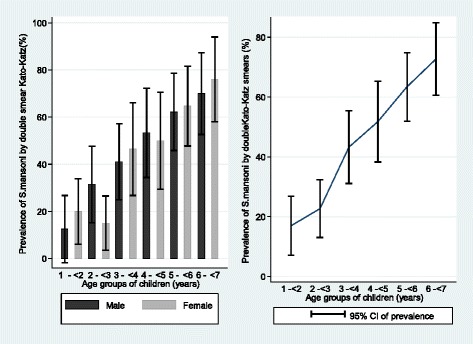
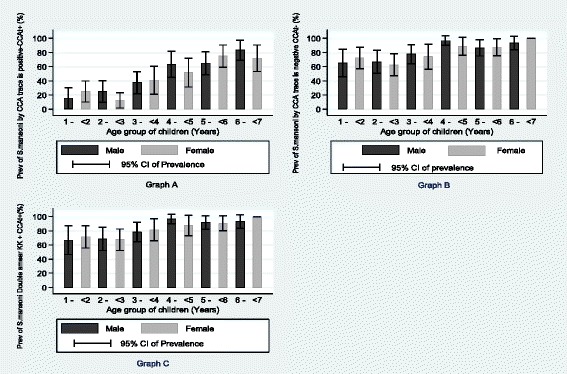
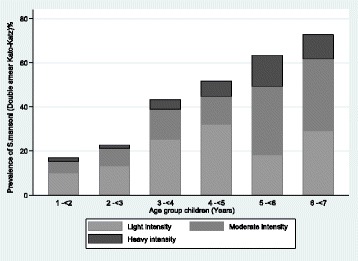
Results: Based on the K-K technique, 44.4% (95% CI: 39.4-49.4) pre-school children were infected with S. mansoni and the overall geometric mean eggs per gram of faeces (GM-epg) was 110.6 epg with 38.2 and 14.7% having moderate and heavy intensity infections respectively. Based on the CCA, 80.1%, (95% CI: 76.0-84.0) were infected if a trace was considered positive, and 45.9%, (95% CI: 40.9-50.9), were infected if a trace was considered negative. Reported history of lake visits (AOR = 2.31, 95% CI: 1.06-5.01, P < 0.03) and the proximity to the lake shore (<500 m) (AOR = 2.09, 95% CI: 1.05-4.14, P < 0.03) were significantly associated with S. mansoni infection. Reported lake visit frequency (4-7 days/week) was associated with heavy intensities of S. mansoni infection (P < 0.00).
Conclusion: The prevalence of S. mansoni infection in the study population using K-K and CCA-trace-negative was moderate. The frequency of lake visits and the proximity to the lake shore were associated with the infection of S. mansoni and its intensity. These findings call for the need to include the PSC in MDA programmes, public health education and provision of safe water for bathing.
Figures
References
-
- Koukounari A, Fenwick A, Whawell S, Kabatereine NB, Kazibwe F, Tukahebwa EM, et al. Morbidity indicators of Schistosoma mansoni: relationship between infection and anemia in Ugandan schoolchildren before and after praziquantel and albendazole chemotherapy. Am J Trop Med Hyg. 2006;75(2):278–86. - PubMed
Publication types
MeSH terms
Substances
Grants and funding
LinkOut - more resources
Full Text Sources
Other Literature Sources
Miscellaneous
