. 2015 Jul 16:14:132.
doi: 10.1186/s12943-015-0407-0.

BCR/ABL1 and BCR are under the transcriptional control of the MYC oncogene

Affiliations

BCR/ABL1 and BCR are under the transcriptional control of the MYC oncogene

Nitesh Sharma et al. Mol Cancer. .

Abstract

Background: Chronic Myeloid Leukaemia (CML) is caused by the BCR/ABL1 fusion gene. Both the presence and the levels of BCR/ABL1 expression seem to be critical for CML progression from chronic phase (CP) to blast crisis (BC). After the oncogenic translocation, the BCR/ABL1 gene is under the transcriptional control of BCR promoter but the molecular mechanisms involved in the regulation of oncogene expression are mostly unknown.

Methods: A region of 1443bp of the functional BCR promoter was studied for transcription factor binding sites through in-silico analysis and Chromatin Immunoprecipitation experiments. BCR and BCR/ABL1 expression levels were analysed in CML cell lines after over-expression or silencing of MYC transcription factor. A luciferase reporter assay was used to confirm its activity on BCR promoter.

Results: In the present study we demonstrate that MYC and its partner MAX bind to the BCR promoter, leading to up-regulation of BCR and BCR/ABL1 at both transcriptional and protein levels. Accordingly, silencing of MYC expression in various BCR/ABL1 positive cell lines causes significant downregulation of BCR and BCR/ABL1, which consequently leads to decreased proliferation and induction of cell death.

Conclusions: Here we describe a regulatory pathway modulating BCR and BCR/ABL1 expression, showing that the BCR promoter is under the transcriptional control of the MYC/MAX heterodimer. Since MYC is frequently over-expressed in BC, this phenomenon could play a critical role in BCR/ABL1 up-regulation and blast aggressiveness acquired during CML evolution.


Figures
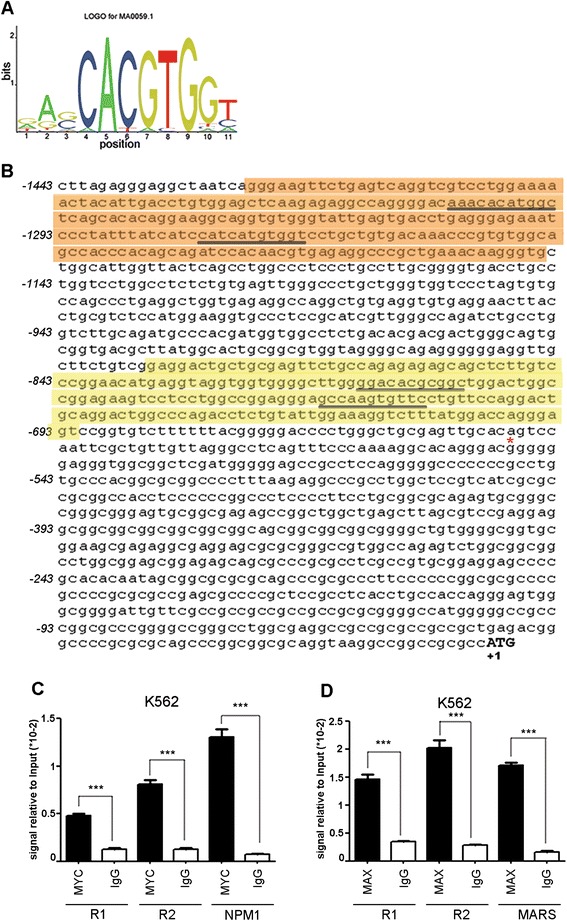
Fig. 1
Fig. 1
MYC and MAX binding at BCR promoter. (a) Schematic representation of 11-nucleotide position frequency matrix for MYC/MAX binding (MA0059.1) as obtained from Jaspar core database. The height of the nucleotides of the “sequence logo” represents the conservation of the nucleotides measured in bits (binary digit) (b) Nucleotide sequence of the BCR promoter region analyzed in this study. Lowercase nucleotides represent the regions cloned in the pGL3 vector. Consensus regions for MYC/MAX binding are underlined. The regions amplified in Chromatin Immunoprecipitation (ChIP) analysis are highlighted in orange (Region 1, R1) and yellow (Region 2, R2). The BCR transcriptional starting site, according to NM_021574.2 and NM_004327.3, is highlighted as a red asterisk. (c, d) ChIP results for MYC and MAX binding at region1 (R1) and region 2 (R2) and for MYC and MAX positive controls. The RTq-PCR data represent the means ± SD (standard deviation) of two independent experiments. An IgG antibody was used as negative control. Signals are normalized to the Input DNA. *** = p < 0.0001
Fig. 2
Fig. 2
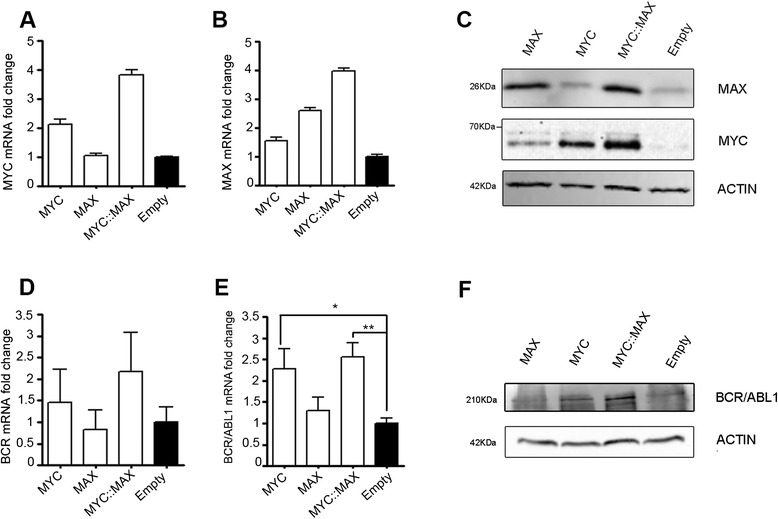
Effect of MYC and MAX on BCR and BCR/ABL1 expression in K562 cell line. MYC (a,c) and MAX (b,c) over-expression in K562 cells stably transfected with MAX, MYC, or pcDNA3 empty vector (Empty) or MYC/MAX (MYC::MAX), as evidenced by RTq-PCR (a,b) and Western Blot from total lysates (c). RT-qPCR (d,e) and Western Blot (f) show BCR and BCR/ABL1 expression levels in K562 transfectants. Actin was used as loading control. The RTq-PCR data shown in (d,e) represent the means ± SD (standard deviation) of three independent experiments. Data are represented as mRNA fold change compared to the Empty sample
Fig. 3
Fig. 3
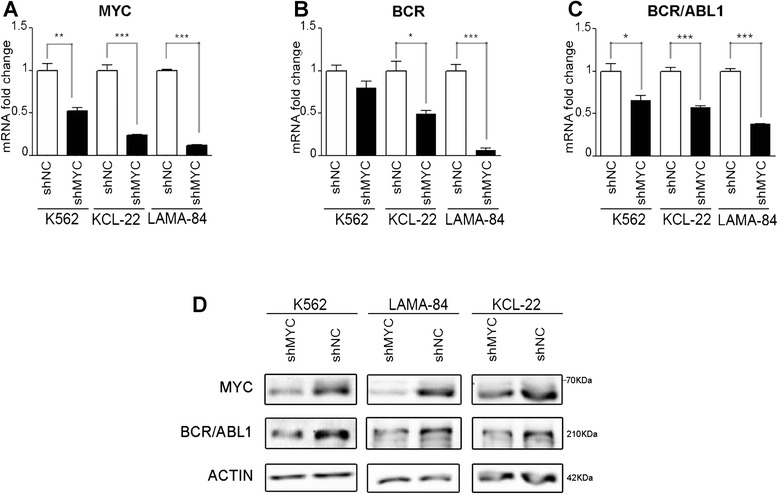
MYC silencing causes downregulation of BCR and BCR/ABL1 expression. The BCR/ABL1-positive cell lines K562, KCL-22 and LAMA-84 were infected with lentiviruses expressing scrambled shRNA (negative control: shNC) or MYC shRNA (shMYC). (a-c) RT-qPCR for MYC, BCR and BCR/ABL1 levels. Data are represented as mRNA fold change compared to the shNC sample. ***: p < 0.001, **: p < 0.01,*: p < 0.05. Signals are representative of two independent experiments (d) Western Blot analysis of total cell lysates. Actin was used as loading control
Fig. 4
Fig. 4
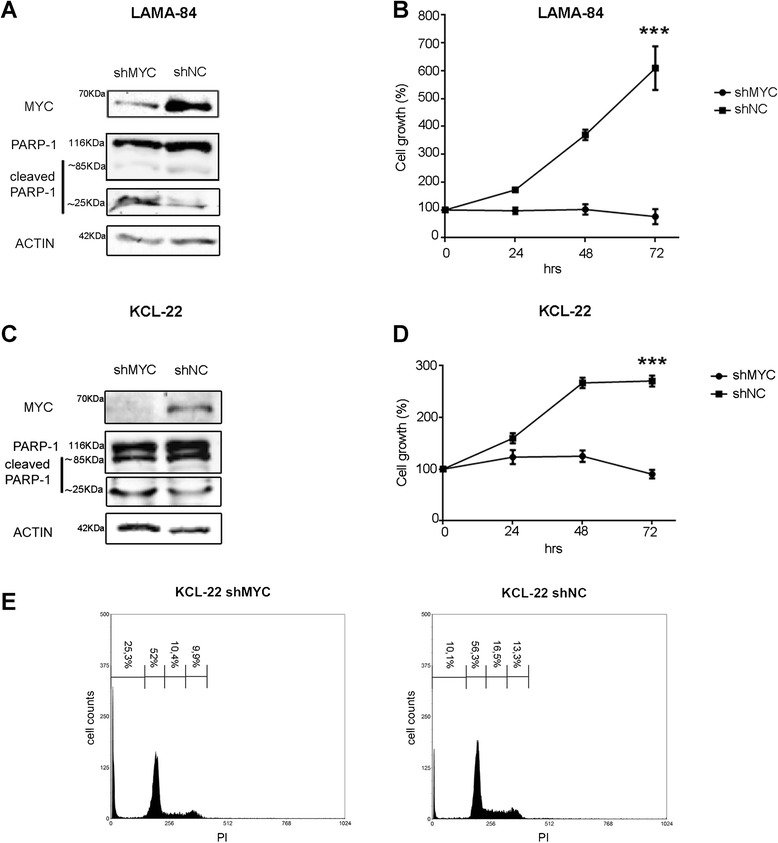
Biological role of MYC silencing in CML cell lines. Immunoblots for MYC, PARP-1 and Actin in LAMA-84 (a) and KCL-22 (c) cell lines encoding MYC-shRNA (shMYC) or the control shRNA (shNC). The PARP-1 antibody recognizes total (116kDA) and cleaved PARP-1 (85/25kDa). Cell viability of the same cells (b,d) was determined by the MTS assay. Values represent the mean normalized percentage of survival compared to control cells (n = 5 wells; ± SD). (***: p < 0.001). (e) Flow cytometry analysis of propidium iodide (PI) stained KCL-22 cells after 72h of MYC silencing
Fig. 5
Fig. 5
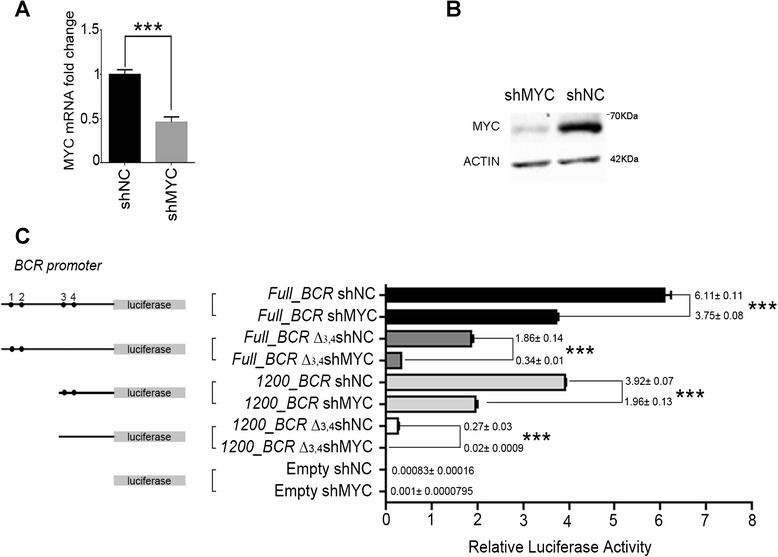
PBS1-4 are critical for BCR promoter regulation. 293 cells were infected with lentiviruses expressing scrambled shRNA (negative control: shNC) or MYC shRNA (shMYC). (a,b) RT-qPCR and Western Blot analyses assessing MYC expression levels. (c) Luciferase assay on 293 infected cells. The four MYC/MAX binding sites are numbered in the figure (1-4). The graph shows the relative luciferase values as assessed after normalization with Renilla Luciferase signal. Values reported in the graph represent the average of three separate experiments. *** = p < 0.0001

References

    1. Bartram CR, de Klein A, Hagemeijer A, van Agthoven T, Geurts van Kessel A, Bootsma D, et al. Translocation of c-ab1 oncogene correlates with the presence of a Philadelphia chromosome in chronic myelocytic leukaemia. Nature. 1983;306:277–280. doi: 10.1038/306277a0. - DOI - PubMed
    1. Grossmann V, Kohlmann A, Zenger M, Schindela S, Eder C, Weissmann S, et al. A deep-sequencing study of chronic myeloid leukemia patients in blast crisis (BC-CML) detects mutations in 76.9 % of cases. Leukemia. 2011;25:557–560. doi: 10.1038/leu.2010.298. - DOI - PubMed
    1. Perrotti D, Jamieson C, Goldman J, Skorski T. Chronic myeloid leukemia: mechanisms of blastic transformation. J Clin Invest. 2010;120:2254–2264. doi: 10.1172/JCI41246. - DOI - PMC - PubMed
    1. Coluccia AM, Vacca A, Dunach M, Mologni L, Redaelli S, Bustos VH, et al. Bcr-Abl stabilizes beta-catenin in chronic myeloid leukemia through its tyrosine phosphorylation. EMBO J. 2007;26:1456–1466. doi: 10.1038/sj.emboj.7601485. - DOI - PMC - PubMed
    1. Chang JS, Santhanam R, Trotta R, Neviani P, Eiring AM, Briercheck E, et al. High levels of the BCR/ABL oncoprotein are required for the MAPK-hnRNP-E2 dependent suppression of C/EBPalpha-driven myeloid differentiation. Blood. 2007;110:994–1003. doi: 10.1182/blood-2007-03-078303. - DOI - PMC - PubMed

Publication types

MeSH terms

Substances