. 2015 Jul 16:10:111.
doi: 10.1186/s13018-015-0236-2.

Benefits of biphasic calcium phosphate hybrid scaffold-driven osteogenic differentiation of mesenchymal stem cells through upregulated leptin receptor expression

Affiliations

Benefits of biphasic calcium phosphate hybrid scaffold-driven osteogenic differentiation of mesenchymal stem cells through upregulated leptin receptor expression

Chi-Chien Niu et al. J Orthop Surg Res. .

Abstract

Background: The use of mesenchymal stem cells (MSCs) and coralline hydroxyapatite (HA) or biphasic calcium phosphate (BCP) as a bone substitute for posterolateral spinal fusion has been reported. However, the genes and molecular signals by which MSCs interact with their surrounding environment require further elucidation.

Methods: MSCs were harvested from bone grafting patients and identified by flow cytometry. A composite scaffold was developed using poly(lactide-co-glycolide) (PLGA) copolymer, coralline HA, BCP, and collagen as a carrier matrix for MSCs. The gene expression profiles of MSCs cultured in the scaffolds were measured by microarrays. The alkaline phosphatase (ALP) activity of the MSCs was assessed, and the expression of osteogenic genes and proteins was determined by quantitative polymerase chain reaction (Q-PCR) and Western blotting. Furthermore, we cultured rabbit MSCs in BCP or coralline HA hybrid scaffolds and transplanted these mixtures into rabbits for spinal fusion. We investigated the differences between BCP and coralline HA hybrid scaffolds by dual-energy X-ray absorptiometry (DEXA) and computed tomography (CT).

Results: Tested in vitro, the cells were negative for hematopoietic cell markers and positive for MSC markers. There was higher expression of 80 genes and lower of 101 genes of MSCs cultured in BCP hybrid scaffolds. Some of these genes have been shown to play a role in osteogenesis of MSCs. In addition, MSCs cultured in BCP hybrid scaffolds produced more messenger RNA (mRNA) for osteopontin, osteocalcin, Runx2, and leptin receptor (leptin-R) than those cultured in coralline HA hybrid scaffolds. Western blotting showed more Runx2 and leptin-R protein expression in BCP hybrid scaffolds. For in vivo results, 3D reconstructed CT images showed continuous bone bridges and fusion mass incorporated with the transverse processes. Bone mineral content (BMC) values were higher in the BCP hybrid scaffold group than in the coralline HA hybrid scaffold group.

Conclusions: The BCP hybrid scaffold for osteogenesis of MSCs is better than the coralline HA hybrid scaffold by upregulating expression of leptin-R. This was consistent with in vivo data, which indicated that BCP hybrid scaffolds induced more bone formation in a spinal fusion model.


Figures

Fig. 1
Fig. 1
Flow cytometry analysis. The mean percentages of CD105+, Stro-1+, α-SMA+, and CD34+ cells were calculated to be 85.7 ± 5.7, 32.7 ± 4.9, 53.6 ± 1.8, and 0.21 ± 0.07 %, respectively
Fig. 2
Fig. 2
mRNA expression of osteogenic genes and leptin-R. After 7 days of culture, the mRNA levels of leptin-R (*p < 0.05, n = 3), osteopontin (*p < 0.05, n = 3), and Runx2 (*p < 0.05, n = 3) were significantly higher in the PLGA/BCP-group MSCs than in the PLGA/coralline-derived-HA-group MSCs. After 14 days of culture, the mRNA levels of leptin-R (**p < 0.01, n = 3), osteopontin (**p < 0.01, n = 3), osteocalcin (*p < 0.05, n = 3), and Runx2 (**p < 0.01, n = 3) were significantly higher in the PLGA/BCP-group MSCs than in the PLGA/coralline-derived-HA-group MSCs
Fig. 3
Fig. 3
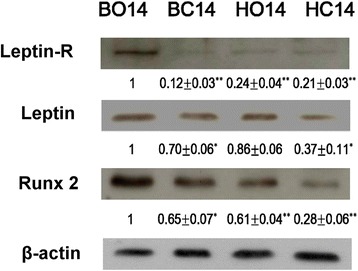
Osteogenic protein expression. Compared to a control group, the expression of the detected osteogenic proteins in the coralline-derived-HA-group MSCs and in the BCP-group MSCs was considerably enhanced. After 14 days of culture, the protein levels of leptin-R (**p < 0.01, n = 3), leptin (0.70 ± 0.06-fold, *p < 0.05, n = 3), and Runx2 (*p < 0.05, n = 3) were significantly higher in the BCP/osteogenic-group MSCs than in the BCP/control-group MSCs. Additionally, the protein levels of leptin-R (**p < 0.01, n = 3) and Runx2 (**p < 0.01, n = 3) were significantly higher in the BCP/osteogenic-group MSCs than in the coralline-derived-HA/osteogenic-group MSCs
Fig. 4
Fig. 4
Quantitative measurement of ALP. MSCs cultured in PLGA/coralline-derived HA hybrid scaffolds or PLGA/BCP hybrid scaffolds had significantly lower ALP activity levels in the control (complete) medium than in the osteogenic medium throughout the 14-day culture period. In addition, ALP activity levels in the PLGA/BCP-group MSCs cultured in the osteogenic medium were significantly higher than those in the PLGA/coralline-derived-HA-group MSCs throughout the 14-day culture period (*p < 0.05, n = 3)
Fig. 5
Fig. 5
Computed tomography findings. Three-dimensional CT reconstructions revealed the presence of continuous bone bridges and satisfactory fusion mass incorporated with the transverse processes (a, b)
Fig. 6
Fig. 6
Dual-energy X-ray absorptiometry examination. Radiographs of the specimens retrieved from the BCP graft and HA graft showed continuous trabecular bone patterns in the area between the transverse processes (a). The BMC values were higher in the BCP graft than in the coralline-derived HA graft (b; *p < 0.05, n = 3)

References

    1. Fernyhough JC, Schimandle JH, Weigel MC, Edwards CC, Levine AM. Chronic donor site pain complicating bone graft harvesting from the posterior iliac crest for spinal fusion. Spine. 1992;17:1474–80. doi: 10.1097/00007632-199212000-00006. - DOI - PubMed
    1. Artzi Z, Weinreb M, Carmeli G, Lev-Dor R, Dard M, Nemcovsky CE. Histomorphometric assessment of bone formation in sinus augmentation utilizing a combination of autogenous and hydroxyapatite/biphasic tricalcium phosphate graft materials: at 6 and 9 months in humans. Clin Oral Implants Res. 2008;19:686–92. - PubMed
    1. Yuan H, Fernandes H, Habibovic P, de Boer J, Barradas AMC, de Ruiter A, et al. Osteoinductive ceramics as a synthetic alternative to autologous bone grafting. PNAS. 2010;107:13614–9. doi: 10.1073/pnas.1003600107. - DOI - PMC - PubMed
    1. Yang C, Unursaikhan O, Lee JS, Jung UW, Kim CS, Choi SH. Osteoconductivity and biodegradation of synthetic bone substitutes with different tricalcium phosphate contents in rabbits. J Biomed Mater Res Part B. 2014;102B:80–8. doi: 10.1002/jbm.b.32984. - DOI - PubMed
    1. Lin SS, Ueng SWN, Niu CC, Yuan LJ, Yang CY, Chen WJ, et al. Hyperbaric oxygen promotes osteogenic differentiation of bone marrow stromal cells by regulating Wnt3a/β-catenin signaling—an in vitro and in vivo study. Stem Cell Res. 2014;12:260–74. doi: 10.1016/j.scr.2013.10.007. - DOI - PubMed

Publication types

MeSH terms

LinkOut - more resources