


doi: 10.1080/87565641.2015.1014487.
Social Interaction in Infants' Learning of Second-Language Phonetics: An Exploration of Brain-Behavior Relations
Affiliations
- PMID: 26179488
- PMCID: PMC4824050
- DOI: 10.1080/87565641.2015.1014487
Item in Clipboard
Social Interaction in Infants' Learning of Second-Language Phonetics: An Exploration of Brain-Behavior Relations
Dev Neuropsychol.
2015.
Abstract
Infants learn phonetic information from a second language with live-person presentations, but not television or audio-only recordings. To understand the role of social interaction in learning a second language, we examined infants' joint attention with live, Spanish-speaking tutors and used a neural measure of phonetic learning. Infants' eye-gaze behaviors during Spanish sessions at 9.5-10.5 months of age predicted second-language phonetic learning, assessed by an event-related potential measure of Spanish phoneme discrimination at 11 months. These data suggest a powerful role for social interaction at the earliest stages of learning a new language.
Figures
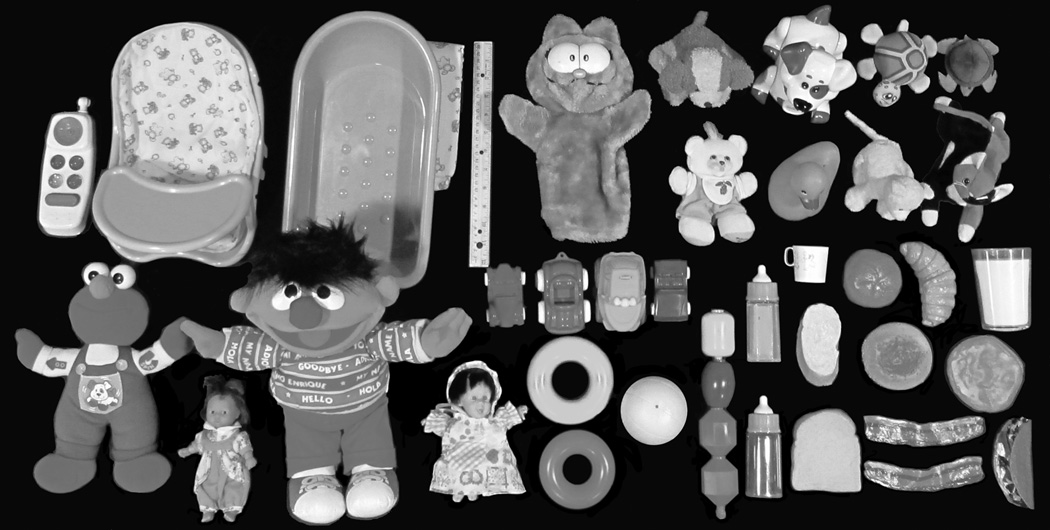
Toy objects presented by the Spanish-speaking tutors (with ruler included to show size).
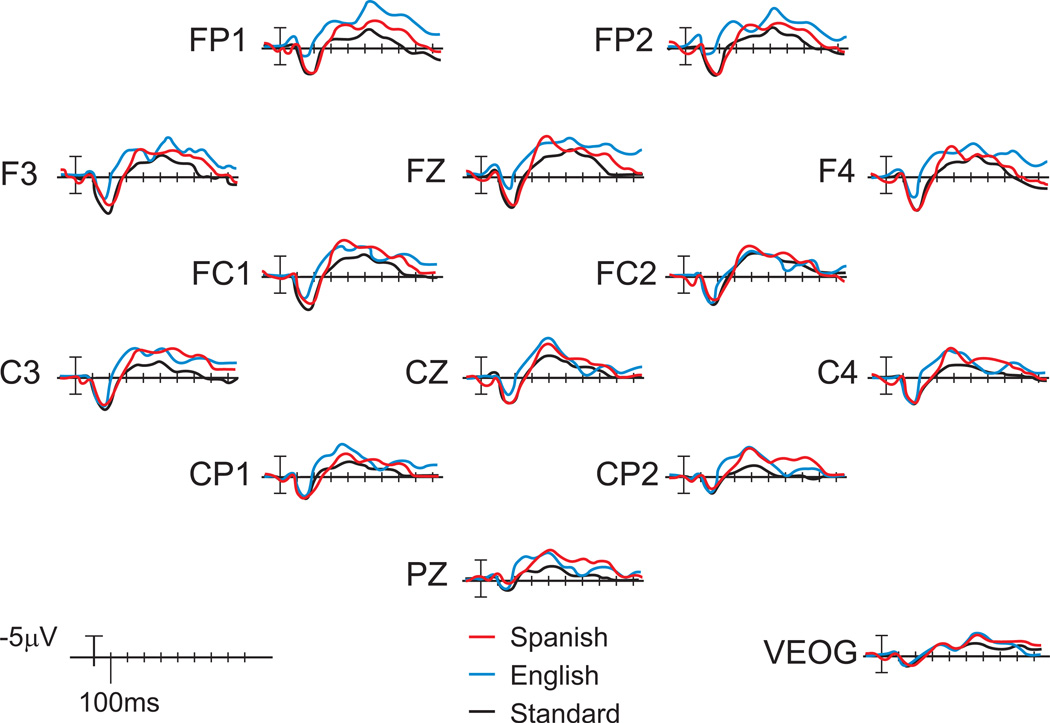
Grand-averaged post-exposure ERPs to syllables in double-oddball paradigm. Significant mismatch responses were observed between the standard stimuli (voiceless unaspirated consonant that is phonemic both in Spanish and in English, black line) and the English deviant (voiceless aspirated /ta/ that is phonemic in English but not in Spanish blue line); and between the standard stimuli (black line) and the Spanish deviant (voiced /da/ that is phonemic in Spanish but not in English, red line). Negative voltages (microvolts) are plotted upward. (Adapted from Conboy and Kuhl, 2011)
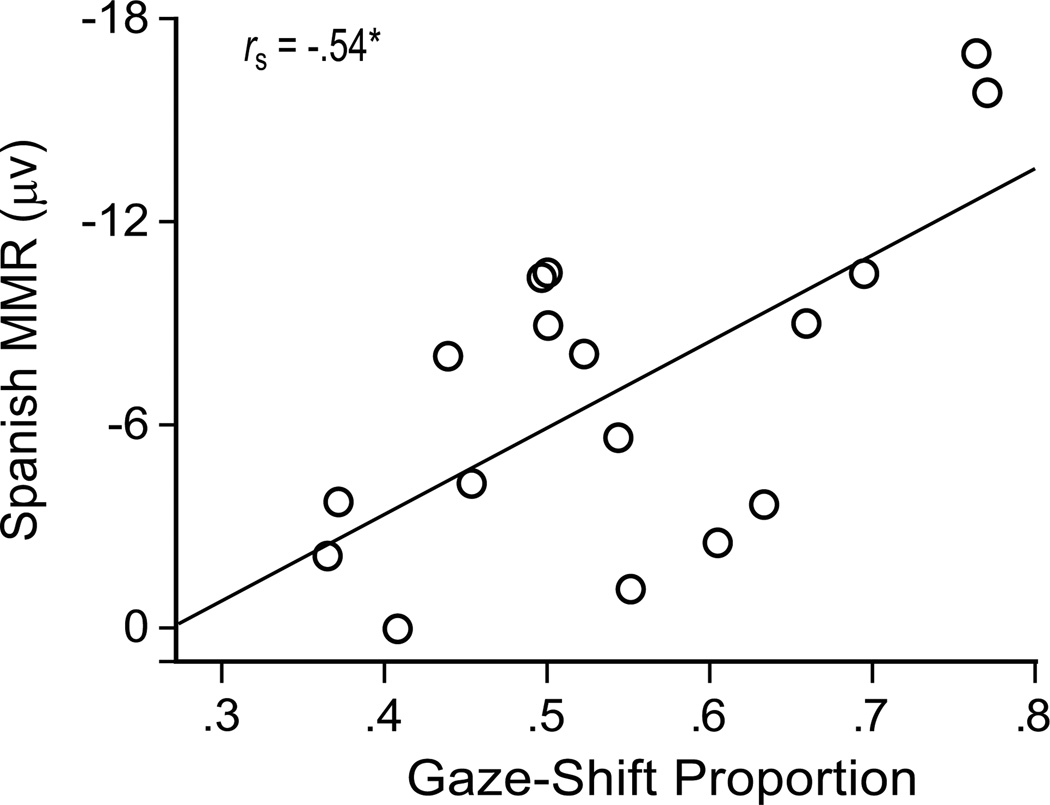
Gaze shifts (proportion) during exposure to Spanish significantly correlate with ERP mismatch response (N250–450 difference peak amplitude averaged across 13 midline and lateral electrode sites, in microvolts) to Spanish phonemic contrast.
References
-
- Adamson LB, Bakeman R, Deckner DF. The development of symbol-infused joint engagement. Child Development. 2004;75:1171–1187. - PubMed
-
- Baldwin DA. Interpersonal understanding fuels knowledge acquisition. Current Directions in Psychological Science. 2000;9:40–45.
-
- Bloom P. How children learn the meanings of words. Cambridge, MA: MIT Press; 2000.
-
- Bloom L, Tinker E. The intentionality model of language acquisition. Monographs of the Society for Research in Child Development. 2001;66(4, Serial No. 267) - PubMed
Publication types
MeSH terms
Grants and funding
LinkOut - more resources
Full Text Sources
Other Literature Sources
Medical
