


Social learning in a high-risk environment: incomplete disregard for the 'minnow that cried pike' results in culturally transmitted neophobia
- PMID: 26180068
- PMCID: PMC4528515
- DOI: 10.1098/rspb.2015.0934
Social learning in a high-risk environment: incomplete disregard for the 'minnow that cried pike' results in culturally transmitted neophobia
Abstract
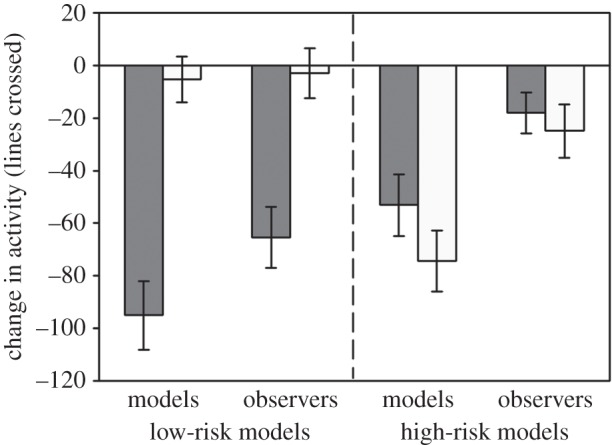
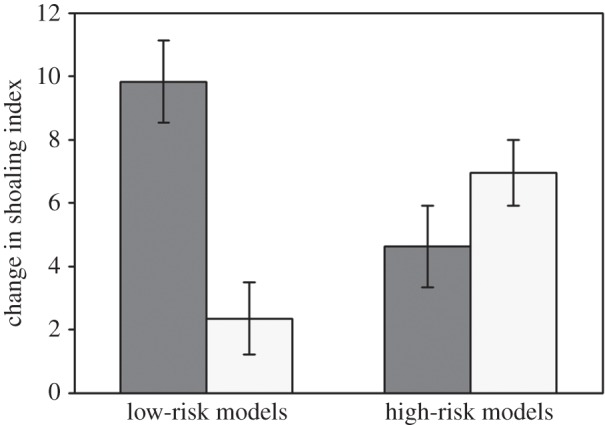
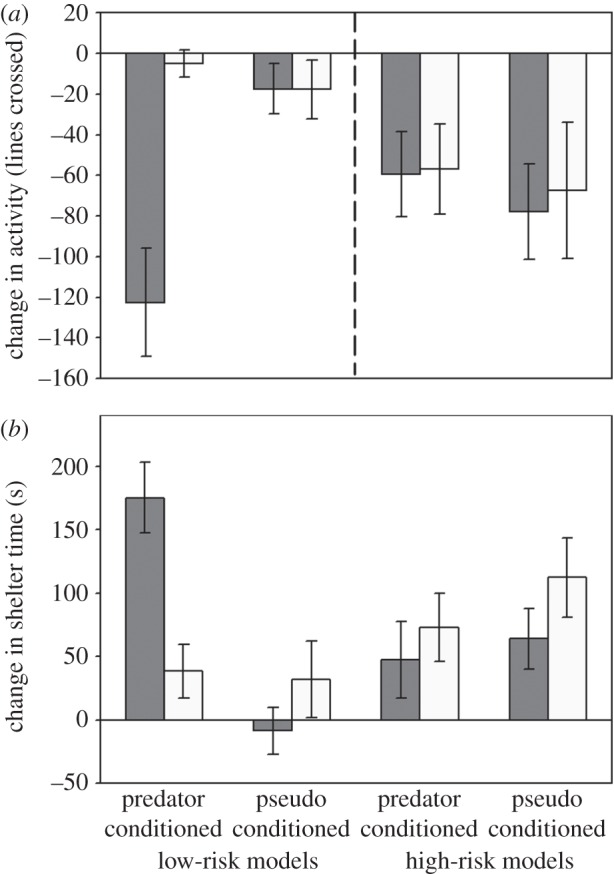
Many prey species rely on conspecifics to gather information about unknown predation threats, but little is known about the role of varying environmental conditions on the efficacy of social learning. We examined predator-naive minnows that had the opportunity to learn about predators from experienced models that were raised in either a low- or high-risk environment. There were striking differences in behaviour among models; high-risk models showed a weaker response to the predator cue and became neophobic in response to the control cue (a novel odour, NO). Observers that were previously paired with low-risk models acquired a strong antipredator response only to the predator cue. However, observers that interacted with high-risk models, displayed a much weaker response to the predator odour and a weak neophobic response to the NO. This is the first study reporting such different outcomes of social learning under different environmental conditions, and suggests high-risk environments promote the cultural transmission of neophobia more so than social learning. If such a transfer can be considered similar to secondary traumatization in humans, culturally transmitted neophobia in minnows may provide a good model system for understanding more about the social ecology of fear disorders.
Keywords: Pimephales promelas; neophobia; secondary traumatization; social learning; uncertainty; vicarious traumatization.
© 2015 The Author(s).
Figures
References
Publication types
MeSH terms
LinkOut - more resources
Full Text Sources
Other Literature Sources
