. 2015 Jul 15:8:21.
doi: 10.1186/s13040-015-0054-4. eCollection 2015.

Interaction networks for identifying coupled molecular processes in microbial communities

Affiliations

Interaction networks for identifying coupled molecular processes in microbial communities

Magnus Bosse et al. BioData Min. .

Abstract

Background: Microbial communities adapt to environmental conditions for optimizing metabolic flux. Such adaption may include cooperative mechanisms eventually resulting in phenotypic observables as emergent properties that cannot be attributed to an individual species alone. Understanding the molecular basis of cross-species cooperation adds to utilization of microbial communities in industrial applications including metal bioleaching and bioremediation processes. With significant advancements in metagenomics the composition of microbial communities became amenable for integrative analysis on the level of entangled molecular processes involving more than one species, in turn offering a data matrix for analyzing the molecular basis of cooperative phenomena.

Methods: We present an analysis framework aligned with a dynamical hierarchies concept for unraveling emergent properties in microbial communities, and exemplify this approach for a co-culture setting of At. ferrooxidans and At. thiooxidans. This minimum microbial community demonstrates a significant increase in bioleaching efficiency compared to the activity of individual species, involving mechanisms of the thiosulfate, the polysulfide and the iron oxidation pathway.

Results: Populating gene-centric data structures holding rich functional annotation and interaction information allows deriving network models at the functional level coupling energy production and transport processes of both microbial species. Applying a network segmentation approach on the interaction network of ortholog genes covering energy production and transport proposes a set of specific molecular processes of relevance in bioleaching. The resulting molecular process model essentially involves functionalities such as iron oxidation, nitrogen metabolism and proton transport, complemented by sulfur oxidation and nitrogen metabolism, as well as a set of ion transporter functionalities. At. ferrooxidans-specific genes embedded in the molecular model representation hold gene functions supportive for ammonia utilization as well as for biofilm formation, resembling key elements for effective chalcopyrite bioleaching as emergent property in the co-culture situation.

Conclusions: Analyzing the entangled molecular processes of a microbial community on the level of segmented, gene-centric interaction networks allows identification of core molecular processes and functionalities adding to our mechanistic understanding of emergent properties of microbial consortia.

Keywords: Acidithiobacillus; Bioleaching; Chalcopyrite; Emergence; Microbial cooperation; Network biology.


Figures
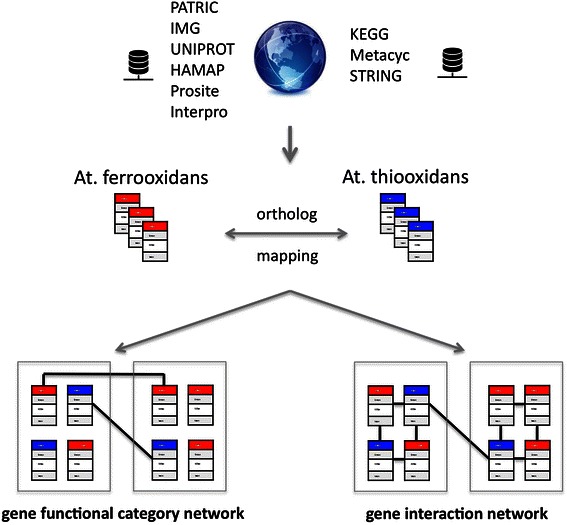
Fig. 1
Fig. 1
From annotation data to interaction networks. Public domain repositories are utilized for gene-centric annotation as well as for retrieving protein coding gene interaction information. Data structures holding the PATRIC ID as central identified are populated with annotation and interaction information, including ortholog mapping for adding to comprehensiveness in annotation. Cross-species interaction networks are built deductively resting on gene functional category assignments (as COG terms) and inductively by utilizing gene interaction information
Fig. 2
Fig. 2
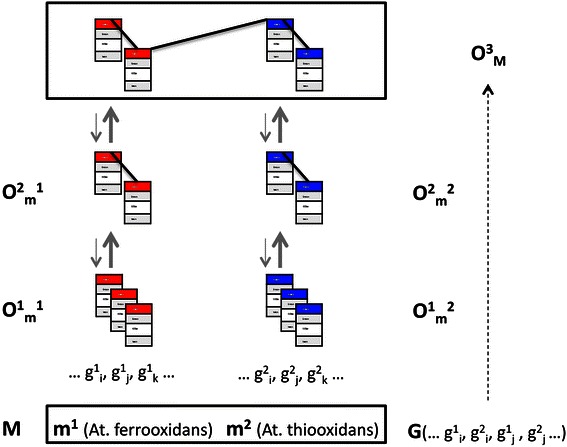
Formal representation of a microbial community. Starting with a microbial community M composed of individual species mi and the set of protein coding genes G observables become apparent on the individual gene level (O1), on the pathway level for each species (O2), and on the level of inter-species molecular processes finally generating a community observable O3. Integrative analysis aims at deriving a model on the level of individual genes gi explaining an emergent property O3M
Fig. 3
Fig. 3
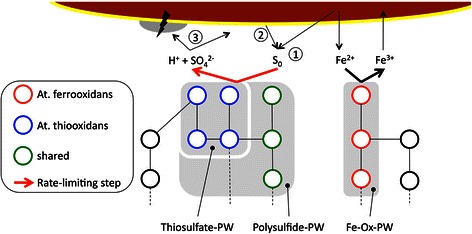
Pathway-centric bioleaching model. Pathway model for cooperation of At. ferrooxidans and At. thiooxidans in chalcopyrite bioleaching. Species-specific molecular processes pi (schematic subgraphs represent protein coding genes and interactions) assigned to the thiosulfate, the polysulfide and the iron oxidation pathway cooperate in mineral dissolution from chalcopyrite. Mechanisms deemed responsible for increased leaching efficiency in a co-culture setting at the interface with the mineral surface as indicated by arrows include (1) proton availability, (2) sulfur layer removal, (3) hindering jarosite formation
Fig. 4
Fig. 4
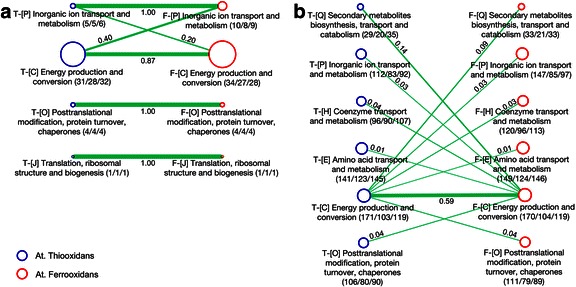
Comparative species analysis, COG level. a COG categories (nodes) relevant in At. ferrooxidans (red) and At. thiooxidans (blue) according to thiosulfate, polysulfide and iron oxidation pathway assignment. Each node holds COG category name, number of genes assigned, number of genes also holding orthologs in the respective COG for the other species, and total number of orthologs, i.e. also indicating multiple ortholog assignments. Edge scaling and numbers represent the percentage of ortholog genes calculated normalized to the species holding the lower number of genes in the respective category. b graph construction as in (A), but the ortholog network is based on the entire gene sets of both species. The graph focuses on the COG category Energy production and conversion and further COG categories holding orthologs
Fig. 5
Fig. 5
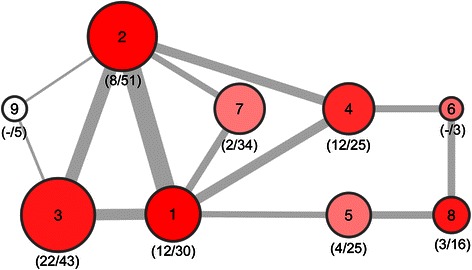
Molecular model of cooperation. Ortholog molecular model on energy production and conversion together with selected transport categories. Nodes represent molecular units, with the node diameter scaling with the number of features included. Edges across units indicate significant dependencies of molecular features across units. Color-coding represents the number of interactions of At. ferrooxidans-specific genes linkable to ortholog genes embedded in units. Numbers in brackets below each node indicate genes assigned to energy production and conversion and number of genes assigned to transport categories (secondary metabolites biosynthesis, transport and catabolism; inorganic ion transport and metabolism; coenzyme transport and metabolism; amino acid transport and metabolism)

References

    1. Karunakaran E, Mukherjee J, Ramalingam B, Biggs CA. "Biofilmology": a multidisciplinary review of the study of microbial biofilms. Applied microbiology and biotechnology. 2011;90:1869–1881. doi: 10.1007/s00253-011-3293-4. - DOI - PubMed
    1. Metzker ML. Sequencing technologies - the next generation. Nature reviews Genetics. 2010;11:31–46. doi: 10.1038/nrg2626. - DOI - PubMed
    1. Handelsman J, Rondon MR, Brady SF, Clardy J, Goodman RM. Molecular biological access to the chemistry of unknown soil microbes: a new frontier for natural products. Chemistry & biology. 1998;5:R245–249. doi: 10.1016/S1074-5521(98)90108-9. - DOI - PubMed
    1. Streit WR, Schmitz RA. Metagenomics--the key to the uncultured microbes. Current opinion in microbiology. 2004;7:492–498. doi: 10.1016/j.mib.2004.08.002. - DOI - PubMed
    1. Thomas T, Gilbert J, Meyer F. Metagenomics - a guide from sampling to data analysis. Microbial informatics and experimentation. 2012;2:3. doi: 10.1186/2042-5783-2-3. - DOI - PMC - PubMed

LinkOut - more resources