


Preoperative Serum Sex Hormone-Binding Globulin Level Is an Independent Predictor of Biochemical Outcome After Radical Prostatectomy
- PMID: 26181566
- PMCID: PMC4617085
- DOI: 10.1097/MD.0000000000001185
Preoperative Serum Sex Hormone-Binding Globulin Level Is an Independent Predictor of Biochemical Outcome After Radical Prostatectomy
Abstract
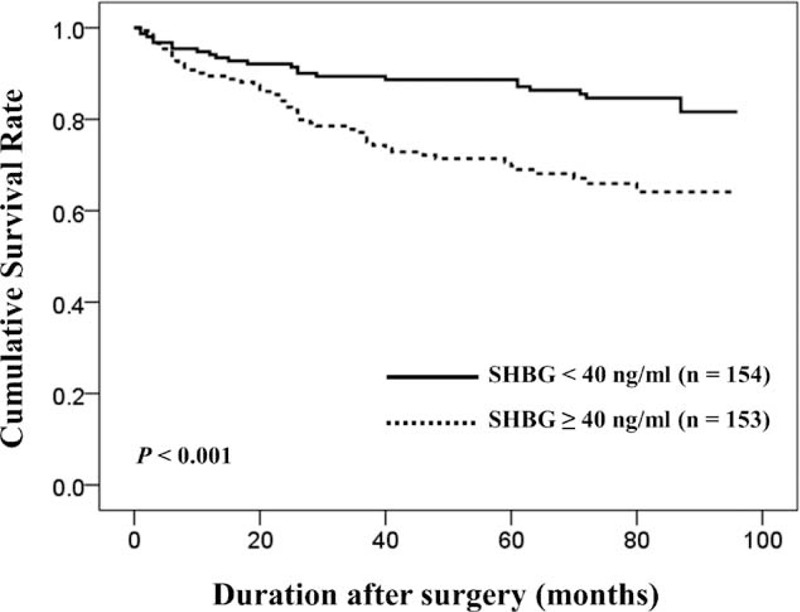
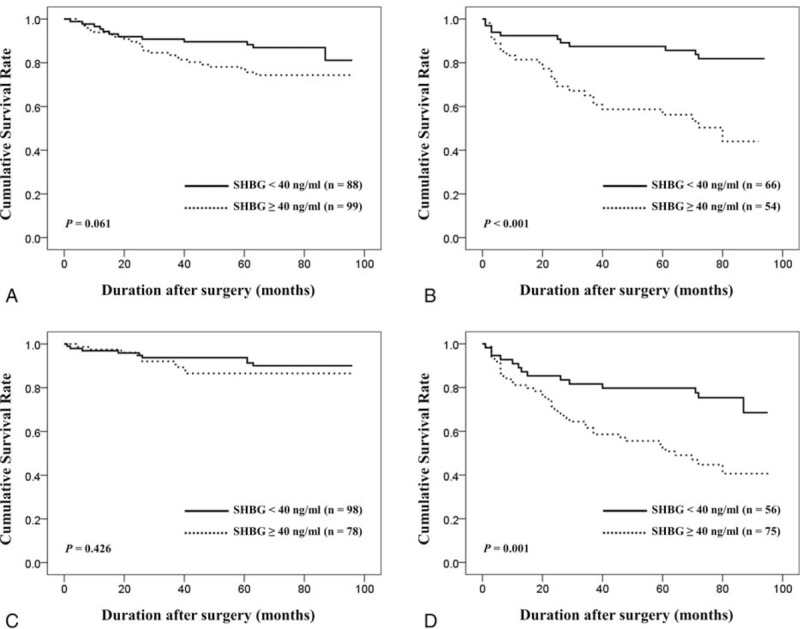
To investigate the significance of preoperative serum sex hormone-binding globulin (SHBG) level regarding the postoperative biochemical outcome in patients who were followed up for relative longer periods after undergoing radical prostatectomy (RP). Preoperative serum levels of testosterone (T), free T, and SHBG level were prospectively analyzed in 307 consecutive patients who underwent RP at our institution between January 2006 and July 2007. We analyzed potential associations of sex hormones with postoperative biochemical recurrence (BCR)-free survival via multivariate Cox proportional regression analysis. Mean postoperative follow-up duration for 307 total patients was 72.1 ± 19.6 months. Kaplan-Meier curve demonstrated that BCR-free survival was significantly worse in patients with higher (≥ 40 ng/mL) SHBG level than others (P < 0.001). Serum T (P = 0.280) and free T (P = 0.606) levels showed no significant association with biochemical outcome. In multivariate analysis encompassing postoperative variables along with PSA, T, and free T, SHBG level (HR 1.825, 1.061-3.138; P = 0.030) was observed to be independently associated with BCR-free survival. Addition of SHBG level to the multivariate model for prediction of BCR-free survival resulted in increased accuracy (83.5% vs. 82.2%; P = 0.164). Our study of patients who were followed up for relative longer periods after RP shows that preoperative serum SHBG level, but not T, is an independent predictor of postoperative BCR-free survival. According to our findings, SHBG measurement may be useful in the selection of candidates for adjuvant treatment following RP.
Conflict of interest statement
The authors have no conflicts of interest to disclose.
Figures
References
-
- Imamoto T, Suzuki H, Yano M, et al. The role of testosterone in the pathogenes of prostate cancer. Int J Urol 2008; 15:472–480. - PubMed
-
- Ellem SJ, Risbridger GP. Aromatase and regulating the estrogen: androgen ratio in the prostate gland. J Steroid Biochem Mol Biol 2010; 118:246–251. - PubMed
-
- Isbarn H, Pinthus JH, Marks LS, et al. Testosterone and prostate cancer: revisiting old paradigms. Eur Urol 2009; 56:48–56. - PubMed
Publication types
MeSH terms
Substances
LinkOut - more resources
Full Text Sources
Medical
Research Materials
Miscellaneous
