. 2015 Jul 16;10(7):e0132783.
doi: 10.1371/journal.pone.0132783. eCollection 2015.

Back to Basics--The Influence of DNA Extraction and Primer Choice on Phylogenetic Analysis of Activated Sludge Communities

Affiliations

Back to Basics--The Influence of DNA Extraction and Primer Choice on Phylogenetic Analysis of Activated Sludge Communities

Mads Albertsen et al. PLoS One. .

Abstract

DNA extraction and primer choice have a large effect on the observed community structure in all microbial amplicon sequencing analyses. Although the biases are well known, no comprehensive analysis has been conducted in activated sludge communities. In this study we systematically explored the impact of a number of parameters on the observed microbial community: bead beating intensity, primer choice, extracellular DNA removal, and various PCR settings. In total, 176 samples were subjected to 16S rRNA amplicon sequencing, and selected samples were investigated through metagenomics and metatranscriptomics. Quantitative fluorescence in situ hybridization was used as a DNA extraction-independent method for qualitative comparison. In general, an effect on the observed community was found on all parameters tested, although bead beating and primer choice had the largest effect. The effect of bead beating intensity correlated with cell-wall strength as seen by a large increase in DNA from Gram-positive bacteria (up to 400%). However, significant differences were present at lower phylogenetic levels within the same phylum, suggesting that additional factors are at play. The best primer set based on in silico analysis was found to underestimate a number of important bacterial groups. For 16S rRNA gene analysis in activated sludge we recommend using the FastDNA SPIN Kit for Soil with four times the normal bead beating and V1-3 primers.


Conflict of interest statement

Competing Interests: The authors have declared that no competing interests exist.

Figures

Fig 1
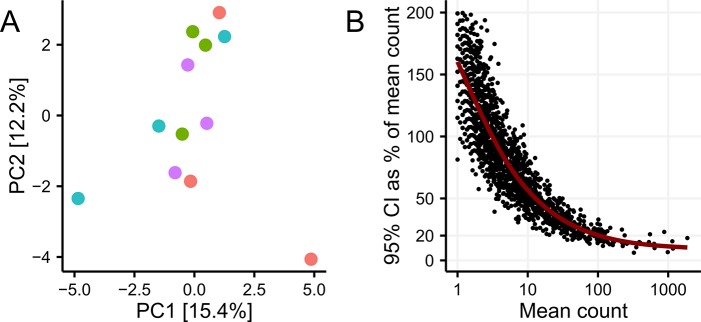
Fig 1. Effect of sampling.
(A) No clustering by sampling site was seen in the PCA analysis of square root transformed OTU abundances (padonis = 0.53, nseq = 17000, nsample = 12). (B) OTU level variation when sequencing three biological replicates as a function of sequencing depth. Variation was measured as the 95% confidence interval in percentage of the mean OTU read count (nseq = 32000, nsd = 11, nse = 3).
Fig 2
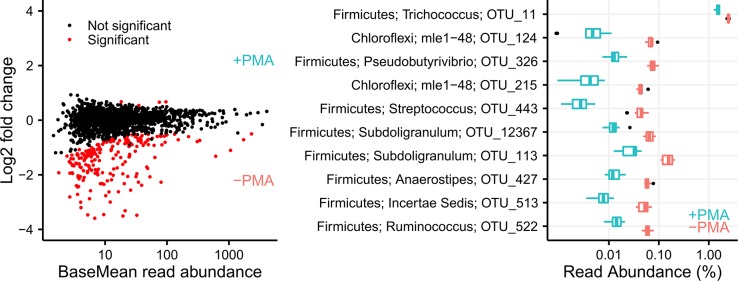
Fig 2. Effect of PMA treatment on individual OTUs.
(A) OTUs determined to be in significant different abundance after PMA treatment using DESeq2. Only species with a padj < 0.001 are visualized as being in significant different abundance. (B) The 10 OTUs with the lowest p-value. For all OTUs a phylum and genus classification is shown along with the OTU number.
Fig 3
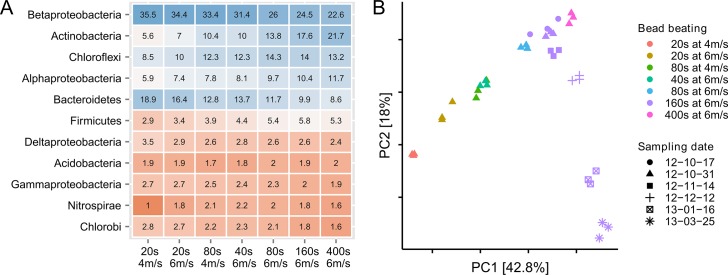
Fig 3. The effect of bead beating on the observed microbial community composition.
(A) Percentage read abundance of the 11 most abundant phyla as function of bead beating intensity (Proteobacteria are show at class level). The data is visualized as a table with the underlying colors visualizing the changes. (B) Principal component analysis of the samples extracted with different bead beating intensities compared to the samples taken at different dates, but extracted with the same bead beating settings (160 s at 6 m/s).
Fig 4
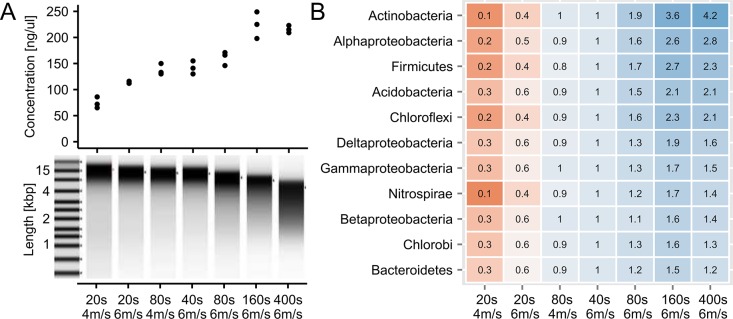
Fig 4. The effect of bead beating on DNA yield, integrity and phylogenetic composition at phylum level.
(A) The increase in yield as a function of bead beating intensity. While yield increased with bead beating, the DNA also became more fragmented. (B) Comparison of absolute phylum level differences as function of bead beating intensity. The relative read abundances were scaled by the DNA yield to obtain absolute counts and normalised relative to the standard settings (40 s at 6 m/s) to facilitate direct comparison between different phyla. The data is visualized as a table with the underlying colors visualizing the changes.
Fig 5
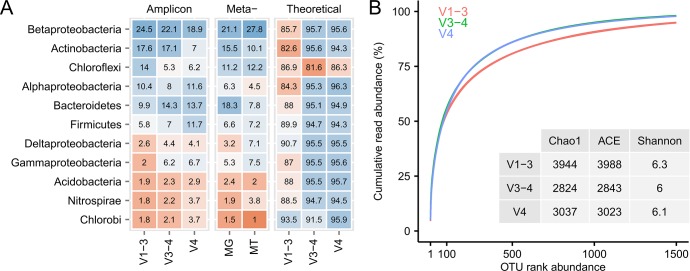
Fig 5. The effect of primer choice on the observed phylogenetic composition.
(A) Comparison of the phylogenetic composition at phylum level using three different sets of primers (V1-3, V3-4, V4), PCR-free metagenomics (MG), stranded metatranscriptomics (MT), and the theoretical primer-set coverage with 1 mismatch allowed. The data is visualized as a table with the underlying colors visualizing the changes. (B) Comparison of alpha-diversity between the different sets of primers using diversity indices and rank abundance curves.
Fig 6
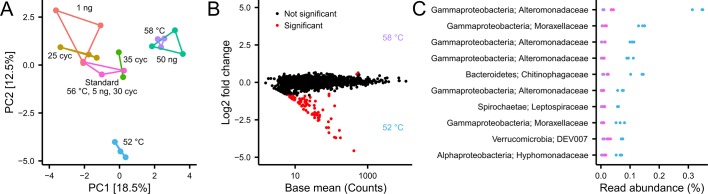
Fig 6. The effect of PCR settings on observed microbial community.
(A) Principal component analysis of all PCR settings tested. (B) Differential abundance analysis of OTUs as an effect of different annealing temperatures. (C) The 10 most significantly differential abundant OTUs as a result of a change in annealing temperature.

References

    1. Nielsen PH, Saunders AM, Hansen AA, Larsen P, Nielsen JL. Microbial communities involved in enhanced biological phosphorus removal from wastewater—a model system in environmental biotechnology. Curr Opin Biotechnol. 2012; 10: 452–9. - PubMed
    1. Sheik AR, Muller EEL, Wilmes P. A hundred years of activated sludge: time for a rethink. Front Microbiol. 2014; 5: a47. - PMC - PubMed
    1. Caporaso JG, Lauber CL, Walters WA, Berg-Lyons D, Huntley J, Fierer N, et al. Ultra-high-throughput microbial community analysis on the Illumina HiSeq and MiSeq platforms. ISME J. 2012; 6: 1621–4. 10.1038/ismej.2012.8 - DOI - PMC - PubMed
    1. Bourrain M, Achouak W, Urbain V, Heulin T. DNA extraction from activated sludges. Curr Microbiol. 1999; 38: 315–9. - PubMed
    1. Yu Z, Mohn WW. Killing two birds with one stone: simultaneous extraction of DNA and RNA from activated sludge biomass. Can J Microbiol. 1999. 45: 269–272.

Publication types

MeSH terms