Borrelia burgdorferi: Carbon Metabolism and the Tick-Mammal Enzootic Cycle
- PMID: 26185064
- PMCID: PMC7942402
- DOI: 10.1128/microbiolspec.MBP-0011-2014
Borrelia burgdorferi: Carbon Metabolism and the Tick-Mammal Enzootic Cycle
Abstract
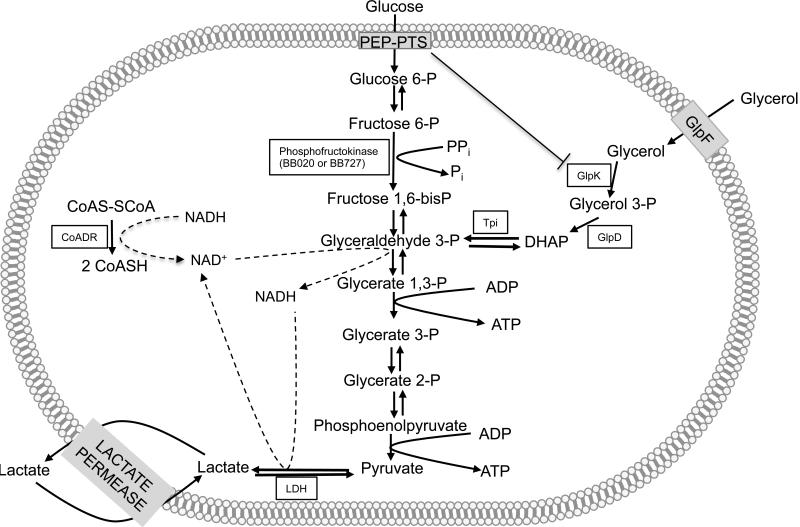
Borrelia burgdorferi, the spirochetal agent of Lyme disease, is a zoonotic pathogen that is maintained in a natural cycle that typically involves mammalian reservoir hosts and a tick vector of the Ixodes species. During each stage of the enzootic cycle, B. burgdorferi is exposed to environments that differ in temperature, pH, small molecules, and most important, nutrient sources. B. burgdorferi has a highly restricted metabolic capacity because it does not contain a tricarboxylic acid cycle, oxidative phosphorylation, or any pathways for de novo biosynthesis of carbohydrates, amino acids, or lipids. Thus, B. burgdorferi relies solely on glycolysis for ATP production and is completely dependent on the transport of nutrients and cofactors from extracellular sources. Herein, pathways for carbohydrate uptake and utilization in B. burgdorferi are described. Regulation of these pathways during the different phases of the enzootic cycle is discussed. In addition, a model for differential control of nutrient flux through the glycolytic pathway as the spirochete transits through the enzootic cycle is presented.
Figures



References
-
- Bacon RM, Kugeler KJ, Mead PS. Surveillance for Lyme disease--United States, 1992-2006. MMWR Surveill Summ. 2008;57:1–9. - PubMed
-
- Steere AC, Grodzicki RL, Kornblatt AN, Craft JE, Barbour AG, Burgdorfer W, Schmid GP, Johnson E, Malawista SE. The spirochetal etiology of Lyme disease. N. Engl. J. Med. 1983;308:733–740. - PubMed
-
- Benach JL, Bosler EM, Hanrahan JP, Coleman JL, Habicht GS, Bast TF, Cameron DJ, Ziegler JL, Barbour AG, Burgdorfer W, Edelman R, Kaslow RA. Spirochetes isolated from the blood of two patients with Lyme disease. N. Engl. J. Med. 1983;308:740–742. - PubMed
-
- Levine JF, Wilson ML, Spielman A. Mice as reservoirs of the Lyme disease spirochete. Am. J. Trop. Med. Hyg. 1985;34:355–360. - PubMed
Publication types
MeSH terms
Substances
Grants and funding
LinkOut - more resources
Full Text Sources
Medical