Review
. 2016 Jan;18(1):16-26.
doi: 10.1093/neuonc/nov136. Epub 2015 Jul 16.

Isocitrate dehydrogenase mutations in gliomas

Affiliations
Review

Isocitrate dehydrogenase mutations in gliomas

Matthew S Waitkus et al. Neuro Oncol. 2016 Jan.

Abstract

Over the last decade, extraordinary progress has been made in elucidating the underlying genetic causes of gliomas. In 2008, our understanding of glioma genetics was revolutionized when mutations in isocitrate dehydrogenase 1 and 2 (IDH1/2) were identified in the vast majority of progressive gliomas and secondary glioblastomas (GBMs). IDH enzymes normally catalyze the decarboxylation of isocitrate to generate α-ketoglutarate (αKG), but recurrent mutations at Arg(132) of IDH1 and Arg(172) of IDH2 confer a neomorphic enzyme activity that catalyzes reduction of αKG into the putative oncometabolite D-2-hydroxyglutate (D2HG). D2HG inhibits αKG-dependent dioxygenases and is thought to create a cellular state permissive to malignant transformation by altering cellular epigenetics and blocking normal differentiation processes. Herein, we discuss the relevant literature on mechanistic studies of IDH1/2 mutations in gliomas, and we review the potential impact of IDH1/2 mutations on molecular classification and glioma therapy.

Keywords: D-2-hydroxyglutarate; brain tumor metabolism; epigenetics; glioma genetics; isocitrate dehydrogenase mutations.


Figures

Fig. 1.
Fig. 1.
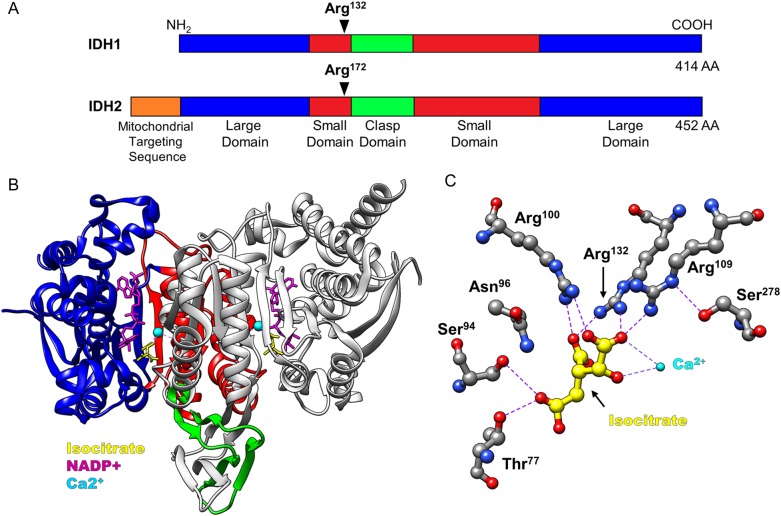
Domain map and active site structure of IDH enzymes. (A) IDH1 and IDH2 are composed of 3 distinct domains: large domain, small domain, and clasp domain. IDH2 contains a 39 amino acid mitochondrial targeting sequence at its NH2-terminus. Conserved arginine residues at Arg132 (IDH1) and Arg172 (IDH2) are critical for catalysis. (B) Crystal structure of IDH1 homodimer, as reported in Xu et al (PDBID: 1T0L). Domains are color-coded as in (A), with only one subunit colored for clarity. The substrate binding pocket contains binding sites for isocitrate (yellow), a calcium ion (cyan), and NADP+ (purple). (C) Structure of critical residues in the IDH1 active site. Hydrogen bonds and hydrophilic interactions are depicted by purple-dashed lines and formed between multiple arginine residues, including Arg132, and carboxylate groups of isocitrate. IDH2 Arg172 is analogous to IDH1 Arg132 in its active site structure, and interactions with isocitrate. NADPH molecules have been removed for clarity.
Fig. 2.
Fig. 2.
Neomorphic enzyme activity of mutant IDH enzymes. IDH1 and IDH2 catalyze the oxidative decarboxylation of isocitrate to generate αKG, using NADP+ as a cofactor and producing NADPH and CO2. Recurrent mutations in the active site of IDH1 and IDH2 confer a gain-of-function activity that catalyzes the conversion of αKG into D2HG in a manner that consumes NADPH.
Fig. 3.
Fig. 3.
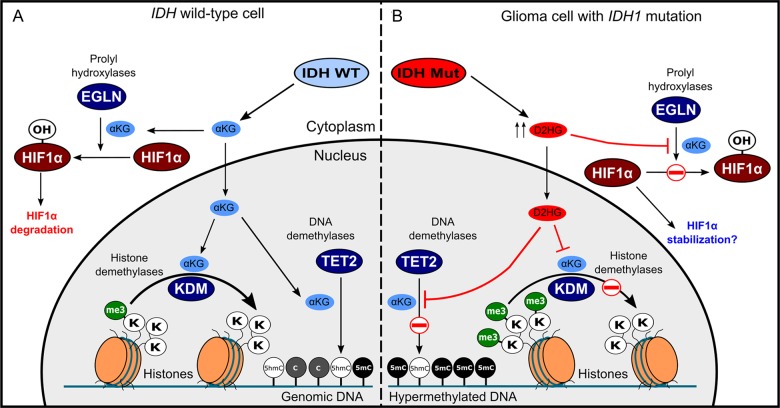
Cellular effects of elevated D2HG levels in glioma cells. IDH1 normally catalyzes the oxidative decarboxylation of isocitrate to generate αKG. Mutant IDH enzymes generate D2HG, which can accumulate in glioma cells to levels >100-fold compared with normal tissue. αKG functions as a cofactor for several cellular dioxygenases, including histone lysine demethylases, TET cytosine hydroxylases, and HIF prolyl hydroxylases. Excessive D2HG accumulation disrupts the normal function of αKG-dependent enzymes causing increases trimethylation of multiple histone lysine residues and decreased 5-hydoxymethlcytosine abundance as well as a concomitant increased in global 5-methylcytosine levels. Several reports also suggest that D2HG can inhibit HIF hydroxylases, preventing HIF1α degradation and increasing HIF1α-dependent transcription.
Fig. 4.
Fig. 4.
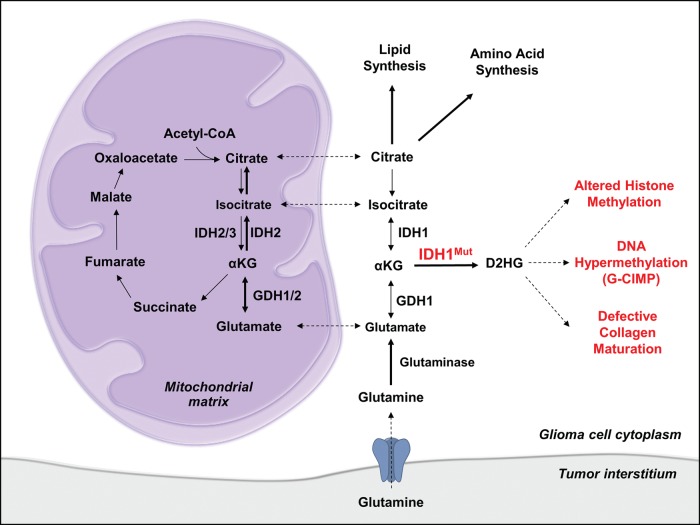
Altered metabolism in gliomas with IDH1 mutations. In the presence of an IDH mutation, normal αKG flux is diverted to generate the oncometabolite D2HG, which acts as a competitive inhibitor of αKG-dependent enzymes. Elevated D2HG ultimately increases genome-wide levels of DNA methylation by inhibition TET cytosine hydroxylases, key enzymes that promote the active demethylation of 5-methylcytosine. D2HG also inhibits histone lysine demethylases and prolyl hydroxylase, thus increasing histone H3 trimethylation and disrupting normal collagen maturation. Glioma cells maintain normal levels of key metabolites in the presence of IDH mutations by increasing the relative anaplerotic flux of glutamine and glutamate into the TCA cycle. This pathway of reductive glutamine metabolism maintains levels of TCA metabolites that are critical for biosynthetic processes.

References

    1. Xu X, Zhao J, Xu Z et al. . Structures of human cytosolic NADP-dependent isocitrate dehydrogenase reveal a novel self-regulatory mechanism of activity. J Biol Chem. 2004;279(32):33946–33957. - PubMed
    1. Hurley JH, Thorsness PE, Ramalingam V et al. . Structure of a bacterial enzyme regulated by phosphorylation, isocitrate dehydrogenase. Proc Natl Acad Sci USA. 1989;86(22):8635–8639. - PMC - PubMed
    1. Macdonald MJ, Brown LJ, Longacre MJ et al. . Knockdown of both mitochondrial isocitrate dehydrogenase enzymes in pancreatic beta cells inhibits insulin secretion. Biochim Biophys Acta. 2013;1830(11):5104–5111. - PMC - PubMed
    1. Ronnebaum SM, Ilkayeva O, Burgess SC et al. . A pyruvate cycling pathway involving cytosolic NADP-dependent isocitrate dehydrogenase regulates glucose-stimulated insulin secretion. J Biol Chem. 2006;281(41):30593–30602. - PubMed
    1. Metallo CM, Gameiro Pa, Bell EL et al. . Reductive glutamine metabolism by IDH1 mediates lipogenesis under hypoxia. Nature. 2012;481(7381):380–384. - PMC - PubMed

Publication types