


Bleeding Risk and Antithrombotic Strategy in Patients With Sinus Rhythm and Heart Failure With Reduced Ejection Fraction Treated With Warfarin or Aspirin
- PMID: 26189039
- PMCID: PMC4554775
- DOI: 10.1016/j.amjcard.2015.06.016
Bleeding Risk and Antithrombotic Strategy in Patients With Sinus Rhythm and Heart Failure With Reduced Ejection Fraction Treated With Warfarin or Aspirin
Abstract
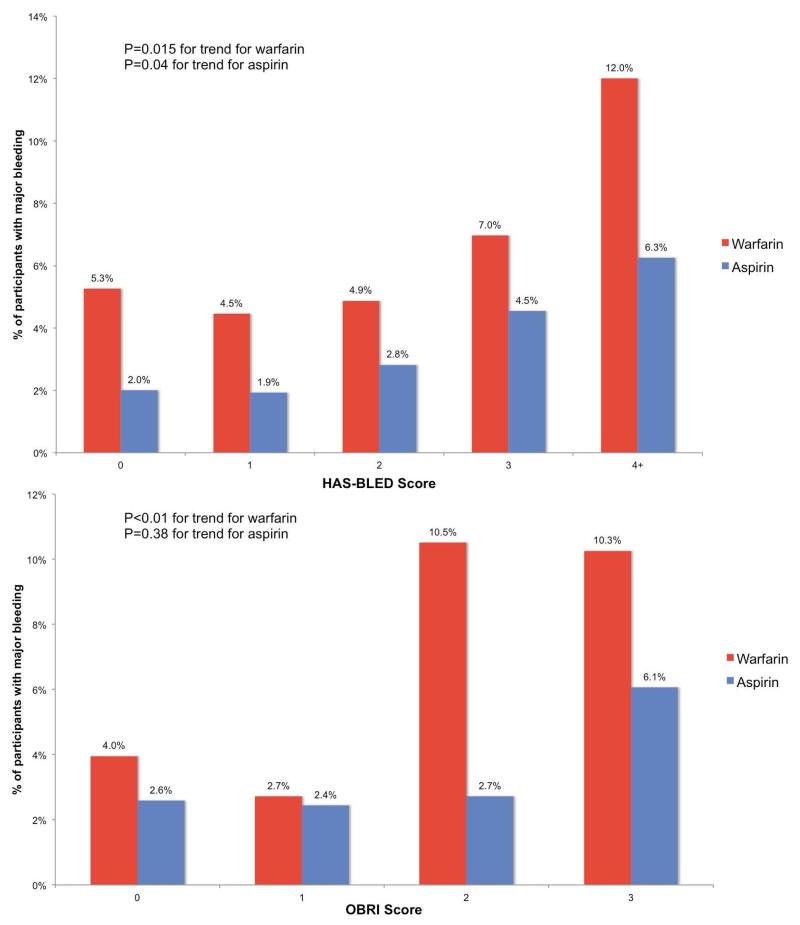
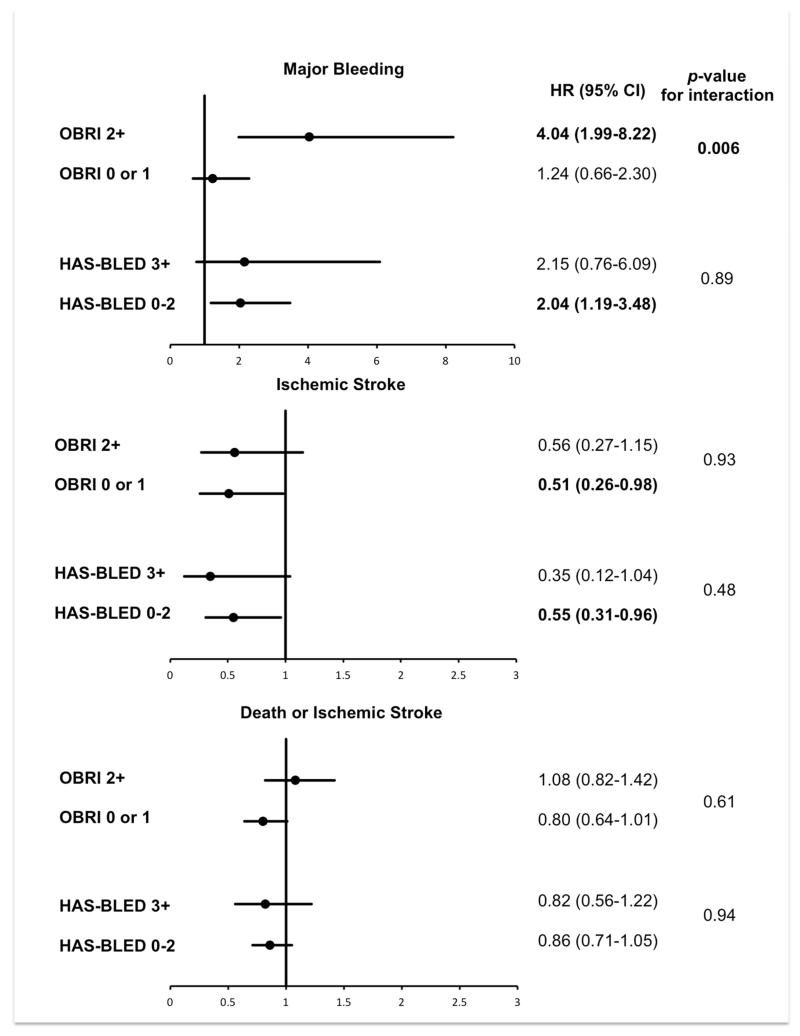
We sought to assess the performance of existing bleeding risk scores, such as the Hypertension, Abnormal Renal/Liver Function, Stroke, Bleeding History or Predisposition, Labile INR, Elderly, Drugs/Alcohol Concomitantly (HAS-BLED) score or the Outpatient Bleeding Risk Index (OBRI), in patients with heart failure with reduced ejection fraction (HFrEF) in sinus rhythm (SR) treated with warfarin or aspirin. We calculated HAS-BLED and OBRI risk scores for 2,305 patients with HFrEF in SR enrolled in the Warfarin versus Aspirin in Reduced Cardiac Ejection Fraction trial. Proportional hazards models were used to test whether each score predicted major bleeding, and comparison of different risk scores was performed using Harell C-statistic and net reclassification improvement index. For the warfarin arm, both scores predicted bleeding risk, with OBRI having significantly greater C-statistic (0.72 vs 0.61; p = 0.03) compared to HAS-BLED, although the net reclassification improvement for comparing OBRI to HAS-BLED was not significant (0.32, 95% confidence interval [CI] -0.18 to 0.37). Performance of the OBRI and HAS-BLED risk scores was similar for the aspirin arm. For participants with OBRI scores of 0 to 1, warfarin compared with aspirin reduced ischemic stroke (hazard ratio [HR] 0.51, 95% CI 0.26 to 0.98, p = 0.042) without significantly increasing major bleeding (HR 1.24, 95% CI 0.66 to 2.30, p = 0.51). For those with OBRI score of ≥2, there was a trend for reduced ischemic stroke with warfarin compared to aspirin (HR 0.56, 95% CI 0.27 to 1.15, p = 0.12), but major bleeding was increased (HR 4.04, 95% CI 1.99 to 8.22, p <0.001). In conclusion, existing bleeding risk scores can identify bleeding risk in patients with HFrEF in SR and could be tested for potentially identifying patients with a favorable risk/benefit profile for antithrombotic therapy with warfarin.
Copyright © 2015 Elsevier Inc. All rights reserved.
Figures
References
-
- Lip GY, Gibbs CR. Does heart failure confer a hypercoagulable state? Virchow’s triad revisited. J Am Coll Cardiol. 1999;33:1424–1426. - PubMed
-
- Kalaria VG, Passannante MR, Shah T, Modi K, Weisse AB. Effect of mitral regurgitation on left ventricular thrombus formation in dilated cardiomyopathy. Am Heart J. 1998;135:215–220. - PubMed
-
- Massie BM, Collins JF, Ammon SE, Armstrong PW, Cleland JGF, Ezekowitz M, Jafri SM, Krol WF, O’Connor CM, Schulman KA, Teo K, Warren SR, Investigators ftWT Randomized Trial of Warfarin, Aspirin, and Clopidogrel in Patients With Chronic Heart Failure: The Warfarin and Antiplatelet Therapy in Chronic Heart Failure (WATCH) Trial. Circulation. 2009;119:1616–1624. - PubMed
-
- Homma S, Thompson JL, Pullicino PM, Levin B, Freudenberger RS, Teerlink JR, Ammon SE, Graham S, Sacco RL, Mann DL, Mohr JP, Massie BM, Labovitz AJ, Anker SD, Lok DJ, Ponikowski P, Estol CJ, Lip GY, Di Tullio MR, Sanford AR, Mejia V, Gabriel AP, del Valle ML, Buchsbaum R. Warfarin and aspirin in patients with heart failure and sinus rhythm. New Engl J Med. 2012;366:1859–1869. - PMC - PubMed
-
- Lip GYH, Andreotti F, Fauchier L, Huber K, Hylek E, Knight E, Lane DA, Levi M, Marin F, Palareti G, Kirchhof P, reviewers D, Collet J-P, Rubboli A, Poli D, Camm J. Bleeding risk assessment and management in atrial fibrillation patients: a position document from the European Heart Rhythm Association, endorsed by the European Society of Cardiology Working Group on Thrombosis. Europace. 2011;13:723–746. - PubMed
Publication types
MeSH terms
Substances
Grants and funding
LinkOut - more resources
Full Text Sources
Other Literature Sources
Medical
Research Materials
