


Impact of Contraceptive Counseling in Clinical Settings: A Systematic Review
- PMID: 26190845
- PMCID: PMC4608447
- DOI: 10.1016/j.amepre.2015.03.023
Impact of Contraceptive Counseling in Clinical Settings: A Systematic Review
Abstract
Context: This systematic review evaluated the evidence on the impact of contraceptive counseling provided in clinical settings on reproductive health outcomes to provide information to guide national recommendations on quality family planning services.
Evidence acquisition: Multiple databases were searched during 2010-2011 for peer-reviewed articles published in English from January 1985 through February 2011 describing studies that evaluated contraceptive counseling interventions in clinical settings. Studies were excluded if they focused primarily on prevention of HIV or sexually transmitted infections, focused solely on men, or were conducted outside the U.S., Canada, Europe, Australia, or New Zealand.
Evidence synthesis: The initial search identified 12,327 articles, of which 22 studies (from 23 articles) met the inclusion criteria. Six studies examined the impact of contraceptive counseling among adolescents, with four finding a significant positive impact on at least one outcome of interest. Sixteen studies examined the impact of counseling among adults or mixed populations (adults and adolescents), with 11 finding a significant positive impact on at least one outcome of interest.
Conclusions: Promising components of contraceptive counseling were identified despite the diversity of interventions and inability to compare the relative effectiveness of one approach versus another. The evidence base would be strengthened by improved documentation of counseling procedures; assessment of intervention implementation and fidelity to put study findings into context; and development and inclusion of more RCTs, studies conducted among general samples of women, and studies with sample sizes sufficient to detect important behavioral outcomes at least 12 months post-intervention.
Published by Elsevier Inc.
Figures
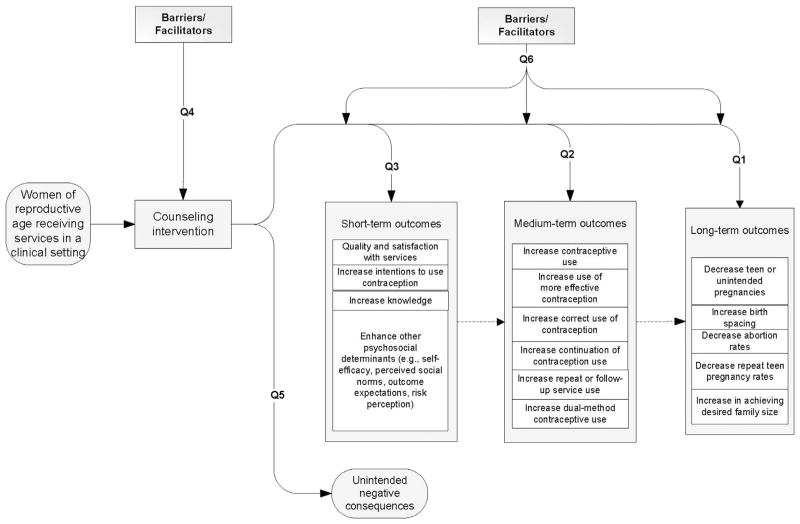
References
-
- Finer LB, Zolna MR. Unintended pregnancy in the United States: incidence and disparities, 2006. Contraception. 2011;84(5):478–485. http://dx.doi.org/10.1016/j.contraception.2011.07.013. - DOI - PMC - PubMed
-
- Mosher WD, Jones J. Use of contraception in the United States: 1982–2008. Vital Health Stat 23. 2010;29:1–44. - PubMed
-
- Gold RB, Sonfield A, Richards CL, Frost JJ. Next Steps for America’s Family Planning Program: Leveraging the Potential of Medicaid and Title X in an Evolving Health Care System. New York: Guttmacher Institute; 2009.
-
- Trussell J. Contraceptive failure in the United States. Contraception. 2011;83(5):397–404. http://dx.doi.org/10.1016/j.contraception.2011.01.021. - DOI - PMC - PubMed
-
- Cassel C, Blank L, Braunstein G, Burke W, Fryhofer SA, Pinn V. What internists need to know: core competencies in women’s health. ABIM Subcommittee on Clinical Competence in Women’s Health. Am J Med. 1997;102(6):507–512. - PubMed
Publication types
MeSH terms
Grants and funding
LinkOut - more resources
Full Text Sources
Other Literature Sources
Medical
Miscellaneous
