


Impact of Reminder Systems in Clinical Settings to Improve Family Planning Outcomes: A Systematic Review
- PMID: 26190847
- PMCID: PMC4523063
- DOI: 10.1016/j.amepre.2015.03.018
Impact of Reminder Systems in Clinical Settings to Improve Family Planning Outcomes: A Systematic Review
Abstract
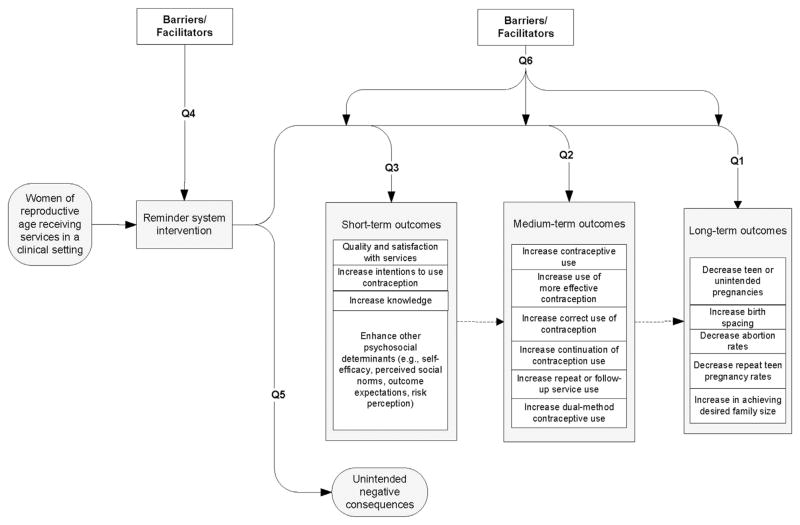
Context: This systematic review evaluated the evidence on the impact of family planning reminder systems-interventions intended to remind patients of behaviors to achieve reproductive health goals (e.g., daily text messages reminding oral contraceptive [OC] users to take a pill)-to provide information to guide national recommendations on quality family planning services.
Evidence acquisition: Multiple databases including PubMed were searched during 2010-2011 for peer-reviewed articles published in English from January 1985 through February 2011 describing studies evaluating reminder systems to improve family planning outcomes. Studies were excluded if they focused primarily on HIV or sexually transmitted infection prevention, focused solely on men, or were conducted outside the U.S., Europe, Australia, or New Zealand.
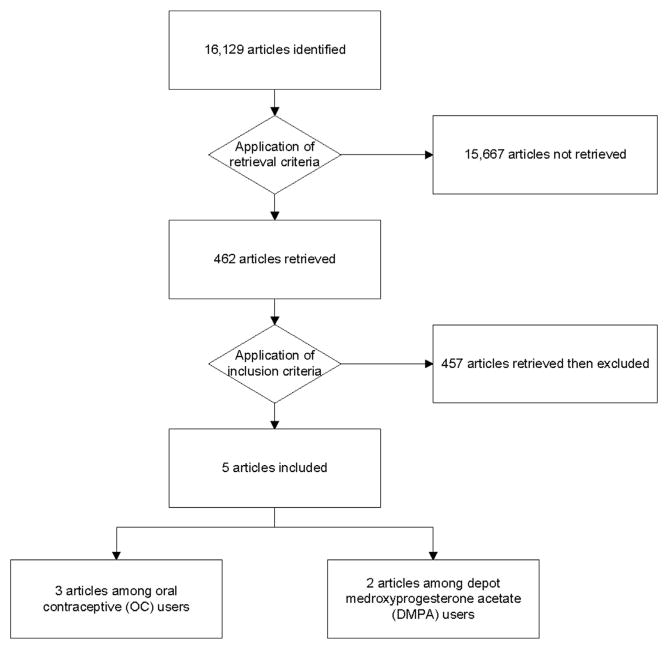
Evidence synthesis: The initial search identified 16,129 articles, five of which met the inclusion criteria. Three studies examined the impact of OC reminder systems; two found a statistically significant positive impact on correct use. Two studies examined the impact of reminder systems among depot medroxyprogesterone acetate (DMPA) users; one found a statistically significant positive impact on correct use.
Conclusions: Although mixed support was found for the effectiveness of reminder system interventions on correct use of OCs and DMPA, the highest-quality evidence yielded null findings. The evidence base would be strengthened by the development of additional studies, especially RCTs, which objectively measure outcomes, examine additional contraceptive methods, and have sufficient sample sizes to detect behavioral outcomes at least 12 months post-intervention.
Published by Elsevier Inc.
Figures
References
-
- Finer LB, Zolna MR. Unintended pregnancy in the United States: incidence and disparities, 2006. Contraception. 2011;84(5):478–485. http://dx.doi.org/10.1016/j.contraception.2011.07.013. - DOI - PMC - PubMed
-
- Trussell J. Contraceptive failure in the United States. Contraception. 2011;83(5):397–404. http://dx.doi.org/10.1016/j.contraception.2011.01.021. - DOI - PMC - PubMed
-
- Frost JJ, Darroch JE, Remez L. Improving contraceptive use in the United States. Issues Brief (Alan Guttmacher Inst) 2008;(1):1–8. - PubMed
-
- Zapata LB, Steenland MW, Brahmi D, Marchbanks PA, Curtis KM. Effect of missed combined hormonal contraceptives on contraceptive effectiveness: a systematic review. Contraception. 2013;87(5):685–700. http://dx.doi.org/10.1016/j.contraception.2012.08.035. - DOI - PMC - PubMed
-
- Rosenberg MJ, Waugh MS. Oral contraceptive discontinuation: a prospective evaluation of frequency and reasons. Am J Obstet Gynecol. 1998;179(3 pt 1):577–582. http://dx.doi.org/10.1016/S0002-9378(98)70047-X. - DOI - PubMed
Publication types
MeSH terms
Grants and funding
LinkOut - more resources
Full Text Sources
Other Literature Sources
Medical
Miscellaneous
