


Developing Federal Clinical Care Recommendations for Women
- PMID: 26190848
- PMCID: PMC11022832
- DOI: 10.1016/j.amepre.2015.02.023
Developing Federal Clinical Care Recommendations for Women
Abstract
The provision of family planning services has important health benefits for the U.S.
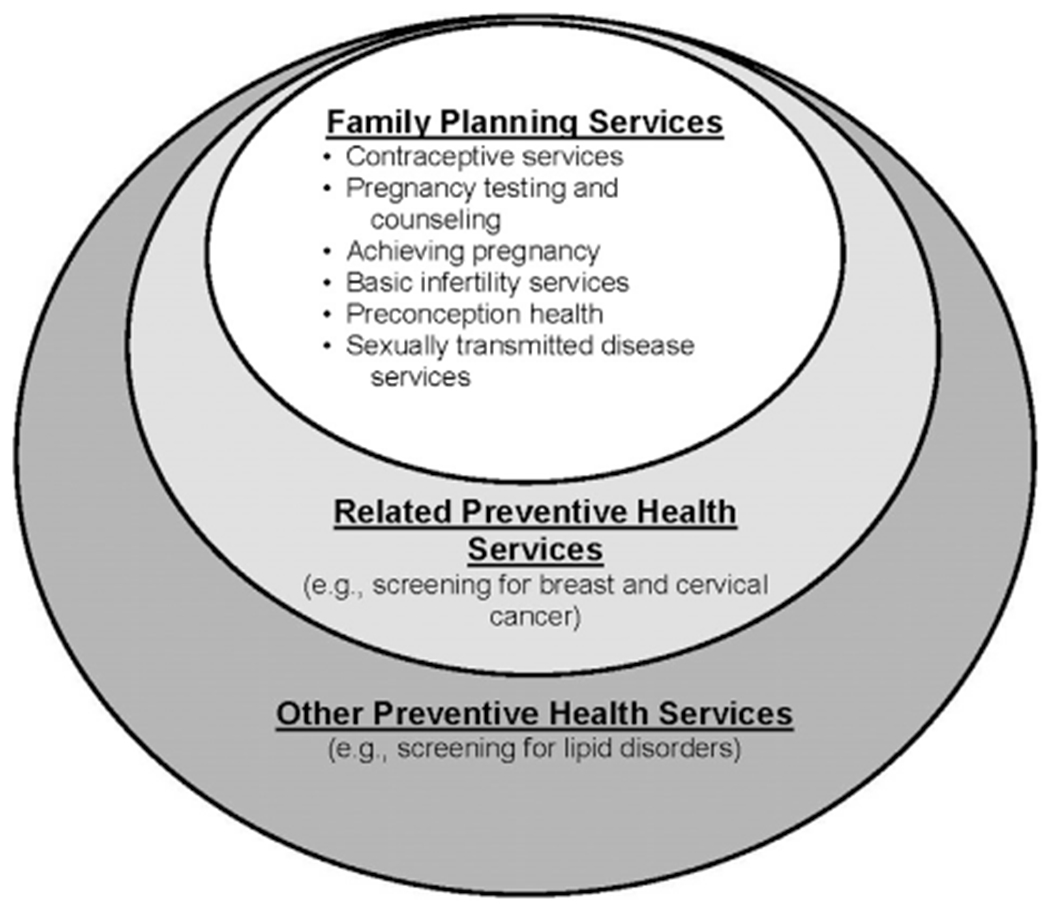
Population: Approximately 25 million women in the U.S. receive contraceptive services annually and 44 million make at least one family planning-related clinical visit each year. These services are provided by private clinicians, as well as publicly funded clinics, including specialty family planning clinics, health departments, Planned Parenthoods, community health centers, and primary care clinics. Recommendations for providing quality family planning services have been published by CDC and the Office of Population Affairs of the DHHS. This paper describes the process used to develop the women's clinical services portion of the new recommendations and the rationale underpinning them. The recommendations define family planning services as contraceptive care, pregnancy testing and counseling, achieving pregnancy, basic infertility care, sexually transmitted disease services, and preconception health. Because many women who seek family planning services have no other source of care, the recommendations also include additional screening services related to women's health, such as cervical cancer screening. These clinical guidelines are aimed at providing the highest-quality care and are designed to establish a national standard for family planning in the U.S.
Published by Elsevier Inc.
Figures
References
-
- IOM. A. Review of the HHS Family Planning Program: Missions, Management, and Measurement of Results. Washington, DC: National Academies Press, 2009. - PubMed
-
- Frost JJ. U.S. Women’s Use of Sexual and Reproductive Health Services: Trends, Sources of Care and Factors Associated with Use, 1995–2010. New York: Guttmacher Institute, 2013. www.guttmacher.org/pubs/sources-of-care-2013.pdf.
-
- Gavin L, Moskosky S, Carter M, et al. Providing quality family planning services: recommendations of CDC and the U.S. office of population affairs. MMWR Recomm Rep. 2014;63(RR-04):1–54. - PubMed
-
- Committee on Quality of Health Care in America, IOM. Crossing the Quality Chasm: A New Health System for the 21st Century. Washington, DC: National Academies of Science, 2001.
MeSH terms
Grants and funding
LinkOut - more resources
Full Text Sources
Medical
