


doi: 10.3389/fmicb.2015.00633.
eCollection 2015.
Complexities of cell-to-cell communication through membrane vesicles: implications for selective interaction of membrane vesicles with microbial cells
Affiliations
- PMID: 26191043
- PMCID: PMC4490254
- DOI: 10.3389/fmicb.2015.00633
Item in Clipboard
Complexities of cell-to-cell communication through membrane vesicles: implications for selective interaction of membrane vesicles with microbial cells
Front Microbiol.
.
No abstract available
Keywords: cell-to-cell communication; horizontal gene transfer; membrane vesicles; predation; quorum-sensing.
Figures
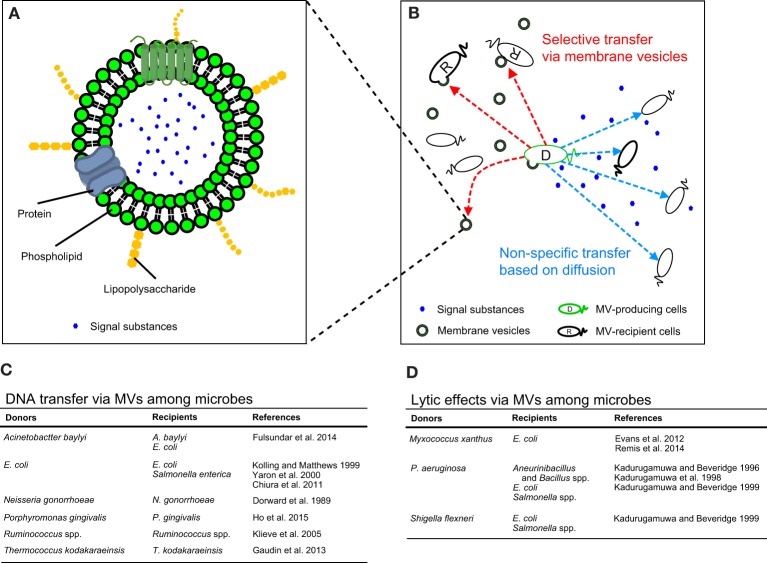
(A) The conceptual structure of membrane vesicles (MVs) derived from Gram-negative bacteria. MVs are composed of phospholipids, membrane proteins and lipopolysaccharides. In addition, various kinds of substances including DNA, exoproteins and quorum-sensing signals are contained in or are associated with MVs. (B) The pattern diagram of MV-mediated (red dashed arrows) and MV-independent (blue dashed arrows) cell-to-cell communications. While signals can be transmitted to bacterial cells non-specifically, MVs maintain the stability of MV-associated signals through protection from environmental stresses and may selectively deliver signals to target cells. (C,D) Representative interaction of MVs with microbial cells, including DNA transfer (C) and microbial lysis (D).
References
-
- Bielaszewska M., Rüter C., Kunsmann L., Greune L., Bauwens A., Zhang W., et al. (2013). Enterohemorrhagic Escherichia coli hemolysin employs outer membrane vesicles to target mitochondria and cause endothelial and epithelial apoptosis. PLoS Pathog. 9:e1003797 10.1371/journal.ppat.1003797 - DOI - PMC - PubMed
LinkOut - more resources
Full Text Sources
Other Literature Sources
