


Age-associated declines in muscle mass, strength, power, and physical performance: impact on fear of falling and quality of life
- PMID: 26194491
- PMCID: PMC4960453
- DOI: 10.1007/s00198-015-3236-5
Age-associated declines in muscle mass, strength, power, and physical performance: impact on fear of falling and quality of life
Abstract
This 3-year longitudinal study among older adults showed that declining muscle mass, strength, power, and physical performance are independent contributing factors to increased fear of falling, while declines of muscle mass and physical performance contribute to deterioration of quality of life. Our findings reinforce the importance of preserving muscle health with advancing age.
Introduction: The age-associated loss of skeletal muscle quantity and function are critical determinants of independent physical functioning in later life. Longitudinal studies investigating how decrements in muscle components of sarcopenia impact fear of falling (FoF) and quality of life (QoL) in older adults are lacking.
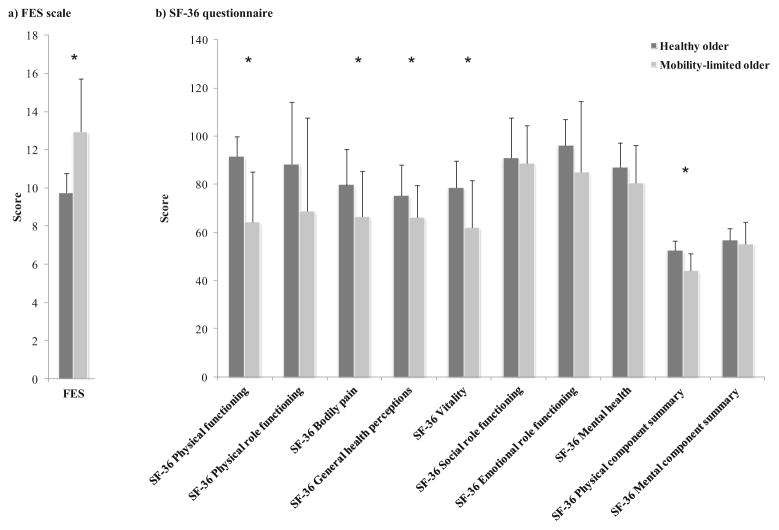
Methods: Twenty-six healthy older subjects (age, 74.1 ± 3.7; Short Physical Performance Battery (SPPB) score ≥10) and 22 mobility-limited older subjects (age, 77.2 ± 4.4; SPPB score ≤9) underwent evaluations of lower extremity muscle size and composition by computed tomography, strength and power, and physical performance at baseline and after 3-year follow-up. The Falls Efficacy Scale (FES) and Short Form-36 questionnaire (SF-36) were also administered at both timepoints to assess FoF and QoL, respectively.
Results: At 3-year follow-up, muscle cross-sectional area (CSA) (p < 0.013) and power decreased (p < 0.001), while intermuscular fat infiltration increased (p < 0.001). These decrements were accompanied with a longer time to complete 400 m by 22 ± 46 s (p < 0.002). Using linear mixed-effects regression models, declines of muscle CSA, strength and power, and SPPB score were associated with increased FES score (p < 0.05 for each model). Reduced physical component summary score of SF-36 over follow-up was independently associated with decreased SPPB score (p < 0.020), muscle CSA (p < 0.046), and increased 400 m walk time (p < 0.003).
Conclusions: In older adults with and without mobility limitations, declining muscle mass, strength, power, and physical performance contribute independently to increase FoF, while declines of muscle mass and physical performance contribute to deterioration of QoL. These findings provide further rationale for developing interventions to improve aging muscle health.
Keywords: Aging; Fear of falling; Muscle; Physical functioning; Quality of life; Sarcopenia.
Conflict of interest statement
Figures
References
-
- Visser M, Goodpaster BH, Kritchevsky SB, Newman AB, Nevitt M, Rubin SM, Simonsick EM, Harris TB. Muscle mass, muscle strength, and muscle fat infiltration as predictors of incident mobility limitations in well-functioning older persons. J Gerontol A Biol Sci Med Sci. 2005;60:324–333. - PubMed
Publication types
MeSH terms
Grants and funding
LinkOut - more resources
Full Text Sources
Other Literature Sources
Medical
Miscellaneous
