


Injury risk is low among world-class volleyball players: 4-year data from the FIVB Injury Surveillance System
- PMID: 26194501
- PMCID: PMC4552924
- DOI: 10.1136/bjsports-2015-094959
Injury risk is low among world-class volleyball players: 4-year data from the FIVB Injury Surveillance System
Abstract
Background: Little is known about the rate and pattern of injuries in international volleyball competition.
Objective: To describe the risk and pattern of injuries among world-class players based on data from the The International Volleyball Federation (FIVB) Injury Surveillance System (ISS) (junior and senior, male and female).
Methods: The FIVB ISS is based on prospective registration of injuries by team medical staff during all major FIVB tournaments (World Championships, World Cup, World Grand Prix, World League, Olympic Games). This paper is based on 4-year data (September 2010 to November 2014) obtained through the FIVB ISS during 32 major FIVB events (23 senior and 9 junior).
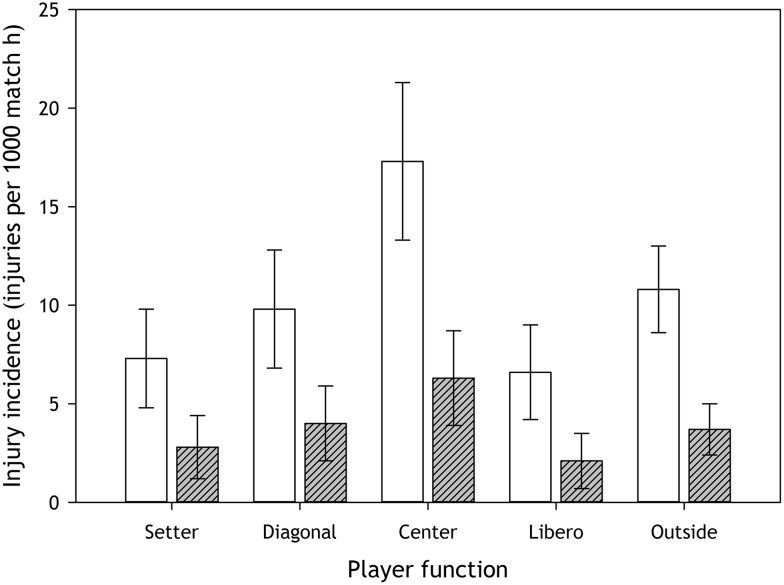
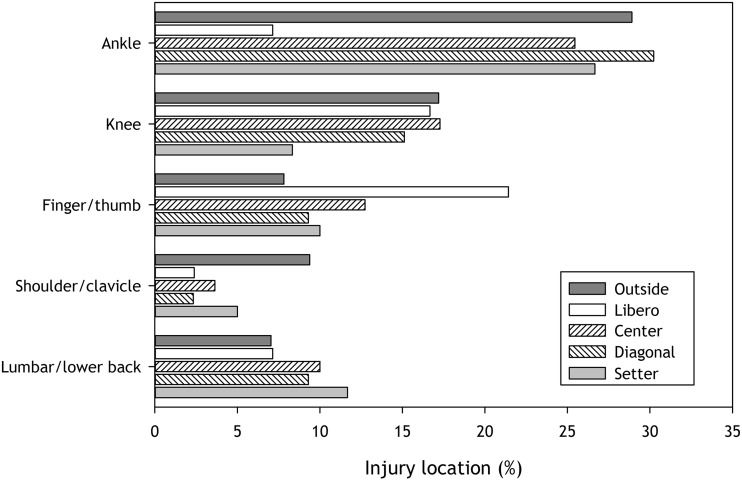
Results: The incidence of time-loss injuries during match play was 3.8/1000 player hours (95% CI 3.0 to 4.5); this was greater for senior players than for junior players (relative risk: 2.04, 1.29 to 3.21), while there was no difference between males and females (1.04, 0.70 to 1.55). Across all age and sex groups, the ankle was the most commonly injured body part (25.9%), followed by the knee (15.2%), fingers/thumb (10.7%) and lower back (8.9%). Injury incidence was greater for centre players and lower for liberos than for other player functions; injury patterns also differed between player functions.
Conclusions: Volleyball is a very safe sport, even at the highest levels of play. Preventive measures should focus on acute ankle and finger sprains, and overuse injuries in the knee, lower back and shoulder.
Keywords: Athlete; Elite performance; Injuries; Prevention; Volleyball.
Published by the BMJ Publishing Group Limited. For permission to use (where not already granted under a licence) please go to http://group.bmj.com/group/rights-licensing/permissions.
Figures
References
Publication types
MeSH terms
LinkOut - more resources
Full Text Sources
Other Literature Sources
